
1073 – 1125·Feast February 8
St. David IV the Builder
King Who Rebuilt Georgia and Broke the Seljuks
Overview
David IV, called Aghmashenebeli, the Builder, of the Bagrationi dynasty, reigned as the fifth king of Georgia from 1089 until his death in 1125 and is popularly judged the greatest ruler in Georgian history. He took the throne as a sixteen-year-old amid Seljuk devastation, when the countryside was nearly depopulated and Georgia paid tribute to the Turks. He first rebuilt the state: reorganized shattered forces into small strike detachments, expelled the nomads, ceased tribute in 1099, tamed rebellious nobles like Liparit of Kldekari, and reunited Kakheti-Hereti with the crown. His Council of Ruisi-Urbnisi purified a corrupted church, and his administrative reforms created the chancellery, ministries and courts of a centralized kingdom. His conquests restored the lost lands: Samshvilde, Rustavi, Tao-Klarjeti, Shirvan, Dmanisi, Tbilisi and finally Ani, so that for the first time Georgia reached from the Black Sea to the Caspian. The victory over a vast Seljuk host at Didgori on 12 August 1121 became the symbol of the Georgian Crusade. A friend of the Church and promoter of Christian culture, he founded Gelati Monastery and Academy, composed the Hymns of Repentance, built hospitals and sent students to Byzantium. He died in Tbilisi on 24 January 1125, was buried at the entrance of his Gelati, and is venerated as a saint.
The Complete Life
A Childhood in Devastated Georgia
David was born in Kutaisi in 1073, the only son of King George II of Georgia and Queen Helen, and received his schooling, most likely, under George of Chqondidi, a court dignitary destined to serve him as adviser for life. He grew up amid war: since 1074 the Seljuk Turks had ravaged Kartli, inflicted repeated defeats on his father, and in the 1080s even captured the royal residence of Kutaisi itself. The misery bred opposition, and in 1089 power passed to the sixteen-year-old David in what one historian calls a palace revolution and others describe as pressure that forced George II to abdicate. The old king lived until about 1112, retaining his title but no real role; frescoes at Ateni Sioni even show him in monastic dress. The chroniclers welcomed the change as a coronation from God: after twelve years of misery in pitch-darkness, the sun of the kingdoms began to rise, and the seventy-second namesake of the biblical David appeared. The kingdom the boy received was drastically diminished, mostly Abkhazia and Kartli, its economy wrecked by seasonal Turkish raids, its people sheltering in citadels, and its Orthodoxy and royal authority both near collapse.
§ Early life and accession to the throne
The Restoration of a Kingdom
David's vocation as king announced itself first in the restoration of his broken land. He began with the army, forming small detachments of minor nobles and peasants from the royal estates, then dozens of such units, and developing a strategy of surprise attacks on Muslim encampments. Within a short time the raids stopped and the nomad settlers were driven out, and Georgian families made their way home to their deserted villages. A truce fixed tribute payments in exchange for peace, but when Malik-Shah died and the First Crusade drew Seljuk attention westward, David stopped paying altogether in 1099, in effect a declaration of war that went unanswered. He then turned on the great feudal lords whose independence had hollowed the monarchy: Liparit of Kldekari, twice imprisoned for conspiracy and finally exiled to Constantinople, and others like Dzagan Abuletisdze, whose lands passed to the crown. Hereditary officials were dismissed and replaced by loyal advisers from the lesser nobility. Military success completed the political work: the fortress of Zedazeni fell, and in 1104 the Kakhetian nobility themselves deposed their Muslim convert king Aghsartan II and handed him to David, reuniting Kakheti-Hereti with the Georgian crown and restoring the eastern frontier to its ancient line.
§ Consolidation of royal authority
Reconquest and the Georgian Crusade
David considered the liberation of the Caucasus from the Seljuks the main goal of his reign, and from 1110 he pursued it relentlessly. In that year Georgian forces recaptured Samshvilde, and when Sultan Muhammad I Tapar sent an enormous army to invade Georgia, David met it near Trialeti with a personal guard of just fifteen hundred men and destroyed it in a battle so complete that the king waited a full day for a retaliation that never came. Rustavi fell in 1115, Tao-Klarjeti was recovered in 1116, Demetrius won his marvelous battles in Shirvan in 1117, and after the death of General Beshken at Javakheti in 1118 David avenged him at Rakhsi and massacred the Seljuk garrisons on the Araxes. To complete the army he crossed the Caucasus in 1118 and brought back nearly forty thousand Kipchak families, who settled in Georgia, adopted Christianity and multiplied his forces to some sixty thousand. Victories at Botora and along the Shirvan frontier in 1120 provoked the sultan Mahmud II to declare jihad and muster a host reckoned in the hundreds of thousands. On 12 August 1121, at the foot of Mount Didgori, David's sixty thousand crushed it; chroniclers, Christian and Muslim alike, recorded that Saint George himself led the Georgian charge, and tales of the victory carried hope to the royal courts of the Crusading West.
§ Battle of Didgori
The Penitent on the Throne
The Georgian Chronicles present David as a profoundly pious king who studied the Bible all his life, criticized and learned its episodes, and read Persian poetry and the Quran as well. Around 1120 he composed the Hymns of Repentance, eight free-verse psalms of remarkable formal intricacy, full of devotion to the Mother of God and emotional sorrow for his sins, yet alive with the conviction that he stood to God as the biblical David had done, and carrying the crusading zeal of his European contemporaries. His confessor, the Armenian version of the Chronicles says, was Hovhannes Imastaser of Haghpat. His charity was practical and personal: he built hospitals and hospices for the sick, and the chronicles describe him visiting his patients, questioning and kissing them one by one, arranging their beds and clothes with his own hands and giving abundant alms. He sent Georgian children to Byzantium to learn languages and return with translations, cherished the Gelati Academy as a second Jerusalem and a second Athens, and carried his books on campaign, enthralled by theology, astrology and history. His spiritual legacy in stone is Gelati Monastery, where he asked to be buried at the entrance, beneath the feet of all who came, the psalm he chose speaking of a dwelling place fixed for eternity.
§ Personal life
The Last Campaigns and Death
David's final years were spent, as his whole reign had been, in the saddle. In 1124 he took Chabran, defeated a coalition of Kurds, Lezgins and hostile Kipchaks north of the Caspian, recovered Shamakhi, and garrisoned Hereti and Kakheti. In January 1125, days before his death, he destroyed an invading Muslim army after five days of battle. He had even begun planning a new great campaign for the spring, but illness and age prevented it, and he entrusted the affairs of the country to his chancellor Simon of Chqondidi. The long reign of thirty-four years ended on 24 January 1125 in his capital, Tbilisi. On his deathbed he appointed his eldest son Demetrius as successor and handed on to him the insignia of Georgian kingship: a jeweled crown, a curved saber, and purple coverings for knees and sleeves. At his own wish he was laid to rest within the Gelati Monastery he had founded, his grave set at the principal entrance of the church so that all who came to his beloved Gelati Academy would first tread upon his grave. There the words of the psalm he chose speak of a dwelling place fixed forever, and a tombstone in asomtavruli script at the entrance has been honored as his since at least the mid-nineteenth century.
§ Death
Saint David, Right-Believing King
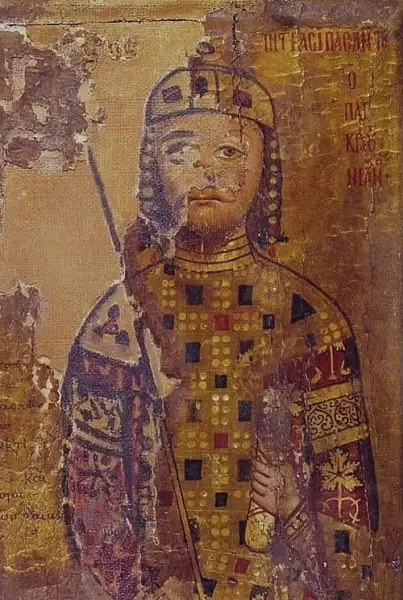
David the Builder is considered a saint by the Orthodox Churches and by Western faiths alike, for no decree of canonization was ever issued; time, history and the devotion of the people accomplished what a decree would have, the verdict of a nation upon the king who saved it. He is invoked as the guardian of the Georgian people, and his feast falls in the West on 24 January, the day of his death, and in the East on 26 January, corresponding to 8 February on the Gregorian calendar. Icons portray him as David Right-Believing, and the twelfth-century icon at Saint Catherine's Monastery on Sinai bears the Greek inscription calling him the Pious Basileus of all the East. A manuscript note in his own hand survives there, sending a book to the Holy Mountain with the request that whoever uses it pray for him. Many churches bear his name, including one dedicated in Pennsylvania in 2009. The poet Ioane Shavteli praised him with Queen Tamar in the Abdulmesiani, and Georgian historiography has never withdrawn its veneration: his reign is regarded as the dawn of the Georgian Golden Age, and his memory as a saint and national father remains alive in both church and nation.
§ Legacy
The Builder's Monument
Few Georgian sovereigns match David in the esteem of historians, who rank him the most prestigious monarch in the country's history and date the Golden Age of Georgia from his reign. The sobriquet the Builder, aghmashenebeli, first attached to him in a charter of 1452 and was fixed by the historians of the seventeenth and eighteenth centuries; his contemporary biographer records that the title was earned by his deeds. The order of his reforms, the reunited kingdom, the reformed church of Ruisi-Urbnisi, the chancellery of Chkondideli, the darbazi and the Court of Petitions, the monaspa guard and the settler soldiers of the Kipchaks, became the permanent institutions of medieval Georgia. His international reputation endured for centuries: when Timur held King Bagrat V captive, the gift of David's own coat of mail won the conqueror's favor and the king's release. Modern Georgia has renewed the cult in secular form, with the Order of David the Builder for service to the nation, the Kutaisi airport, the National Defence Academy, a university, avenues and monuments bearing his name, and presidents from Shevardnadze to Saakashvili invoking him as the builder of the Georgian nation. He remains the standard against which Georgian kingship is measured, in history and in sanctity.
§ Legacy
Timeline
- 1073
Born in Kutaisi, only son of King George II of Georgia and Queen Helen
§ Early life and accession to the throne
- 1085
A charter styles him king and sebastos, evidence he already ruled alongside his father
§ Early life and accession to the throne
- 1089
Power passes from George II to the sixteen-year-old David in what historians call a palace revolution
§ Early life and accession to the throne
- 1093
Uncovers a conspiracy by Duke Liparit V of Kldekari and has him imprisoned
§ Consolidation of royal authority
- 1099
Halts tribute payments to the Seljuks as the First Crusade diverts their attention
§ Cessation of tribute to the Seljuks
- 1103
Convokes the Council of Ruisi-Urbnisi to purify a corrupt Georgian Church
§ Domestic reforms
- 1104
Kakhetian nobles depose Aghsartan II and surrender him, reuniting Kakheti-Hereti with Georgia
§ Reunification of Kakheti–Hereti
- 1107
Repudiates the Armenian princess Rusudan and weds Gurandukht, daughter of the Kipchak khan Otrok
§ Negotiations with the North Caucasus
- 1110
Georgian forces retake Samshvilde, then destroy an enormous invading army at Trialeti
§ The reconquest of lost territories
- 1115
George of Chqondidi storms Rustavi, a principal Turkish stronghold of the south
§ The reconquest of lost territories
- Feb 1116
Traps the Seljuks on the Chorokhi, recovering Tao-Klarjeti with the riches left there
§ The reconquest of lost territories
- 1116
His daughter Kata is married into the Byzantine imperial family
§ Relations with the Byzantine Empire
- 1117
Crown Prince Demetrius invades Shirvan, seizing the fortresses of Gishi and Kaladzori
§ The reconquest of lost territories
- Apr 1118
Avenges General Beshken at Rakhsi and exterminates the Seljuk garrisons along the Araxes
§ The reconquest of lost territories
- 1118
Crosses the Great Caucasus by the Darial pass and returns with nearly 40,000 Kipchak families
§ Negotiations with the North Caucasus
- 1120
Composes the Hymns of Repentance, eight free-verse psalms of penitential devotion
§ Personal life
- 7 May 1120
Ravages Shirvan from Arbia-lizhatat to Kurdevan after routing local forces
§ Battles to drive out the Turks
- 12 Aug 1121
Crushes the Sultan's vast jihad army at the Battle of Didgori
§ Battle of Didgori
- Feb 1122
Captures Tbilisi after a brief siege and transfers the capital there from Kutaisi
§ Liberation of Tbilisi
- Jun 1123
Invades Shirvan, takes Gulistan, dethrones his son-in-law Manuchihr III and annexes the land
§ Conquest of Shirvan
- Mar 1124
Storms Dmanisi, the final Muslim stronghold of Georgia, completing the unification
§ Liberation of Tbilisi
- Apr 1124
Seizes Chabran from the Derbent emirate and defeats a coalition of Kurds, Lezgins and Kipchaks
§ Georgian power on Caucasus
- 20 Aug 1124
Receives Ani's offer of surrender and takes the Armenian capital without a fight
§ Georgian power on Caucasus
- 24 Jan 1125
Dies in Tbilisi and is buried at Gelati Monastery's main entrance, as he had asked
§ Death
In Their Own Words
Soldiers of Christ! If we fight bravely for our Faith, we will defeat not only the devil's servants, but the devil himself.
Christ! This is my resting place for eternity. It pleases me; here I shall dwell.
The Record
- Major works
- Hymns of Repentance (c. 1120), eight free-verse psalms·Gelati Monastery and Academy·Council of Ruisi-Urbnisi church reform·Hospitals and hospices for the sick·Construction of the city of Gori for Armenian settlers
- Patron of
- Georgia·the Georgian nation·Christian kings and rulers
- Symbols
- Crown and scimitar·Processional cross·Icon at Saint Catherine's Monastery inscribed Pious Basileus of all the East·Tomb at the entrance of Gelati
- Canonization
- Venerated by a historical and popular process; considered a saint by the Eastern Orthodox Churches and Western faiths, never formally canonized
Prayer
Bibliography
Show 10 sources
- Asatiani, Nodar; Bendianashvili, Alexandre (1997). Histoire de la Géorgie. Paris: L'Harmattan. ISBN 2-7384-6186-7
- Asatiani, Nodar; Janelidze, Otar (2009). History of Georgia. Tbilisi: Publishing House Petite. ISBN 978-9941-9063-6-7
- Brosset, Marie-Félicité (1849). Histoire de la Géorgie depuis l'Antiquité jusqu'au XIXe siècle. Volume I. Saint Petersburg: Imperial Academy of Sciences
- Eastmond, Antony (1998). Royal Imagery in Medieval Georgia. University Park: Pennsylvania State Press. ISBN 0-271-01628-0
- Lordkipanidze, Mariam (1987). Georgia in the XI–XII Centuries. Tbilisi: Ganatleba
- Rayfield, Donald (2012). Edge of Empires: A History of Georgia. Reaktion Books. ISBN 978-1780230306
- Rapp, Stephen H. (2003). Studies In Medieval Georgian Historiography: Early Texts And Eurasian Contexts. Leuven: Peeters. ISBN 90-429-1318-5
- Salia, Kalistrat (1980). Histoire de la nation géorgienne. Paris: Nino Salia
- Toumanoff, Cyril (1990). Les dynasties de la Caucasie chrétienne de l'Antiquité jusqu'au XIXe siècle. Rome: Tables généalogiques et chronologiques
- Metreveli, Roin (1990). Davitʻ Aġmašenebeli. Tʻbilisi: Ganatʻleba. ISBN 5-505-01428-3
Profile text adapted from the Wikipedia article, licensed CC BY-SA 4.0.
Pray with this saint every day
Save St. David IV the Builder to your favorites, read the full profile, and get feast-day reminders in the Saints app.
Get the Saints AppFree on the App Store for iPhone and iPad