
1616-1679·Feast August 27
St. David Lewis
Jesuit Priest and Martyr
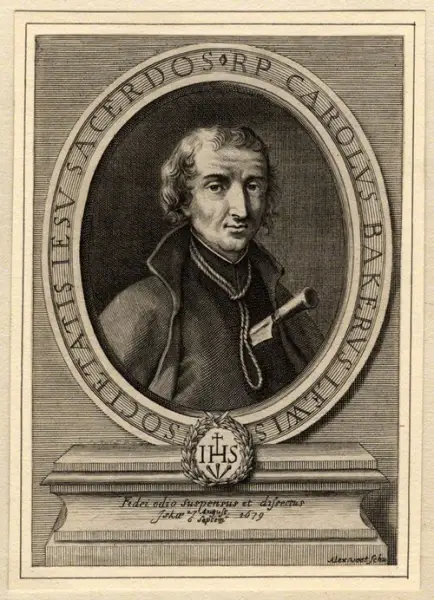
Overview
David Lewis, born at Abergavenny in Monmouthshire in 1616, was the youngest of the nine children of an Anglican schoolmaster, the Reverend Morgan Lewis, and his Catholic wife, Margaret Pritchard. A visit to Paris at sixteen brought about his conversion, and he went on to the English College in Rome, studying under the alias Charles Baker — an ordinary precaution against the priest-hunters of the Crown — and was ordained a Catholic priest in July 1642. He entered the Jesuits three years afterward. After serving as spiritual director to the seminarians in Rome he returned to his native Monmouthshire, where for some thirty years he worked in the apostolate, so constantly among the poor that Wales came to call him Tad y Tlodion, the Father of the Poor. He ended as superior of the illegal Jesuit mission based at the Cwm near Llantarnam. A cousin, John Kemble, would die a martyr as well. Swept up in the Popish Plot panic, he was arrested at Llantarnam church on 17 November 1678, examined by Titus Oates in London, tried for high treason at the Monmouth assizes on 16 March 1679 for the crime of being a Catholic priest in Wales, and suffered the full penalty of treason at Usk on 27 August 1679, declaring himself a Catholic priest and a Jesuit to the last.
The Complete Life
Early Life
David Lewis was born in 1616 at Abergavenny in Monmouthshire, the youngest of nine children of an Anglican clergyman, the reverend Morgan Lewis, headmaster of the local grammar school, and his Catholic wife Margaret Pritchard. The household embodied the religious division of Wales after the Reformation: a conformist father, a recusant mother, and children who would choose between them. David grew up Anglican, in a family embedded in the established church, and his cousin John Kemble, another future martyr, belonged to the same Catholic network of the Welsh borders. At sixteen, while visiting Paris, he converted to Catholicism, a passage across the Channel that recurs constantly in the biographies of the Welsh and English martyrs, since the continent held both the Catholic worship forbidden at home and the colleges that trained priests to serve it.
§ Early life
Conversion and Vocation
After his conversion Lewis went to the English College in Rome, where, like all students of the era who would return to the English mission, he assumed an alias, Charles Baker, a protection against the priest hunters, spies, and informers who catalogued such men in the Crown's employ. Ordination came in Rome on 20 July 1642, during the civil wars that were consuming both England and the church's position in it. Three years later he entered the Society of Jesus, and after a period as spiritual director to the seminarians of the English College in Rome he returned to his own country, where he would spend the next three decades.
§ Early life
Spirituality and Teaching
Lewis's spirituality was that of the recusant mission made systematic: the Jesuit discipline of the Spiritual Exercises applied to a hidden rural apostolate sustained over decades. He kept the Cwm as a house of regular observance amid illegality, with the order's prayer, examination, and rule maintained as far as a hunted life allowed, and he formed the laypeople around him into a church of the household, where the devotional life of the family carried what the public worship of the parish could not. His poverty of spirit was practical rather than ascetical in the showy sense: he owned nothing, depended on the gentry who sheltered him, and gave what he received to the poor who could not shelter anyone. The witness of his constancy at trial, answering the treason charge with the plain statement that his priesthood was his only crime, was taken by Catholics of his time as the teaching of the whole penal era condensed.
§ References
Mission and Ministry
Lewis worked for over thirty years in the apostolate of Monmouthshire and the Welsh borders, based at the Cwm, the Jesuit mission house near Abergavenny that served as the center of the underground church of south Wales. The mission he led as superior was a complete church in hiding: Mass in private houses, often at night; instruction of children; reconciliation of converts; the care of gentry families and of the rural poor alike. His special care for the poor, sustained across decades of famine and penal taxation, earned him the Welsh name by which his countrymen remembered him, Tad y Tlodion, Father of the Poor. The work was carried on under the Elizabethan and later penal statutes, which made his priesthood itself capital treason, and Lewis survived repeated waves of arrests that carried off colleagues, including members of his own network.
§ Introduction
Trial and Final Years
In the Popish Plot panic of 1678 to 1681, the fabricated conspiracy invented by Titus Oates, the Jesuits of England and Wales were marked men, and Lewis was arrested by the priest hunter John Arnold of Monmouthshire. Aged over sixty, he was tried at Monmouth and convicted of high treason as a Catholic priest, the charge requiring no evidence of any act beyond his priesthood. At Usk, on 27 August 1679, he was hanged, drawn, and quartered, the same judicial killing that took five of his fellow martyrs in that summer. Accounts of his execution report that he was allowed to die on the gallows before the butchery, and that the crowd, which in Monmouthshire included many who knew the Father of the Poor, mourned rather than jeered him.
§ Introduction
Canonization
Lewis was beatified by Pope Pius XI in 1929 among the hundred and six martyrs of England and Wales, and Paul VI canonized him on 25 October 1970 within the Forty Martyrs of England and Wales, the representative company of the penal era's dead. With John Kemble, his cousin, and Philip Evans, his fellow Welsh worker, he gives Wales its martyrs in the canonized roll. His feast is kept on 27 August, and the site of his execution at Usk is now marked by the Catholic church dedicated to him.
§ Introduction
Legacy
Lewis's legacy is the memory of the Welsh Catholic underground, of which he is the outstanding witness: a mission sustained for a century and a half by a handful of priests and a stubborn laity, invisible in the official history of Protestant Wales but continuous in its survival to emancipation in 1829. The church of St David Lewis at Usk, on the place of his martyrdom, is a site of annual pilgrimage on his feast, drawing Catholics from the diocese and beyond, and his title Father of the Poor has become his monument, preserving the social character of a ministry that made no distinction of rank. He is invoked as a patron of Wales and of priests working under disability, and his life is a standing record that the recusant church in Wales was built by men who expected to die at the scaffold.
§ Introduction
Timeline
- 1616
Born at Abergavenny, Monmouthshire, youngest of the nine children of an Anglican clergyman and his Catholic wife.
§ Early life
- 1632
While visiting Paris at sixteen, he converts from Anglicanism to Catholicism.
§ Early life
- 20 Jul 1642
Ordained a Catholic priest in Rome, where he studied at the English College under the alias Charles Baker.
§ Early life
- 1645
Three years after ordination he enters the Society of Jesus.
§ Early life
- 17 Nov 1678
Arrested at St Michael's Church, Llantarnam, and sent to London for examination by Titus Oates and other informers.
§ Arrest and execution
- 16 Mar 1679
Tried and convicted of high treason at the Monmouth Assizes for being a Catholic priest and saying Mass.
§ Arrest and execution
- 27 Aug 1679
Hanged, drawn, and quartered at Usk; the crowd insists he hang until dead and receive burial.
§ Arrest and execution
- 15 Dec 1929
Beatified by Pope Pius XI.
§ Introduction
- 25 Oct 1970
Canonized by Pope Paul VI at the Vatican among the Forty Martyrs of England and Wales.
§ Recognition
- Nov 2007
A plaque is erected near Llantarnam Abbey on the spot where he was arrested.
§ Recognition
In Their Own Words
My religion is Roman Catholic; in it I have loved above these forty years; in it now I die, and so fixedly die, that if all the good things in the world were offered to me to renounce it, all should not remove me one hair's breadth from the Roman Catholic faith.
A Roman Catholic I am; a Roman Catholic priest I am; a Roman Catholic priest of that order known as the Society of Jesus, I am.
The Record
- Patron of
- Wales·The poor and destitute
- Symbols
- Jesuit cassock·The gallows of Usk·A heart given to the poor (Tad y Tlodion, 'Father of the Poor')
- Canonization
- Beatified by Pope Pius XI on 15 December 1929; canonized by Pope Paul VI on 25 October 1970 among the Forty Martyrs of England and Wales
Prayer
Bibliography
Show 12 sources
- 1 2 3 "St David Lewis, SJ" . The Jesuit Singapore Website. Archived from the original on 12 June 2014 . Retrieved 12 July 2014 .
- ↑ Jan Morris (1984), The Matter of Wales: Epic Views of a Small Country , Oxford University Press . Page 101.
- ↑ Jan Morris (1984), The Matter of Wales: Epic Views of a Small Country , Oxford University Press . Page 101-102.
- ↑ Jan Morris (1984), The Matter of Wales: Epic Views of a Small Country , Oxford University Press . Page 102.
- ↑ "August 27th: Saint David Lewis, SJ" . The Jesuits Prayer Ministry Singapore . Archived from the original on 20 May 2021 . Retrieved 20 May 2021 .
- ↑ Dodd, Arthur Herbert (1959). "Lewis, David" . Dictionary of Welsh Biography . National Library of Wales . Retrieved 12 July 2014 .
- ↑ "St David Lewis, SJ" . friendsoftheordinariate.org.uk. Archived from the original on 22 August 2022 . Retrieved 22 August 2022 .
- ↑ and martyrs Profile Archived 17 January 2018 at the Wayback Machine , jesuit.org. Retrieved 17 January 2018.
- ↑ Williams, Peter N. (2003). Presenting Wales from a to Y – The People, the Places, the Traditions . Trafford Publishing . p. 151. ISBN 9781553954828 . Retrieved 12 July 2014 .
- ↑ Challoner, Richard (1836). Modern British Martyrology: Commencing with the Reformation, A.D. 1535, 26th Henry VIII. to A.D. 1684, 24th Charles II . London : Keating, Brown, & Co. p. 240 . Retrieved 12 July 2014 .
- ↑ Cambden, Burnet (1720). The dying speeches and behaviour of the several state prisoners that have been executed the last 300 years . London. p. 350 . Retrieved 12 July 2014 .
- ↑ and martyrs Archived 17 January 2018 at the Wayback Machine Retrieved on 17 Jan 2018
Profile text adapted from the Wikipedia article, licensed CC BY-SA 4.0.
Pray with this saint every day
Save St. David Lewis to your favorites, read the full profile, and get feast-day reminders in the Saints app.
Get the Saints AppFree on the App Store for iPhone and iPad