
flourished 6th century·Feast May 7
St. David of Gareji
Desert Father and Founder of the Georgian Thebaid
Overview
David of Gareji, whose Georgian name means David who sits outside, was an anchorite, Desert Father and wonderworker, one of the thirteen Assyrian Apostles who carried monasticism to the Kingdom of Iberia in the sixth century. A disciple of John of Zedazeni, he withdrew to the arid hills of southeastern Georgia and there founded the monastery of David Gareji together with his disciples Dodo and Lukiane, the beginning of what hagiography calls the Georgian Thebaid. His most celebrated act was a pilgrimage he never completed: approaching Jerusalem, he judged himself too sinful to walk in the footsteps of Jesus and stopped on a hill outside the gates, refusing even to meet the Patriarch Elijah. He took three stones from the Holy Land; the patriarch's envoys reclaimed two near Nablus, so that Jerusalem would not lose the fullness of its grace, and David carried the single remaining stone back to Iberia. That relic, the stone of grace, became famous as a miracle-working object venerated by Christians of the East and even by Muslim visitors. David remained at his monastery until his death in the second half of the sixth century and was buried in the David Gareji Lavra, which keeps his name.
The Complete Life
One of the Thirteen Assyrian Fathers
David belonged to the great wave of ascetic renewal that poured from the monastic centers of the Christian East into the Caucasus in the sixth century. He was a disciple of John of Zedazeni, the leader of the band tradition remembers as the thirteen Assyrian Apostles of the Kingdom of Iberia, monks from the Byzantine world who planted the desert ideal in Georgian soil. His Georgian epithet, garejeli, is explained as David who sits outside, the name of a man who made his home on the margin of the settled world. With his disciples Dodo and Lukiane he settled in the semi-arid hill country that now bears his name and founded the monastery of David Gareji, which grew into a complex of lavras and became the heart of the Georgian Thebaid, the monastic desert of the Georgian Church. The choice of such a landscape was itself a confession of faith: like the fathers of Egypt and Palestine, David believed that the barren place, emptied of comfort, was the ground where grace was found. From that foundation the monastic tradition he carried from the East took permanent root in Iberia and shaped the spirituality of the Georgian Church for centuries.
§ Life
The Pilgrimage Not Completed
The story that gave David his enduring fame concerns the journey he refused to finish. Setting out with a group of his disciples on pilgrimage to Jerusalem, the holiest goal available to a monk of his age, he reached Palestine and climbed one of the hills surrounding the Holy City, but would not pass through its gates. Considering himself a sinner, he felt that in drawing near the summit of Grace he dared not trace the path his Lord had trodden on earth. More than that, he declined even a meeting with Elijah, Patriarch of Jerusalem. Yet the desire of his pilgrimage found another form: three stones of the Holy Land went with him as he set out for Iberia. Pursuers dispatched by the patriarch caught up with him close to Nablus and, by Elijah's command, reclaimed two of the stones, so that the monk would not carry away the full grace of Jerusalem. The one stone David brought home became famous throughout the Georgian kingdom as a wonder-working relic, the stone of grace, believed to heal and venerated by pilgrims of the Christian East and even by Muslim visitors. The episode, modern scholars note, also shows how actively sacred objects moved along the routes joining Georgia with Palestine.
§ Life
Return to the Lavra
David's pilgrimage ended where his vocation had begun. Back within his own enclosure once more, he never left it again, keeping the enclosure he had carved out of the wilderness rather than resuming the travels that his holiness might have invited. His death came in the later sixth century, and he was laid to rest in the David Gareji Lavra, the community of his foundation, where his tomb became the center of the monastery's sacred geography. The relic of his pilgrimage, the stone of grace, remained the treasury of his house through the centuries that followed. In the late Middle Ages, when Georgia suffered wave after wave of invasion, the David Gareji Monastery was itself repeatedly raided and devastated, and to shield its most sacred object the keepers concealed the relic now here, now there as danger approached. That long guardianship, carried on under threat, is the final act of David's own story: the community he founded kept faith with the humble stone he had carried home, until in our own day it could be brought into the open again and enthroned in the capital of the nation he serves as patron.
§ Life
Veneration Through the Centuries
David has been venerated in the Eastern Orthodox Church since antiquity, his feast kept on May 7 and, by a moving custom, again on the first Thursday after the Ascension of Jesus. In the ninth century, at the initiative of Hilarion the Iberian, the monk's tomb was transformed into a place of public worship, an early and formal recognition of his cult. Orthodox hagiography honors him as father of the Georgian Thebaid and ranks him with the most deeply venerated saints and guardians of the Georgian Church. The saint's vita, known as the Life and Deeds of Our Saint Father David of Gareji, took shape on Mount Athos, written within the Athonite Georgian community that looked back to Euthymius the Iberian and his school, testimony to the reach of his fame across the Orthodox world. His cult has not depended on documents alone: in 2000, with the blessing of His Holiness Ilia II, Catholicos-Patriarch of All Georgia, his tomb was opened and cleaned, and what was found confirmed how faithfully the texts and the monastery's own traditions had preserved his memory. Since the 1990s his miracle-working stone has rested in the Sameba Cathedral at Tbilisi, where the nation's patron keeps his grace among his people.
§ Veneration
Timeline
- 500
Flourishes in the sixth century as an anchorite and one of the thirteen Assyrian Apostles of Iberia
§ Introduction
- 550
Dies in the second half of the sixth century and is buried in the David Gareji Lavra
§ Life
- 800
His tomb is made a shrine of public devotion in the ninth century at Hilarion the Iberian's urging
§ Veneration
- 1990
His miracle-working stone of grace is kept in Tbilisi's Sameba Cathedral from the 1990s onward
§ Life
- 2000
With Catholicos-Patriarch Ilia II's blessing, his tomb is opened and cleaned, confirming the old sources
§ Veneration
In Their Own Words
the summit of Grace
The Record
- Major works
- Founder of the David Gareji monastery complex
- Patron of
- Georgia
- Symbols
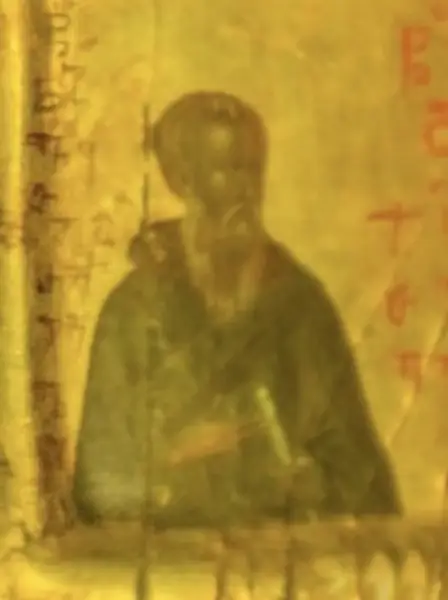
- Stone of grace·Monastic habit of the Desert Fathers·Triptych icon at Saint Catherine's Monastery
- Canonization
- Pre-congregation; venerated as a saint in the Eastern Orthodox Church since antiquity
Prayer
Bibliography
Show 5 sources
- Bartal, R., Bodner, N. & Kuhnel, B. (2017) Natural Materials of the Holy Land and the Visual Translation of Place, 500-1500, Taylor & Francis, ISBN 978-1-351-80928-3
- Rayfield, D. (2013) The Literature of Georgia: A History, Taylor & Francis, ISBN 978-1-136-82529-3
- Eastmond, A. (2010) Royal Imagery in Medieval Georgia, Pennsylvania State University Press, ISBN 978-0-271-04391-3
- Tchekhanovets, Y. (2018) The Caucasian Archaeology of the Holy Land: Armenian, Georgian and Albanian Communities Between the Fourth and Eleventh Centuries CE, ISBN 978-90-04-36555-1
- Charkiewicz, J. (2005) Gruzińscy święci, Warszawa: Warszawska Metropolia Prawosławna, ISBN 978-83-60311-87-5
Profile text adapted from the Wikipedia article, licensed CC BY-SA 4.0.
Pray with this saint every day
Save St. David of Gareji to your favorites, read the full profile, and get feast-day reminders in the Saints app.
Get the Saints AppFree on the App Store for iPhone and iPad