
died 1082·Feast June 25
St. David of Munktorp
Anglo-Saxon Missionary and Apostle of Västmanland
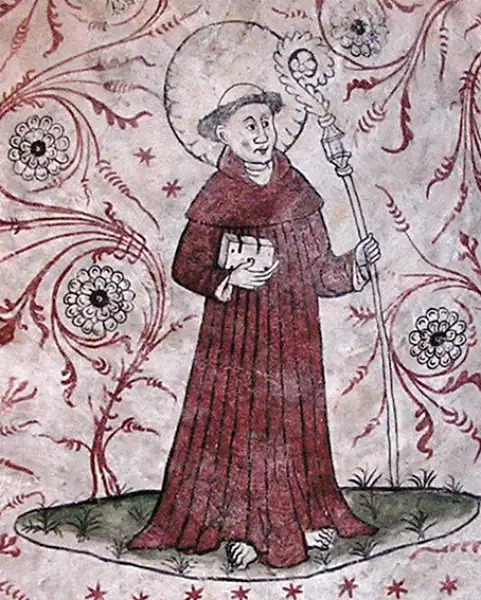
Overview
David of Munktorp was an Anglo-Saxon monk of the eleventh century who carried the Christian faith to the Swedish lands around Lake Mälaren and is honored as the apostle of Västmanland. Saint Sigfrid of Växjö dispatched him northward as a missionary to Sweden, in the fellowship of Saints Botvid and Eskil, and the three concentrated their preaching on Södermanland and Västmanland. David's work centered on Munktorp, a village in Köping Municipality in Västmanland County, where he is credited with originating the parish church; its earliest structures were known as David's Church, and an ancient carving of the saint survives there. The Västerås breviary preserves the memory of those labors: it remembers how he moved from village to village with God's word and the baptismal font, kept vigil through the night, and commended his numerous spiritual children to heaven amid tears and sighs. The same breviary records that he had come to Sweden hoping to win the martyr's crown, though in fact he died peacefully of old age in 1082. A charming oral tradition, written down in 1754, held that his holiness was so great he could hang his gloves on the rays of the sun. He was buried in Munktorp Church, which became the shrine of the apostle of Västmanland.
The Complete Life
A Monk Sent North
David's story begins in the monastic world of eleventh-century England, where he lived as a Cluniac monk, formed in the reforming observance of Cluny that was then spreading through the Anglo-Saxon church. His vocation took a decisive turn when Saint Sigfrid of Växjö, the great missionary bishop of Sweden, chose him for the northern mission, sending him out in the company of two other saints of the Swedish church, Botvid and Eskil. Missionaries David, Eskil and Botvid gave the bulk of their preaching to Södermanland and Västmanland, provinces that ring the waters of Mälaren that formed the heartland of the emerging Swedish kingdom and one of its last strongholds of the old faith. The Västerås breviary adds a poignant detail to this sending: David, it relates, had crossed to Sweden for the gospel in the hope of gaining martyrdom, longing after his Master's example to seal what he preached with his own blood. That desire shaped the self-understanding of his whole mission, even though Providence had decreed for him the slower martyrdom of a lifetime's labor rather than the swift witness he sought. Whatever hardships the northern climate and the resistance of old beliefs placed in the missionaries' path, David remained faithful to the sending he had received, and the province of his labors became the field of his sanctity.
§ Introduction
Apostle of Västmanland
David's missionary field became his life's work and his memorial. The breviary pictures him moving from settlement to settlement with the gospel, washing new believers in the waters of baptism, and rising for prayer each night, in the course of which he commended to heaven, with tears and sighs, the plentiful offspring he had born in the Lord, his image for the converts he gathered into the church. Around this evangelizing work a fixed center grew at Munktorp, a village in Köping Municipality in Västmanland County. David is credited with originating the church there, whose original structures were known as David's Church; an ancient carving of the saint survives in the building, which belongs to the diocese of Västerås and stands northeast of Köping. The attachment between the missionary and the province was remembered in the title the Swedish church gave him: the Västmanland apostle. Alongside his historical work, popular devotion cherished his wonderworking reputation; an oral tradition, retold by Grau in 1754, declared that David's sanctity was such that gloves hung by him would stay fastened to a beam of sunlight, a picture of a man at ease in the created order his God had made.
§ Introduction
A Peaceful Death and a Lasting Shrine
Unlike many of the missionaries who carried the faith to Scandinavia, David did not die a martyr's death, though he had crossed the sea seeking one. He died peacefully in 1082, worn out by old age after decades of labor among the villages of the Mälaren country. The church that remembered him saw in this ending not a failure but a providential comedy of grace: the man who came to be martyred was instead allowed to grow old among the people he had fathered in the faith, and to die in the land he had evangelized. His body was then laid to rest within Munktorp Church, the temple he himself had caused to rise, where his tomb made the parish church a shrine for the faithful of Västmanland. There the memory of the English monk remained alive through the centuries in carving, in liturgy and in local tradition, the apostle of the province resting in the church of his own founding and keeping, from the altar he had raised, a continuing intercession for the Swedish people. The breviary's portrait of nightly vigils and tears for his spiritual children suggests an old man who never ceased the work of intercession that had sustained his mission from the first.
§ Introduction
Memory in Church and Breviary
David's sanctity was recognized by the undivided devotion of the Swedish church rather than by any formal process; he belongs to the pre-congregation saints whose cult grew from the gratitude of the evangelized. His feast is kept on June 25, and he is venerated in both the Roman Catholic Church and Lutheranism, a rare double memory that reflects Sweden's passage through the Reformation: the parish church he founded kept his carving and his tomb even as the country became Lutheran, and the Västerås breviary, the liturgical book of his own diocese, preserved the account of his labors for later generations. That breviary remains the principal source for his life, recording both his missionary practice and his longing for martyrdom, and its text, together with the notices of the medieval Swedish scriptoria and the studies of modern scholars, transmits the little that is certainly known of him. For the church of Västmanland he remains what he was called in life's aftermath: the apostle of the province, the Englishman who made Malmaren country his own and left it Christian. In him the church of Sweden honors the quiet fidelity of the missionary whose only monument is a parish church that still stands.
§ Introduction
Timeline
- 1082
Dies peacefully of old age in Sweden, though the Västerås breviary says he came seeking martyrdom
§ Introduction
- 1082
His remains are laid to rest in Munktorps kyrka, the church he founded
§ Introduction
- 1754
Grau records the oral tradition that his holiness let him hang gloves on sunbeams
§ Introduction
In Their Own Words
wandered among villages and towns, preaching the word of God and baptizing the converted, kept nightly prayer vigils, committing to God with tears and sighs his plentiful offspring, which he had thus born in the Lord
The Record
- Major works
- Foundation of Munktorp Church (Davidskyrkan)
- Patron of
- Västmanland·Sweden
- Symbols
- Abbot's staff·Book·Biretta·Gloves hung on a sunbeam
- Canonization
- Pre-congregation; venerated from medieval times in Sweden, with his cult recorded in the Västerås breviary
Prayer
Bibliography
Show 7 sources
- "Sweden", The Catholic Encyclopedia, Vol. 14. New York: Robert Appleton Company, 1912
- Scriptores Rerum Suecicarum Medii Aevi, vol II, part i, pp. 389-404, especially p. 392 (Eskil) and 410 (David)
- "Eskil", The Catholic Encyclopedia, New York: Robert Appleton Company, retrieved 2008-05-15
- "Munktorp (Köpings kommun)", archived from the original on 2010-08-18, retrieved 2010-06-14
- "Munktorps kyrka (Köpings kommun)", archived from the original on 2010-08-20, retrieved 2010-06-14
- "Mapping Saints", University of Gothenburg
- "David", Riksarkivet
Profile text adapted from the Wikipedia article, licensed CC BY-SA 4.0.
Pray with this saint every day
Save St. David of Munktorp to your favorites, read the full profile, and get feast-day reminders in the Saints app.
Get the Saints AppFree on the App Store for iPhone and iPad