
c. 450 – 540·Feast June 26
St. David the Dendrite
Tree-Dwelling Ascetic and Monk of Thessaloniki
Overview
David the Dendrite, remembered also as David the Tree-Dweller and David of Thessalonika, was an ascetic monk of the fifth and sixth centuries whose whole life was a search for silence in the midst of a demanding world. Born around 450 in Upper Mesopotamia, he traveled west and embraced monastic life at the monastery of Saints Merkourios and Theodore outside Thessaloniki. His counsel proved so sound that crowds would not leave him in peace, hounding him for advice and intercession until the contemplative existence he craved became impossible. His answer was radical: he withdrew into the branches of an almond tree and lived there for three years, earning the name Dendrite, the tree-dweller. Seclusion ended for a cause beyond himself. David came down and set out for Constantinople to ask Emperor Justinian the Great to send soldiers for the defense of Thessaloniki against attack. He died in 540 while his ship was still sailing toward Macedonia. The Catholic and Eastern Orthodox Churches keep his memory on June 26, and the Greek Orthodox Church marks September 16 as the translation of his relics.
The Complete Life
From Mesopotamia to the Monastery
The record of David's beginnings is spare. Two facts survive: that he was born around the year 450 in Upper Mesopotamia, and that in due course he bound himself to monastic life at the monastery of Saints Merkourios and Theodore, which stood outside the walls of Thessaloniki. Nothing is preserved of his family, his baptismal name, or the circumstances that carried him from the borderlands of Mesopotamia to the great Macedonian city on the Aegean. The distance alone suggests a man who had surrendered the ordinary securities of home in order to follow Christ wherever grace led him. At the monastery he would have shared the common round of prayer, work, and psalmody that shaped Byzantine monasticism in his century, and there his gift for spiritual counsel first became visible to those around him. Whatever formation he received, it produced a monk whose advice was so sound that the world outside the cloister would soon come looking for the man who gave it.
§ Introduction
The Ascetic in the Almond Tree
David's fame as a counselor became, paradoxically, the burden of his monastic life. Crowds pressed upon him without pause, hunting for words of wisdom and prayer, and the unending stream of visitors made the quiet, contemplative existence he longed for impossible. Rather than harden himself against the needy, he answered the problem in a strikingly ascetic way: he fled the company of men and took up dwelling in an almond tree, remaining there for three years. The choice gave him the name by which history remembers him, the Dendrite or tree-dweller, and places him among those Byzantine ascetics whose apparent eccentricity concealed a radical embrace of the Gospel. Exposed to weather and darkness in the branches, he traded the esteem of admirers for solitude with God, trusting that intercession offered from a treetop could travel further than counsel given from a chair. His three suspended years became the emblem of his vocation: a life lifted free of earthly attachment, rooted yet hanging between heaven and earth.
§ Introduction
A Petition for a Threatened City
The seclusion of the almond tree ended not for David's own sake but for the sake of others. Coming down at last, he undertook the long journey to Constantinople to petition the emperor Justinian the Great in person, asking that soldiers be dispatched for the defense of Thessaloniki against attack. It was a striking reversal for a man who had renounced human affairs: the hermit of the branches re-entered them at the highest level, standing before the most powerful ruler of his age on behalf of a city in peril. He never completed the return. In 540, while his ship was still making its way toward Macedonia, David died. He had exchanged the contemplative quiet he prized for one final act of advocacy, and the exchange cost him his life on the road. The tree-dweller thus closed his career as a pleader for others, having learned what his whole life already suggested: that love of God and care for one's neighbor are a single movement of the heart.
§ Introduction
Memory in Thessaloniki
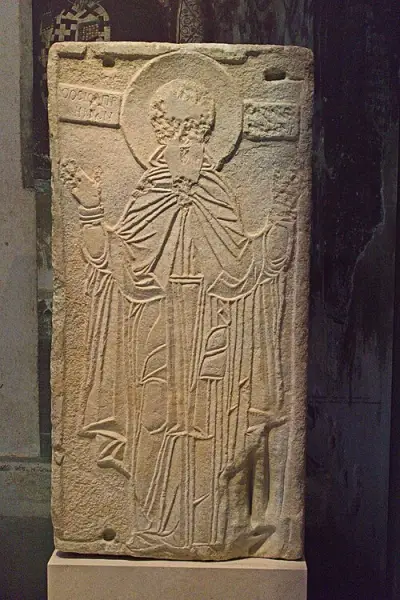
Thessaloniki has not forgotten the ascetic who died attempting to secure its safety. The Catholic Church and the Eastern Orthodox Church commemorate David on June 26, while the Greek Orthodox Church keeps a second observance on September 16 in memory of the translation of his relics. He is honored as a patron of the city itself, and his likeness endures in a relief icon of the thirteenth or fourteenth century preserved in the Museum of Byzantine Culture in Thessaloniki. The image belongs to a long tradition in which the tree-dweller represents a particular species of holiness: the holy foolishness of those who abandon worldly calculation to cling to Christ alone. David is counted among the Byzantine world's celebrated fools for Christ, ascetics whose strange penance preached more eloquently than a sermon. For the faithful of Thessaloniki he remains what he became in 540: a monk who abandoned his refuge in the branches and gave his life on the journey to bring soldiers to the city's aid.
§ Introduction
Timeline
- 450
Born in Upper Mesopotamia
§ Introduction
- 540
Dies aboard ship while en route to Macedonia
§ Introduction
The Record
- Patron of
- Thessaloniki
- Canonization
- Pre-congregation; venerated in the Catholic Church and the Eastern Orthodox Church
Prayer
Bibliography
Show 4 sources
- Parry, Ken (1999). David Melling (ed.). The Blackwell Dictionary of Eastern Christianity. Malden, MA: Blackwell Publishing. ISBN 0-631-23203-6.
- "Roman Martyrology for June 26." Archived from the original on 2011-07-05.
- Orthodox Church in America: "Monkmartyr David of Thessalonica."
- Velimirovic, Nicholas. The Prologue from Ochrid, vol. 2. Birmingham: Lazarica Press, 1986.
Profile text adapted from the Wikipedia article, licensed CC BY-SA 4.0.
Pray with this saint every day
Save St. David the Dendrite to your favorites, read the full profile, and get feast-day reminders in the Saints app.
Get the Saints AppFree on the App Store for iPhone and iPad