
d. late 5th century·Feast July 24
St. Declán of Ardmore
Apostle of the Déisi and founder of Ardmore
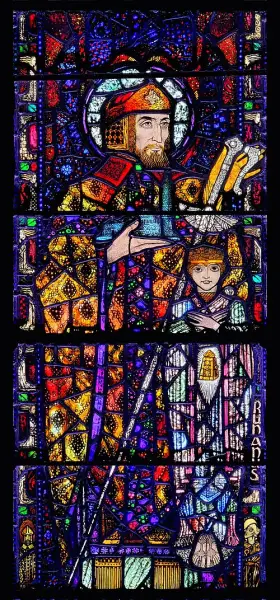
Overview
Declán of Ardmore bears in Old Irish the patronymic Declán mac Eircc. An early Irish saint belonging to the Déisi Muman, he is recalled as the one who brought Christianity to the Déisi of what is now County Waterford and founded the monastery of Ardmore on the coast there. He belonged by his father Erc to the royal dynasty of the Déisi, and his Latin Life, the principal source for his career, presents him as a bishop of his people: a pilgrim to Rome who was ordained bishop there by the Pope, a friend and counterpart of Saint Patrick, and the founder of Ardmore at Patrick's direction. Like Ailbe of Emly, Ciarán of Saigir and Abbán of Moyarney, he belongs to the celebrated company of Munster saints whose Lives claim they preached the Gospel before Patrick ever reached Ireland. He is also linked with the Déisi of Meath, whose king granted him land for the house later called Cill Décláin. He died, according to his Life, at Ardmore and was buried there; his grave, his round tower and his annual July pattern still draw his people to the coast.
The Complete Life
Born of the Royal House of the Déisi
Declán came from the blood royal of the Déisi Muman. Through his father he belonged to the dynasty that ruled the people of east Munster, and the sources name that father with unusual variety: the Latin Life, the Félire Óengusso and the Book of Ballymote genealogy call him Erc, the Book of Leinster and another Ballymote passage call him Ernbrand, the Leabhar Breac calls him Ross or Russ, and Rawlinson B 502 carries the conflated form Ercbrand. His mother, Dethiden in the Latin Life, is given no pedigree at all — a silence that recalls how much of these women's history the records never kept. The place of his birth is fixed by tradition at Drumroe, near Cappoquin in western County Waterford. Every detail of this early life comes filtered through the Latin Life of the saint, which has come down only in a late-twelfth-century recension, attested by two Dublin manuscripts that Charles Plummer showed derive from one original. That Life leans heavily on the Life of Ailbe of Emly, yet may preserve older matter, and its opening chapters draw on the early Irish sagas of the Déisi, weaving the saint's story into the people's own origin legend.
§ Family background and career
Rome, Episcopacy and Patrick
In the narrative of his Life, Declán's formation took him to the centre of the Church: he journeyed to Rome, studied there, and was ordained bishop by the Pope himself — a detail that gives his later mission in Ireland an apostolic pedigree. At Rome he met his fellow countryman Ailbe of Emly, and on the way home he encountered Saint Patrick. Everywhere in the narrative Declán defers to the supreme authority of both men; with Patrick he reaches an agreement fixing the sphere of their respective missions in Ireland, and it is on Patrick's instruction that he founds the monastery of Ardmore — Ard Mór, the great height — on the coast in the southeast of the Déisi kingdom. Having obtained Patrick's blessing, he goes on to preach the faith to the Déisi and converts them to Christianity. The Life even stretches his career across generations, making him a contemporary of Saint David of Wales in the sixth century and presenting the later Ultan of Ardbraccan, dead in the 650s, as his pupil. Historians see in such claims the monastery's twelfth-century ambitions: Ardmore wanted to be the episcopal see of the new diocesan system, and the privilege went instead to Lismore.
§ Family background and career
One of the Pre-Patrician Bishops of Munster
Declán stands among the four Munster bishop-saints — with Ailbe of Emly, Ciarán of Saigir and Abbán of Moyarney — whose Lives maintain that they established monasteries and spread the Gospel across Munster before Patrick ever reached the island, a company known since the seventeenth century as the quattuor sanctissimi episcopi. The claim, late as it is, touches a genuine historical question: the south coast of Munster was the likeliest point of entry for Christianity from Britain or Gaul, linked to southwest Wales by the Déisi and Uí Liatháin settlements there, by the slave raids that carried British Christians to Ireland, and by the wine trade with the continent that the pottery in Munster settlements attests. The tradition also served a polemical purpose. As Armagh built its case for Patrick as the national apostle, the Munster houses answered with dossiers of their own: Declán's Life calls Ailbe a 'second Patrick and patron of Munster' while still honouring Patrick himself. The Life adds one further foundation: visiting the Déisi of Meath, Declán was welcomed by the King of Tara, who granted him land for a monastery of canons — the house remembered as Cill Décláin, Killegland at Ashbourne in County Meath.
§ The pre-Patrician saints of Munster
Repose at Ardmore
According to his Life, Declán ended his days where his work had been planted: he reposed in the Lord at his monastery of Ardmore and was buried there, by the sea in the kingdom he had evangelised. The martyrologies fix his feast at 24 July, the day on which his memory has been kept for over a thousand years. A curious Middle Irish note added to the Félire Óengusso — a gloss of no historical value, the scholars say — credits him with introducing rye into Ireland, the Latin secale lurking behind the Irish word for the grain. The monastery he founded outlived the age that made it: the see of Ardmore, with its episcopal church, lasted until the 1200s, when it yielded at last to Lismore. On the site today the round tower still stands, together with the earlier ecclesiastical remains — an oratory of stone and a little stone church — remains that render Ardmore among the most complete early monastic landscapes in Ireland. The saint's burial place remains the heart of the foundation, as it has been since the day his people laid him there.
§ Commemoration
Pattern, Stone and the Irish Camino
Declán's reputation in Waterford has never lapsed. Many church dedications across the county still bear his name, and on his feast day each 24 July the locals and people of the wider region keep his pattern — the traditional devotional gathering — performing acts of devotion at the sites associated with his life. On the beach at Ardmore lies St Declan's Stone, which the tradition says carried his bell across the sea to Ireland. The old road has come back to life: the path the saint walked from Ardmore to Cashel in County Tipperary has been restored as St Declan's Pilgrim Path, and since 2013 an annual walk along it, nicknamed the 'Irish Camino', has been organised each year from 24 to 28 July. The literary memory is equally alive. The Félire Óengusso salutes him in verse — Erin, it says, if she needs a champion of battle, has the head of a hundred thousands in Declan of Ardmore. His Latin Life travelled into Irish in versions copied by Ó Cléirigh in 1629 and by Murphy 'na Raheenach' in 1740, and Power's 1914 edition carried the saint into modern print. Few Irish saints can show an unbroken local cult of fifteen centuries.
§ Commemoration
Timeline
- 500
Reposed at his monastery of Ardmore around the close of the fifth century, after converting the Déisi, and was buried there
§ Commemoration
- 1190
His Latin Life reached its surviving form in a late twelfth-century redaction, as the Irish Church was reformed into dioceses
§ Sources
- 1582
A manuscript copy of the Irish Life, the direct exemplar behind Ó Cléirigh's version, belonged to Eochaidh Ui Ifernain
§ Sources
- 1629
Mícheál Ó Cléirigh copied the Irish Life, Betha Decclain, with some revision into Brussels, Royal Library MS 4190–4200
§ Sources
- 1740
John Murphy 'na Raheenach' transcribed another Irish version in Dublin, Royal Irish Academy MS 23 M 50
§ Sources
- 1914
Rev. Patrick C. Power issued his edition and translation of the Irish Life for the Irish Texts Society
§ Sources
- 24 Jul 2013
The restored St Declan's Pilgrim Path hosted the first annual 'Irish Camino' walk, run each 24–28 July
§ Commemoration
The Record
- Major works
- Monastery of Ardmore (Ard Mór), County Waterford·Cill Décláin (Killegland), Ashbourne, County Meath
- Patron of
- the Déisi of East Munster·Ardmore (principal foundation)·Cill Décláin
- Canonization
- Pre-congregation; an early Irish saint honoured in the Catholic, Orthodox and Anglican traditions, with a cult attested in the martyrologies
Prayer
Bibliography
Show 7 sources
- Breen, Aidan. "St Declan (Déclán)", Dictionary of Irish Biography.
- Johnston, Elva (2004). "Munster, saints of (act. c.450–c.700)", Oxford Dictionary of National Biography. Oxford University Press.
- Sharpe, Richard (1991). Medieval Irish Saints' Lives: An Introduction to 'Vitae Sanctorum Hiberniae'. Oxford.
- Ó Riain-Raedel, Dagmar (1998). "The Question of the 'Pre-Patrician' Saints of Munster", in Early Medieval Munster: Archaeology, History and Society, ed. M.A. Monk and J. Sheehan. Cork, pp. 17–22.
- Ó Cathasaigh, Tomás (1984). "The Déisi and Dyfed", Éigse 20, pp. 1–33.
- Power, Rev. Patrick C. (1914). Life of St. Declan of Ardmore, Irish Texts Society 16. London.
- Óengus of Tallaght (1905). The Martyrology of Oengus the Culdee, ed. Whitley Stokes. Henry Bradshaw Society 29. London, p. 415.
Profile text adapted from the Wikipedia article, licensed CC BY-SA 4.0.
Pray with this saint every day
Save St. Declán of Ardmore to your favorites, read the full profile, and get feast-day reminders in the Saints app.
Get the Saints AppFree on the App Store for iPhone and iPad