
died 286·Feast January 2
St. Defendens
Soldier-martyr of the Theban Legion
Overview
Defendens of Thebes, honoured in Italian as San Defendente di Tebe, is a soldier-saint of the earliest Christian centuries. Christian tradition counts him among the martyrs of the Theban Legion, the entirely Christian unit whose members, according to the ancient account, were put to death at Agaunum in the Alpine valley of the Rhone rather than take part in persecution; his death is placed in 286. A doubtful tradition gives Africa as his homeland. Whatever the exact identity of the man, the cult that grew around him in the later Middle Ages was real and widespread. Particular devotion to Defendens flourished across northern Italy, documented from 1328, with January 2 kept as his feast in Chivasso, Casale Monferrato, Novara and Lodi, and oratories, altars and confraternities raised in his honour. He was revered as far away as Marseille, where the Catholic Encyclopedia numbers him among the soldier-martyrs belonging in a special way to that city. Until 1476 his relics rested in the church of Santa Croce at Casale Monferrato. To this day he is patron of Romano di Lombardia and is invoked against wolves and fires.
The Complete Life
A Soldier of the Theban Legion
Every account of Defendens begins with his uniform. He is remembered as a soldier, and more precisely as a member of the Theban Legion, the famous all-Christian unit of the imperial army whose martyrdom at Agaunum — Saint-Maurice in the Swiss Alps today — became one of the foundational stories of the Church in the Alpine lands. The date given for his death is 286, the year traditionally assigned to that collective massacre. According to the tradition, the legion's soldiers chose death over orders that violated their faith, and Defendens is counted among those who made that choice. A second tradition, less certain still, points to Africa as his birthplace; the question mark that hangs over it in the oldest notices is honest, for the early lives of the Theban martyrs preserve fragments rather than biographies. Some scholars have in fact wondered whether the Defendens venerated in Italy was a different man from the Theban martyr, a hesitation the record itself invites. Yet the Church received him as a martyr-soldier, and it is in that character — armed, steadfast, and conquered only by death — that art and devotion have always shown him.
§ Saint Defendens of Thebes
Death at Agaunum and the Trail of the Relics
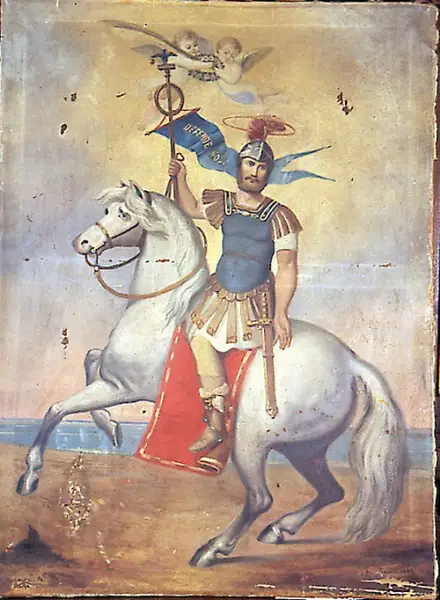
The martyrdom of Defendens was not the end of his story but the beginning of his movements. His remains, by the testimony of the tradition recorded in Pietro Galesino's Martyrologium Sanctae Romanae Ecclesiae of 1578, were kept for centuries in the church of Santa Croce at Casale Monferrato, in the Montferrat region of Piedmont. That circumstance was more than a curiosity of inventory: it suggested to earlier writers that the martyrdom itself may have taken place in that region rather than in the Alpine valley of Agaunum, one of the loose threads that runs through the story of the Theban cult. Whatever the truth of the geography, the relics anchored devotion at Casale until 1476, when they were removed from Santa Croce. By then the saint had long since spread across the plain of the Po in a different way — through feasts, altars and foundations that kept his memory alive independently of any single grave. The 1885 canvas by Marcello Baschenis, showing the saint in his soldier's dress, belongs to this long visual afterlife, painted for communities that had honoured him for centuries.
§ Veneration
An Ancient and Documented Cult
Defendens belongs to the great company of martyrs who were raised to the altars not by papal decree but by the voice of the Church at prayer; his canonization is pre-congregational, older than the machinery of formal causes. What makes his case unusually well documented is the medieval paper trail. By 1328 there is firm evidence that devotion to him was widespread across northern Italy — not a local peculiarity but a cult with real geographical reach. The cities of Chivasso, Casale Monferrato, Novara and Lodi all celebrated his feast on January 2, and the forms that devotion took were the full apparatus of late-medieval lay piety: oratories built under his name, altars consecrated to him, confraternities assembled in his honour. Nor was his cult confined to Italy. Marseille claimed him among its own, the Catholic Encyclopedia listing him beside the soldier-martyr Victor as one of the saints who belong in a particular way to that city, killed at the same time under the same persecution. Antonio Borrelli notes that some scholars distinguish this Italian Defendens from the Theban legionary, a critical caution that does nothing to diminish the antiquity or the warmth of the devotion itself.
§ Veneration
Patron Against Wolves and Fires
The living memory of Defendens is northern Italian. Churches still stand under his invocation: the church of San Defendente at Clusone, another at Invorio, and the oratory dedicated to him at Solto Collina, each a testimony to communities that wanted his protection near at hand. At Romano di Lombardia he is honoured as patron, and there his intercession is sought against two of the oldest terrors of rural life — wolves that raided the folds and fires that consumed the harvest and the house. That a soldier-martyr should be asked for protection against beasts and flames belongs to a very old logic of the cult of the saints, in which those who triumphed over the roaring powers of persecution are trusted to fence off their lesser analogues. The saint even left his mark on the history of Italian art in an unexpected way: the painter Defendente Ferrari, born at Chivasso where the martyr was honoured, carried the saint's baptismal name, a small but telling sign of how thoroughly the cult had entered the life of the region. Old paintings across the churches of Lombardy still show him standing in his military attire among the court of heaven.
§ Veneration
Timeline
- 286
Put to death at Agaunum as a soldier of the Theban Legion, according to Christian tradition.
§ Saint Defendens of Thebes
- 1328
Earliest evidence for the devotion to Defendens that was then widespread across northern Italy.
§ Veneration
- 1476
Until this year his relics rested in the church of Santa Croce at Casale Monferrato.
§ Veneration
- 1578
Pietro Galesino's Martyrologium Sanctae Romanae Ecclesiae records that the relics were kept at Casale.
§ Veneration
- 1885
Marcello Baschenis produces his oil-on-canvas image of the martyr.
§ Gallery
In Their Own Words
several saints belong in a particular way to Marseille: the soldier St. Victor... martyr under Maximian... the soldier St. Defendens and his companions, martyrs at the same time...
The Record
- Patron of
- Romano di Lombardia·against wolves·against fires
- Symbols
- military attire
- Canonization
- Pre-congregation; venerated as a martyr from antiquity, with a documented cult in northern Italy by 1328
Prayer
Bibliography
Show 5 sources
- "San Defendente di Tebe", Santiebeati.it.
- "Mescia - Comune di Invorio" (archived 2011-07-22, retrieved 2008-07-06).
- The Catholic Encyclopedia (Encyclopedia Press: 1913), 717.
- Ibsen, Monica. "Church of San Defendente", Visit Lake Iseo.
- Cappelletti, Giuseppe. Le chiese d'Italia della loro origine sino ai nostri giorni, XIV: Stati Sardi: Torino e le sue chiese suffraganee (Venice: 1858), p. 565.
Profile text adapted from the Wikipedia article, licensed CC BY-SA 4.0.
Pray with this saint every day
Save St. Defendens to your favorites, read the full profile, and get feast-day reminders in the Saints app.
Get the Saints AppFree on the App Store for iPhone and iPad