
c. 530 – 625·Feast January 18
St. Deicolus
Columbanan monk and first abbot of Lure
Overview
Deicolus — his name survives in a dozen spellings, among them Déicole, Domgall, Dichuil, Desle and Deicola — was an Irish missionary monk of the sixth century and the elder brother of Saint Gall. Born in Leinster around 530, he crossed the Irish Sea to study at Bangor Abbey in County Down, and there his life intersected with the great missionary enterprise of the age: he was chosen as one of the twelve companions who went with Columbanus to the continent. After 576 he laboured in Gaul, in Austrasia and Burgundy, and from about 590 lived in the community at Luxeuil. When the Merovingian court expelled Columbanus in 610, Deicolus, then some eighty years old, tried to follow his master into exile but could not sustain the journey. Left behind, he settled at Lure in the diocese of Besançon and became the apostle of that district. A hermitage became a church, the church an abbey, the abbey a school of disciples under the Rule of St. Columbanus, enriched by King Clothaire II. He died there on 18 January 625, and his memory has never left Lure.
The Complete Life
A Brother of Saint Gall
Deicolus was born around 530 in Leinster, in the south-east of Ireland, into a family that would give the Church not one missionary but two: his younger brother was Gall, the future apostle of what is now Saint-Gall in Switzerland. The name he carried has proved as restless as his life — Dichuil, Deicola, Deicuil, Delle, Desle, Dicuil and Domgall all appear in the sources, and around Lure it settled into the affectionate forms Deel and Deela, which the children of the district still commonly bear. For his formation he crossed to Bangor Abbey in County Down, one of the great schools of monastic Ireland, whose discipline of continuous prayer and strenuous penance shaped the missionaries of the following generation. There Columbanus found him. When that most demanding of Irish abbots prepared his continental mission, he chose twelve companions, and Deicolus stood among the chosen — a mark of the reputation for holiness and endurance he had already earned. He left Ireland knowing that he would not see it again; the twelve who went out from Bangor into Europe understood the terms of their mission, and none of the company came back.
§ Life
With Columbanus to Gaul
In 576, after a short stay in Great Britain, Deicolus crossed to the continent with Columbanus's band and shared the hardships of the mission in Austrasia and Burgundy — the courts, forests and half-Christian villages of Merovingian Gaul. From about 590 he resided with Columbanus at Luxeuil, the monastery in the Vosges that became the heart of the whole enterprise, a house whose severe Rule would shape monastic life across Europe. For some twenty years Luxeuil was his home. The rupture came from politics. Theuderic II, offended by Columbanus's refusal to bless his illegitimate marriages and his wars, expelled the abbot from the kingdom in 610. Deicolus was by then about eighty years old, and he determined to follow his master into banishment all the same. He set out, but the road proved too much for him; after a short stretch he had to abandon the journey. What looked like failure became his vocation. A swineherd directed him to a place called Lutre — Lure — where a church dedicated to Saint Martin stood, and there the old monk stayed, alone at first, in what would become the field of his final and longest work.
§ Life
Apostle of the District of Lure
At Lure the fugitive from one mission founded another. Deicolus settled by the church of Saint Martin and began to preach and minister among the people of the diocese of Besançon, and the district received him as its apostle. Providence supplied his needs through Berthelde, the widow of Weifar, lord of Lure, who gave him a church and a tract of land. Disciples gathered around the old solitary in numbers that required more than a hermitage: a noble abbey rose for his many followers, and the community adopted the Rule of St. Columbanus, transplanting to the Burgundian forest the discipline in which its founder had been formed. The sources record a series of striking miracles around him, among them the tale of his cloak hung to dry on a sunbeam, and his power to tame the wild beasts of the woods. Even kings took notice. Clothaire II, King of Burgundy, recognised the virtues of the Irishman and considerably enriched the abbey, granting him the manor, woods and fisheries of the town that had grown up around the monastery — a royal charter for a work that had begun with a swineherd's directions.
§ Life
Resignation and a Small Chapel of the Trinity
Deicolus governed Lure long enough to see it secured, but he ended as he had lived: detached from command. Feeling his end draw near, he handed the government of the abbey over to one of his young monks — a namesake of his old master, called Columbanus — and withdrew to the modest oratory he had raised there, a humble chapel dedicated to the Holy Trinity. There, in that enclosure of prayer a short distance from the abbey that his labour had raised, he died on 18 January, in about the year 625. He had spent some fifty years on the continent: a youth given to Bangor, a maturity given to Columbanus's mission, an old age given to Lure. The king who had enriched his abbey and the widow who had given him his first acres both fade from the story at the end; what remains is an old monk in a Trinity chapel, keeping the office he had learned half a century earlier in County Down. The date of that death, 18 January, has been his feast day ever since.
§ Life
The Memory of Lure
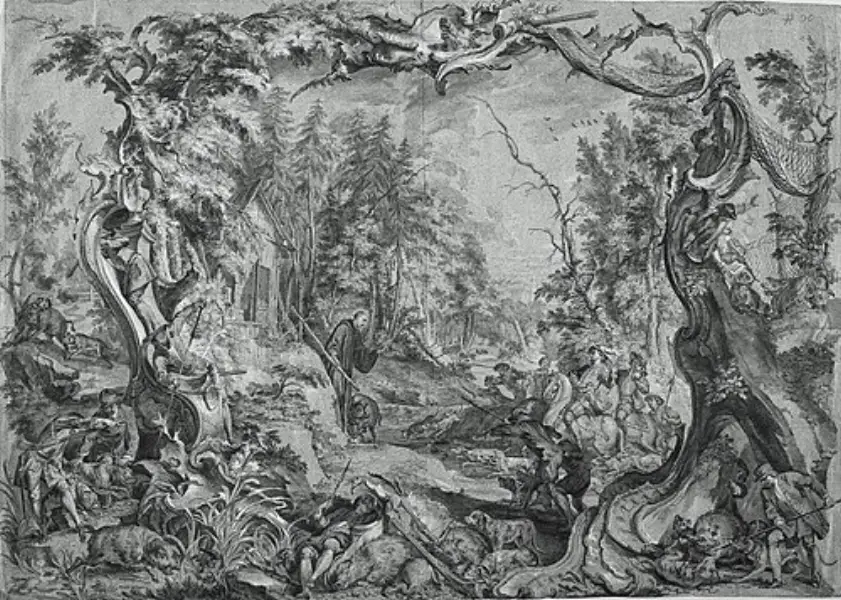
Few local cults have proved as tenacious as Deicolus's. A monk of his own monastery wrote his Acts in the tenth century, three hundred years after his death, and the shrine at Lure remained a centre of pilgrimage. His name took root in the very population of the district: under the slightly disguised forms Deel and Deela, carried by most of the district's children, it persisted as a baptismal name into modern times — an extraordinary fossil of an Irish missionary's reputation in Burgundy. The cultus was strong around Lure well into the nineteenth century, and it attached itself to a spring associated with the saint whose water was credited with curing childhood illnesses; mothers washed their children's clothes in it, and the sick little ones of the district were commended to Deicolus as their particular patron. Art added its own memorials, among them Johann Wolfgang Baumgartner's Saint Deicolus and the Boar, recalling the legend in which a wild boar hunted by King Clothaire took refuge at the saint's feet and was spared — an image of the man whose presence gentled everything wild. His feast is kept on 18 January in the Catholic and Orthodox calendars alike.
§ Veneration
Timeline
- 530
Born in Leinster, elder brother of the future missionary Saint Gall.
§ Life
- 576
After a brief stay in Great Britain, journeys to Gaul and toils with Columbanus in Austrasia and Burgundy.
§ Life
- 590
Resides with Columbanus at Luxeuil from around this date.
§ Life
- 610
Tries to follow the exiled Columbanus, then stays behind and founds a hermitage at Lure in the diocese of Besançon.
§ Life
- 18 Jan 625
Dies at his Holy Trinity oratory near Lure, aged about ninety-five.
§ Life
The Record
- Major works
- Abbey of Lure (Lutre), in the diocese of Besançon
- Patron of
- against childhood illnesses
- Symbols
- ray of light·depicted as a hermit·a wild boar hunted by King Clothaire taking refuge at his feet
- Canonization
- Pre-congregation, and pre-dating the East–West Schism of 1054; venerated in both the Catholic and Eastern Orthodox Churches
Prayer
Bibliography
Show 5 sources
- O'Neel, Brian. "Deicolus of Lure", Franciscan Media, May 19, 2020.
- "Catholic Encyclopedia: St. Deicolus".
- Breen, Aidan. "Deicolus", Dictionary of Irish Biography, October 2009.
- Butler, Alban. The Lives of the Saints, Volume I, 1866.
- Ó Riain-Raedel, Dagmar. "Deicolus (d. c.625)", Oxford Dictionary of National Biography, Oxford University Press, 2004.
Profile text adapted from the Wikipedia article, licensed CC BY-SA 4.0.
Pray with this saint every day
Save St. Deicolus to your favorites, read the full profile, and get feast-day reminders in the Saints app.
Get the Saints AppFree on the App Store for iPhone and iPad