
died 572·Feast September 11
St. Deiniol
First Bishop of Bangor in Gwynedd
Overview
Deiniol, whose name is rendered Daniel in English and Latin and who is venerated in Brittany as Saint Denoual, stands at the head of the Christian history of north Wales as the traditional first Bishop of Bangor in the kingdom of Gwynedd. He came of a noble and churchly line: the Latin Life preserved in Peniarth MS 226 makes him the son of Abbot Dunod Fawr and grandson of Pabo Post Prydain, a family that had lost its lands in the north of England and been resettled in Powys by King Cyngen Glodrydd. Formed in the monastic schools of southern Wales, a hermit before he was a bishop, Deiniol was called north to found the monastery of Bangor under the patronage of King Maelgwn Gwynedd, whose endowments raised it to the rank of an episcopal seat. He was consecrated, the tradition says, by Saint Dubricius in 516, and he spent the remainder of his life there as abbot and bishop, taking part in the Synod of Llanddewi Brefi around 545. He died in 572 and was buried on Bardsey Island. Bangor Cathedral bears his dedication to this day.
The Complete Life
A Noble Line Dispossessed
The little that can be known of Deiniol's origins comes from a Latin Life of the saint preserved in Peniarth MS 226 and transcribed in 1602 by Sir Thomas Williams of Trefriw. By its account he was the son of Abbot Dunod Fawr, himself the son of Pabo Post Prydain, a chieftain of the old north. The family's history was one of displacement: they lost their lands in northern England, in the territories slipping out of British control, and the king of Powys, Cyngen Glodrydd, received them and granted them new land in his own kingdom. It was a household in which secular nobility and ecclesiastical office were already intertwined — his father an abbot as well as a lord — and the son's double vocation followed naturally. The early sources are frank that not everything about Deiniol's background can be taken as history; his early life is flagged in the reference works as contested ground. Yet the outline is coherent: a British Christian aristocracy, retreating and regrouping in the western kingdoms, producing from its exile the monks and bishops who would give Wales its first Christian institutions.
§ Life
Hermite and Reluctant Bishop
Deiniol embraced the religious life and, by the tradition, studied under Cadoc of Llancarfan, whose monastery in Glamorgan was among the most celebrated schools of the Welsh Church. Sir David Trevor describes him as one of the seven blessed cousins — a kinship circle of saints — and records that for a time he lived the solitary life in a cell on Pembrokeshire's far seaward arm. The solitary life, not the episcopal one, was the ambition of his first years. Then came the call he felt himself unfit for: he was summoned to be a bishop, and Trevor is careful to note the tradition that he answered it despite deficiencies in his formal education. Whatever a sixth-century Welsh hermit lacked of book-learning, the Church judged him to possess what mattered more. The movement of his life — from Powys to Llancarfan, from Llancarfan to a Pembrokeshire cell, from the cell to the cathedra — traces the pattern of so many early British saints, in whom the eremitical ideal and the demands of a young and missionary Church were held together in one vocation.
§ Life
Bangor and the Kingdom of Gwynedd
Leaving Powys for the north, Deiniol founded the monastery of Bangor in Gwynedd, and its fortune was made by royal favour: Maelgwn Gwynedd, the powerful and formidable king of the realm, took the house under his patronage, granting it lands and privileges and elevating it to serve as the official seat of a bishopric, its territory running along the edge of the principality itself. The tradition records that Deiniol was consecrated to that see by Saint Dubricius in the year 516, and there he remained for the rest of his days, holding together in one person the two great offices of the early Welsh Church, abbot and bishop. His responsibilities were not confined to Gwynedd: around 545 he attended the Synod of Llanddewi Brefi in the company of Saint David himself, the assembly at which rules for penance were discussed — evidence that he stood among the recognised leaders of the British Church at the moment of one of its defining councils. The present Bangor Cathedral, dedicated to him, is said to occupy the very site of his monastery, so that the worship of Gwynedd has continued on the same ground for some fourteen centuries.
§ Life
Death and the Isle of the Saints
Deiniol governed his see until his death, and the date of that death has a small detective story of its own. The Annales Cambriae record it under 584, but the reference works observe that this figure, in company with the death dates assigned to Saints David and Kentigern, as with the death dates assigned to Saints David and Kentigern; on that reckoning the correct year is 572, which has become the date generally assigned. After his death he was buried on Bardsey Island, the isle off the Llŷn peninsula that gathered to itself the bodies of so many of the saints of Wales that it was said to be the burial place of twenty thousand of them. His major shrine was shared between the cathedral at Bangor and the holy island: both remain places of his memory. He had spent, by the tradition, more than half a century in the service of one church — consecrated in 516, dead by 572 or 584 — a tenure of stability remarkable in an age of raids and migrations, and the reason Bangor remembers him not as one bishop among many but as the first.
§ Life
Churches, a Library and a Hymn Tune
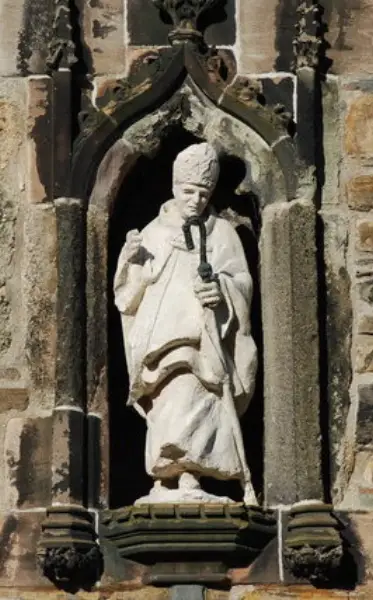
Deiniol's cult in North Wales was extensive, and its dedications still map the geography of his reputation: Worthenbury near Wrexham and Hawarden in Flintshire, other Flintshire churches, foundations at Llangarron in Herefordshire, Llanfor, Llanuwchllyn, Eyton and Itton, the church of Marchwiel, and near Cardigan Bay the village of Llanddeiniol — the parish of St Deiniol — which once bore the name of Itton. Across the sea in Brittany he is honoured as Saint Denoual. In modern Wales his memory took civic and cultural forms: the Deiniol Centre in Bangor carries his name into the daily life of the city, and in 1896 William Ewart Gladstone dedicated St Deiniol's Library at Hawarden, a residential library for arts students, planting the saint's name beside one of the great scholarly foundations of Victorian Britain. Some trace his name even in St Denio, the hymn tune of 'Immortal, invisible, God only wise'. The Roman Catholic calendar for Wales today, together with that of the Anglican Church in Wales, keeps his commemoration on 11 September; Bangor Cathedral keeps the statue of its founder at its heart.
§ Legacy
Timeline
- 516
Consecrated first Bishop of Bangor by Saint Dubricius, after founding the monastery there under Maelgwn Gwynedd's patronage
§ Life
- 545
Attends the Synod of Llanddewi Brefi with Saint David as canons of penance are debated
§ Life
- 572
Dies and is buried on Bardsey Island; the annalistic 584 is judged twelve years too late
§ Life
- 584
The Annales Cambriae enter his death under this year, probably a dozen years astray
§ Life
- 1602
Sir Thomas Williams of Trefriw transcribes the Latin Life of Deiniol kept in Peniarth MS 226
§ Life
- 1896
William Ewart Gladstone dedicates St Deiniol's Library at Hawarden, a residential library for arts students
§ Legacy
The Record
- Major works
- Monastery of Bangor, Gwynedd
- Canonization
- Pre-congregation; commemorated on 11 September in the Roman Catholic calendar for Wales and that of the Church in Wales
Prayer
Bibliography
Show 6 sources
- James, John William (1959). "Deiniol", Dictionary of Welsh Biography. National Library of Wales.
- Stanton, Richard. A Menology of England and Wales. London: Burns & Oates, 1892, pp. 445–446.
- Martyrologium Romanum, 2004, Vatican Press (Typis Vaticanis), page 509.
- Monks of Ramsgate. "Daniel", Book of Saints, 1921. CatholicSaints.Info, 23 October 2012.
- Lapa, Dmitry. "Holy Hierarch Deiniol, Bishop of Bangor in Wales", OrthoChristian.Com (retrieved 30 December 2018).
- Daw, Carl P. Jr (2016). Glory to God: A Companion. Westminster John Knox Press. ISBN 9781611646528.
Profile text adapted from the Wikipedia article, licensed CC BY-SA 4.0.
Pray with this saint every day
Save St. Deiniol to your favorites, read the full profile, and get feast-day reminders in the Saints app.
Get the Saints AppFree on the App Store for iPhone and iPad