
c. 1093 – 1156·Feast May 23
St. Demetrius I of Georgia
Right-believing king, warrior, and hymnographer of Georgia
Overview
Demetrius I, a Bagrationi by descent, reigned over the Kingdom of Georgia during 1125–1154 and once more from 1155 until he died in 1156, and he was the firstborn son of King David IV and his Armenian wife Rusudan. Trained as a commander under his father, he won renown as a young man when a punitive expedition he led into Shirvan captured Kaladzori Castle and returned with captives and treasure, and at the Battle of Didgori in 1121 he commanded the hidden reserve whose flanking assault helped shatter the Seljuk host. His own reign became a long defence of the southern marches: he drove the Seljuks out of Dmanisi, brought Shirvan to a negotiated settlement, handed Ani over to the Shaddadids as vassals, and in 1139 seized the iron gates of Ganja as a trophy for Gelati Monastery. Dynastic politics brought the reign to a tragic close. Having set aside his eldest son David and chosen the younger George instead, he provoked rebellion; in 1154 David's coup succeeded and the old king, confined to a monastery under the monastic name Damian, saw his son reign only six months before dying, probably by poison. Restored, Demetrius crowned George III co-ruler and retired to the monastery of David Gareja. He passed away in 1156 and was laid to rest at Gelati. The Orthodox Church keeps his memory as the right-believing St. Damiane on May 23, and his hymn Thou Art a Vineyard remains a crown of Georgian liturgical song.
The Complete Life
A Prince of the Reunited Kingdom
Demetrius was born around 1093, the eldest son of King David IV of Georgia and his first wife Rusudan, an Armenian noblewoman, and he grew up in the household of the king who would restore Georgian power after decades of Seljuk domination. His father early marked him out for command. In 1117 David sent the young prince on a punitive expedition against Shirvan, where Demetrius quickly showed a remarkable gift for war: his forces stormed Kaladzori Castle, the stronghold later known as Alberd and now called Agdash, and came home loaded with captives and considerable wealth, a success that spread his fame through the kingdom. The decisive test came at Didgori on August 12, 1121, when the armies of David IV met the Seljuk Empire in one of the great battles of the Caucasian middle ages. David divided his host in two and gave his son command of a hidden reserve. When the Georgians feigned defection and threw the enemy camp into confusion, Demetrius launched a flanking attack at the moment of maximum disorder; the Seljuk leadership faltered, the main assault went in, and the enemy broke. The prince pursued the fleeing foe for three days, securing a victory that fixed Georgian supremacy over the region for a generation and prepared the ground for his own rule.
§ Early life
Crowned by His Father's Hands
In 1125, according to the Life of King Demetre, David the Builder named his son co-ruler of Georgia and placed the crown on his head with his own hands, declaring that Demetrius would govern the kingdom successfully through his wisdom, chastity, bravery, and good appearance. It was a rare and solemn consecration of a successor, and it placed on the new king the full weight of his father's achievement: Georgia was now the dominant power of the Caucasus, holding Tbilisi and the approaches to Shirvan, and every neighbouring ruler watched for the first sign of weakness. The inheritance was tested almost at once. Already in 1125 the Seljuks had to be driven out of the stronghold of Dmanisi, a fortress commanding the chief southern approaches to Tbilisi, and in the same year Manuchihr, the king's brother-in-law, recovered western Shirvan, while in 1126 the Muslim population of that land rebelled with Seljuk backing. Demetrius answered these challenges not with reckless campaigns but with the patience of a ruler who understood that his father's conquests would survive only if their borders were made manageable. The crown his father had given him became, in practice, a lifetime of hard frontier diplomacy punctuated by sharp and usually successful strokes of arms.
§ Reign
Defender of the Southern Marches
The long middle of Demetrius's reign was spent holding the line between Christian Georgia and its Muslim neighbours. By 1129-30 he had negotiated a settlement of the Shirvan question through his sister's influence: the country was divided along the Tetritsqali, the Christian portion was incorporated into Georgia, and Manuchihr was confirmed as emir of the eastern part under Georgian vassalage. In 1130 the prince of the Shah-Armens made an attempt to push the Georgians out of northern and central Armenia, and Demetrius, judging the position untenable, gave Ani back to the Shaddadid emirs as vassals on terms that guaranteed the cathedral of Ani would remain a Christian church and reserved Georgia's right to intervene for the Christians of the city; a tense stand-off over the ancient Armenian capital then continued for two decades. The same year brought treachery at home, when his half-brother Vakhtang, backed by the great feudal lord Ivane Abuletisdze, rose against him; the king seized the conspirators, and Vakhtang, blinded and imprisoned, died soon afterwards. In 1139 Demetrius took his most famous prize: a raid on Ganja in Arran ended with the city's iron gates carried off to Georgia and presented to Gelati Monastery, where they remain as a trophy of Georgian victory, though the city itself could be held only a few years and fell back to the Eldiguzid sultan in 1143.
§ Reign
The Poet of the Vineyard
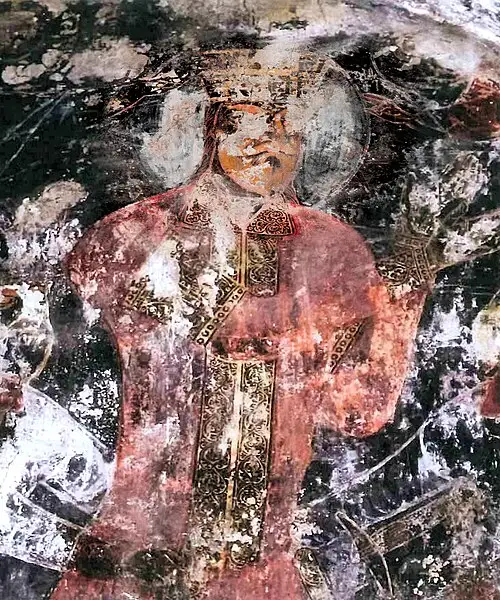
Beside the sword, Demetrius carried a pen. Georgian tradition remembers him as an author of several poems, written mainly on religious themes, and one of them has outlived every conquest of his reign. Shen Khar Venakhi, Thou Art a Vineyard, is a hymn to the Virgin Mary in which the Theotokos is likened to the tender vineyard of ancient Georgian song, and it has become perhaps the most beloved piece of music in the Georgian Church, sung at ordinations, weddings, and feasts ever since. The image of the vineyard had deep roots in the country's literature, but the king gave it a form of such purity that eight and a half centuries of singers have not improved on it. His poetry belongs to the same world as his politics: a Christian kingdom ringed by rival powers, confident in the protection of the Mother of God, seeing its fields and its faith as one inheritance to be kept. The fresco of Demetrius painted at the church of the Savior at Matskhvarishi in 1140, in the middle years of his reign, shows the king in the full dignity of his office; the hymn he wrote shows the interior man, addressing heaven in the accent of a gardener who tends a planting he did not make and cannot fail to love.
§ Poems
Deposition, Monastic Life, and Restoration
The last decade of the reign was consumed by the question of the succession. In the 1140s it became plain that Demetrius intended to bypass his eldest son David and promote the younger, George, and the nobles who had once supported the king's brother Vakhtang took up the disinherited prince's cause. A first coup bid failed in 1150, but the second attempt succeeded in 1154: David seized the throne, and the old king was banished to a monastery, where he received the monastic name Damian. Providence, or poison, cut the rebellion short. David V died suddenly six months after his accession, and the chronicler Vardan Areveltsi reports that he was poisoned by Sumbat I and Ivane II Orbeli, who had made an agreement with one of the rivals for the succession. By law the crown should then have passed to David's young son Demna, but Demetrius was restored instead; he crowned George co-ruler and retired toward the David Gareja monastery in the last year of his life, while others alleged that he had in fact died and that George took the throne by force. He died in 1156 at Mtskheta and was buried with his fathers at Gelati Monastery, the royal pantheon his father had built.
§ Reign
The Right-Believing King Damiane
The Church received the fallen king not as a politician who had lost his throne but as a confession of faith kept through humiliation. Eastern Orthodox tradition venerates him under his monastic name as Saint Damiane the Right-Believing, the king who died in 1156 after wearing both the crown of the Bagrationi and the habit of a monk, and the Eastern Orthodox liturgical calendar keeps his feast on May 23. His memory is recorded in the Great Synaxaristes among the saints of Georgia, a land whose royal saints form an unbroken line from the first Christian kings to the last of the medieval monarchy, and the Orthodox synaxarion enters him as Damiane the King and Hymnographer, joining the two halves of his life into a single offering. In Georgian eyes the double character was the point: a mepe who defended the Church with the sword in the morning and praised the Mother of God with poetry in the evening, and who ended his days stripped of the first crown and faithful to the second. His cult required no formal process; the Church of his fathers simply enrolled the man who had ruled them, suffered dispossession, and died in peace, among the right-believing kings whose intercession the nation has never ceased to ask.
§ Saint Damiane Right-Believing
The Hymn and the Gates
Two objects preserve the memory of Demetrius better than any chronicle. The first is the hymn Thou Art a Vineyard, which he composed in honour of the Virgin Mary and which remains the most famous of all Georgian sacred songs, sung whenever the Church rejoices and instantly recognizable to every Georgian believer; through it the king's own voice is still audible in the liturgy of a nation whose independence has often failed but whose song has not. The second is the pair of iron gates of Ganja, carried back from his victorious raid of 1139 and donated to Gelati Monastery at Kutaisi, where they were set up as a trophy of the Georgian victory; travellers to Gelati can still see the spoil of a campaign that no other record recalls so vividly. His dynasty went on to rule the united kingdom at its height: his son George III reigned until 1184 and bequeathed the crown to Queen Tamar, under whom Georgia reached its golden age, so that the old king's restoration in 1155 proved to be the necessary bridge between the achievement of David the Builder and the glory of Tamar. Historians remember him as a poet on the throne and as the author of a reign that was hard, competent, and ended in forgiveness.
§ Poems
Timeline
- 1093
Born, eldest son of King David IV of Georgia and his Armenian wife Rusudan
§ Early life
- 1117
Sent by his father on a punitive expedition into Shirvan, storming Kaladzori Castle and winning renown
§ Early life
- 12 Aug 1121
Leads the hidden reserve at the Battle of Didgori, turning the Seljuk flank and pursuing the foe for three days
§ Early life
- 1125
Crowned co-ruler by David IV's own hands and succeeds as King of Georgia; drives the Seljuks from Dmanisi
§ Reign
- 1129
Settles the Shirvan question by dividing the land: the Christian portion joins Georgia, Manuchihr keeps the east
§ Reign
- 1130
Cedes Ani to the Shaddadids as vassals on terms protecting its cathedral; crushes half-brother Vakhtang's revolt
§ Reign
- 1139
Raiding Ganja in Arran, he carries the city's iron gates home and presents them to Gelati Monastery
§ Reign
- 1143
Loses Ganja when the Eldiguzid sultan retakes the town after repeated assaults
§ Reign
- 1150
Escapes a first coup attempt by nobles championing his disinherited eldest son David
§ Reign
- 1154
Is deposed by David V's successful coup and banished to a monastery under the monastic name Damian
§ Reign
- 1154
Gives an unnamed daughter in marriage to Iziaslav II of Kiev, though no alliance results
§ Reign
- 1155
Restored to the throne after David V dies suddenly, allegedly poisoned by the Orbeli brothers
§ Reign
- 1156
Crowns his younger son George co-ruler, retires toward David Gareja, and dies; buried at Gelati Monastery
§ Reign
The Record
- Major works
- Shen Khar Venakhi (Thou Art a Vineyard), a hymn to the Virgin Mary·Several religious poems
- Patron of
- Georgia·Orthodox monarchs·Hymnographers
- Symbols
- Royal crown·Monastic habit·The iron gates of Ganja at Gelati
- Canonization
- Pre-congregation; venerated in the Eastern Orthodox Church as St. Damiane the Right-Believing, feast on May 23
Prayer
Bibliography
Show 7 sources
- Baumer, Christoph (5 October 2023). History of the Caucasus: Volume 2: In the Shadow of Great Powers. Bloomsbury Publishing. ISBN 978-0-7556-3630-3.
- Dostourian, Ara Edmond, ed. (1993). Armenia and the Crusades, Tenth to Twelfth Centuries: The Chronicle of Matthew of Edessa. Lanham, Maryland: University Press of America. ISBN 0819189537.
- Eastmond, Antony (1998). Royal Imagery in Medieval Georgia. University Park: Pennsylvania State Press. ISBN 0-271-01628-0.
- Lortkipanidze, Mariam; Japaridze, Otar; Muskhelishvili, David; Metreveli, Roin (2012). History of Georgia in four volumes, vol. II. Tbilisi: National Academy of Sciences of Georgia. ISBN 978-9941-19-585-3.
- Mikaberidze, Alexander (2011). Conflict and Conquest in the Islamic World: A Historical Encyclopedia. Vol. 1–2. ABC-CLIO.
- Rayfield, Donald (2012). Edge of Empires, a History of Georgia. London: Reaktion Books. ISBN 978-1-78023-070-2.
- Toumanoff, Cyrille (1976). Manuel de Généalogie et de Chronologie pour l'histoire de la Caucasie chrétienne. Rome: Edizioni Aquila.
Profile text adapted from the Wikipedia article, licensed CC BY-SA 4.0.
Pray with this saint every day
Save St. Demetrius I of Georgia to your favorites, read the full profile, and get feast-day reminders in the Saints app.
Get the Saints AppFree on the App Store for iPhone and iPad