
1651 – 1709·Feast October 28
St. Demetrius of Rostov
Metropolitan of Rostov and compiler of the Lives of Saints
Overview
Demetrius of Rostov, born Daniil Savvich Tuptalo, was a hierarch of the Russian Orthodox Church and one of its most prolific baroque men of letters. A Cossack's son from the Hetmanate, educated at the Kievo-Mohyla Academy, he brought the florid Ukrainian Baroque into Muscovite church life at the turn of the seventeenth and eighteenth centuries. Tonsured at Kiev in 1668 under the name of the great soldier-saint of Thessalonika, he served as hegumen of several major Ukrainian monasteries before undertaking the work that fixed his fame: the Chetyi-Minei, or Monthly Readings, a vast synthesis of the lives of the saints arranged by the calendar, published between 1684 and 1705. In 1701 he was named Metropolitan of Siberia but, pleading poor health, remained in Moscow, and was soon invested instead with the archbishopric of Rostov. There he founded a school and a small theatre for his own plays, composed penitential psalms that passed into Ukrainian folk song, and is credited with the Rostov Mysteries of 1705, sometimes called the first Russian opera. In politics he resisted both the Old Believers and the caesaropapist church reforms of Theophan Prokopovich, drifting toward the party of the tsaritsa Eudoxia Lopukhina and Tsarevich Alexis. He died on October 28, 1709, was buried at St. Jacob's Monastery, and was glorified by the Russian Church on April 22, 1757.
The Complete Life
A Cossack's Son at the Academy
Daniil Savvich Tuptalo was born on December 11, 1651, into a Cossack family in the Hetmanate, the autonomous Ukrainian polity on the left bank of the Dnieper; his birthplace, Makariv, lay in a country whose Orthodox gentry sent their sons to the schools of Kiev. Soon after his birth the family moved to Kiev, and at the age of eleven the boy entered the Kievo-Mohyla Academy, the institution founded by Peter Mogila that gave the Orthodox east of Europe its most complete education in rhetoric, poetry, philosophy, and theology on the western baroque model. There he absorbed the learning and the literary taste that would distinguish everything he later wrote, and there he acquired, in the standard music curriculum established by Theophan Prokopovich, the only documented training in composition he ever received. The Ukraine of his youth was a borderland of confessions: Uniate metropolitans held ancient Byzantine-Slavic shrines in Belarus and Ukraine under the Polish-Lithuanian Commonwealth, and Orthodox monasteries kept the old faith alive under pressure. The young man chose the monastic life. On July 9, 1668, at St. Cyril's Monastery in Kiev, he took his vows and received the name Demetrius, taken in honour of Saint Demetrius of Thessalonika, the great martyr whose Acts he would one day give to the Church of Russia in its most complete form.
§ Life
Monk and Preacher of the Hetmanate
After his tonsure Demetrius served briefly at Chernigov and then made a pilgrimage of veneration to the Byzantine-Slavic Christian shrines of Belarus, which at that time belonged to the Uniate metropolitans and lay within the Polish-Lithuanian Commonwealth; the journey placed him in direct contact with the churches of the Kyivan tradition in their full, divided breadth. In 1678 he came back from Vilno to Baturyn, where he joined the court of Hetman Ivan Samoylovych and entered the service of the Cossack state whose leading families patronized Orthodox learning. During the 1680s he lived mostly at the Kiev Pechersk Lavra, the great monastery of the caves, and there his preaching won him renown far beyond Ukraine: his discourses against drunkenness and lax morals resounded across Russia and fixed his reputation as a voice of reform within the Church. He was appointed hegumen, or superior, of several major Ukrainian monasteries in succession, but his real ambition lay elsewhere. At the Lavra he gave himself to a project of unprecedented scale: to gather all the lives of the Russian saints, with the lives of the universal Church that the Slavic calendars preserved, into a single great collection arranged by the months of the year. The work he began there would occupy him, on and off, for the remaining two decades of his life.
§ Life
Metropolitan on the Frontier of Reform
In 1701 Demetrius was appointed Metropolitan of Siberia, an enormous and distant charge, but he pleaded ill health and preferred to remain in Moscow until he was invested instead with the archbishopric of Rostov, a see of old renown in the heart of Russia. There the Ukrainian prelate became a builder of Russian church culture: he opened a school and founded a small theatre in Rostov, on whose stage his own dramatic works could be performed, carrying the religious drama of the Kyivan baroque into Muscovy. Politically he stood against the two great movements of Peter the Great's church policy. He opposed the Old Believers, and shortly before his death he produced the synodic act against the Armenian heretic Martin, a monk — a forgery meant to undermine them by portraying their movement as a revival of ancient heresy; he also wrote a direct Inquiry into the Schismatic Brynsk Faith. But he opposed the other pole as well, the caesaropapist reform of Theophan Prokopovich that subordinated the Church to the state, and in his last years he drifted toward the party of the former tsaritsa Eudoxia Lopukhina and Tsarevich Alexis. He was, in this sense, a representative of everything the Petrine revolution meant to sweep away.
§ Life
Baroque Devotion and the Passion of Christ
Demetrius's spirituality belonged to the baroque world of the Kyivan school, and its most striking feature is a devotion to the suffering humanity of Christ of a kind more familiar from western practice than from the older Russian tradition. His devotional prose, collected in English as Jesus Crucified: the Baroque Spirituality of St Dimitri of Rostov, addresses the wounds and sorrows of the Lord in language of tender, almost nuptial intimacy; one line of it, cited in modern studies, greets the heart that lives forever, wounded for our sake by deathly sorrows, sadness and the lance. Writers in modern Orthodoxy note that this devotion, though it recalls Catholic devotion to the Sacred Heart, is understood in an Orthodox light as simply the limitless love and mercy of Christ toward the faithful, and it has led to the sanctioning of a Divine Compassion Mass and Office in the Western Rite churches of the Antiochian Orthodox Vicariate. His penitential psalms circulated widely, reaching not only Ukraine but the Balkans, and many entered Ukrainian folk tradition through the kobzari, the itinerant blind singers who carried the monk's contrition from village to village. In all of this he gave the Russian Church a language of feeling that the austere tradition of Muscovy had not possessed before him.
§ Work as composer
Death and Relics at Rostov
Demetrius died at Rostov on October 28, 1709, having lived just long enough to see the Petrine reform triumph at Poltava and to complete the great works of his pen. His followers buried his relics at St. Jacob's Monastery, the house he had loved, and rebuilt it around his shrine; the monastery became a place of pilgrimage where the hierarch's remains, his reliquary, and even his crozier were preserved and venerated, as early photographs of the church of St. Demetrius in Rostov record. His memory took hold in the land with unusual speed. A fortress on the Don River was named in his honour, and it grew into the great southern city known today as Rostov-on-the-Don, so that the Ukrainian monk from Makariv gave his name to two Russian cities, Rostov the Great where he governed, and Rostov on the Don which bears him still. The Church did not forget the man whose book had given it a year of saints: on April 22, 1757, less than half a century after his death, the Russian Orthodox Church solemnly canonized him, and his three feasts were fixed: September 21 for the uncovering of his relics, October 28 for his repose, and May 23 for the Synaxis of All Saints of Rostov, the diocese he had governed and sanctified.
§ Death
Glorification by the Russian Church
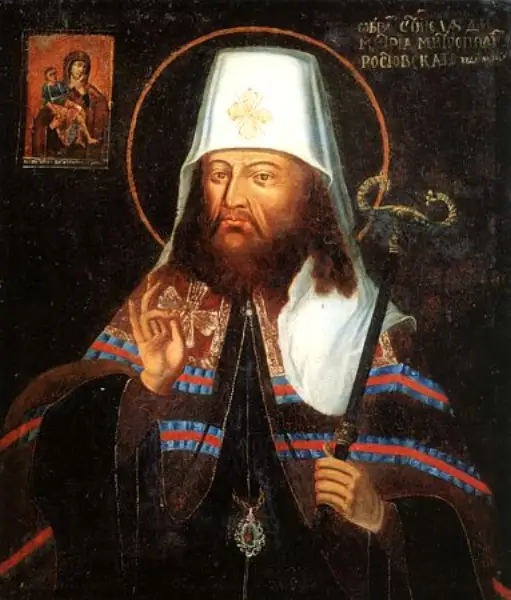
The canonization of Demetrius on April 22, 1757, came only two generations after his death, and it ratified a devotion that had already spread on its own through the shrines and the printed lives. The Russian Orthodox Church enrolled him among its hierarchs with the attributes that his icons still show: vested as a bishop, his right hand raised in blessing, the composition of the late seventeenth century preserved on panel and in engraving. The Church assigned him no fewer than three days of commemoration, an honour few Russian saints receive: the uncovering of his relics on September 21, his repose on October 28, and the Synaxis of All Saints of Rostov on May 23, at which his name is joined to the whole choir of holy hierarchs of his former see, as the Great Synaxaristes records in Greek as well as Slavonic. In the centuries since, his cult has spread along the rivers and railways of Russia: the faithful of Rostov-on-Don, Rostov the Great, and Votkinsk all claim him as patron, and his icon hangs over classrooms as the helper of students and teachers, the scholar-saint whose own learning had been at the service of the Church's memory. He stands among the first great saints of the Petrine age, a rebuke to it from within.
§ Demetrius of Rostov
The Book That Gave Russia Its Saints
Demetrius's enduring monument is the Chetyi-Minei, the Lives of the Saints published in four great volumes in 1689, 1690, 1700, and 1705, the work that integrated the memory of the Russian saints with the whole communion of the calendar and gave every household and Church reader a year of holy example. The book shaped Russian letters as much as Russian piety: when Pushkin sat down in 1825 to write Boris Godunov, it was to Demetrius's Menologion that he turned for his material, and historians of Russian music still debate the Rostov Mysteries of 1705, the six-hour work Demetrius is credited with composing or compiling, which has been staged by Boris Pokrovsky's Moscow Chamber Musical Theatre and at the Brighton Festival in 1993, and which is best described as an oratorio built on the lives of Russia's saints — arguably the first Russian opera. His written corpus remains vast: an apology for the afflicted, meditations on the Passion for every Friday, the Dew-Laden Fleece, the chronicle from the creation to the Nativity. Modern scholarship, notably John Mikitish's study of his baroque spirituality, has restored the depth of his devotional writing to English readers. Above all he is remembered as the man who opposed Prokopovich's state church and gave Russian Orthodoxy a memory of its saints strong enough to outlast the empire that tried to manage it.
§ Works and further reading
Timeline
- 11 Dec 1651
Born Daniil Savvich Tuptalo into a Cossack family at Makariv in the Cossack Hetmanate
§ Life
- 1662
Entered the Kievo-Mohyla Academy in Kiev at the age of eleven after his family moved to the city
§ Life
- 9 Jul 1668
Took monastic vows at St. Cyril's Monastery in Kiev, receiving the name Demetrius
§ Life
- 1678
Moved from Vilno to Baturyn, where he joined the household of Hetman Ivan Samoylovych.
§ Life
- 1684
Began publishing the Chetyi-Minei (Monthly Readings), the great calendar of saints' lives completed in 1705
§ Life
- 1689
First volume of the Chetyi-Minei issued, followed by volumes in 1690, 1700 and 1705
§ Work as composer
- 1701
Appointed Metropolitan of Siberia but, pleading ill health, stayed in Moscow
§ Life
- 1705
Credited with the Rostov Mysteries, a six-hour sacred work sometimes counted the first Russian opera
§ Work as composer
- 28 Oct 1709
Died at Rostov; his relics were placed at St. Jacob's Monastery, later rebuilt as his shrine
§ Death
- 22 Apr 1757
Canonized by the Russian Orthodox Church
§ Demetrius of Rostov
In Their Own Words
Rejoice, heart ever-living, which for our sake was wounded by deathly sorrows, sadness and the lance.
The Record
- Major works
- Chetyi-Minei (Lives of the Saints / Monthly Readings), published 1684-1705·Rostov Mysteries (1705), sacred drama sometimes called the first Russian opera·Penitential Psalms, widely circulated in Ukraine and the Balkans·An Apology to Assuage the Sorrow of a Person in Distress, Persecution, and Bitterness·A Grateful Remembrance and Prayerful Meditation on the Passion of Christ·The Dew-Laden Fleece (Runo oroshennoe)·An Inquiry into the Schismatic Brynsk Faith·A Chronicle Recounting Events from the Beginning of the World to the Nativity of Christ
- Patron of
- Students and teachers·Rostov-on-Don·Rostov the Great·Votkinsk
- Symbols
- Vested as a bishop·Right hand raised in blessing
- Canonization
- Canonized 22 April 1757 by the Russian Orthodox Church
Prayer
Bibliography
Show 8 sources
- Great Synaxaristes: Σύναξις πάντων τῶν ἐν Ροστὼβ – Γιαροσλὰβλ διαλαμψάντων Ἁγίων. 23 Μαΐου. ΜΕΓΑΣ ΣΥΝΑΞΑΡΙΣΤΗΣ.
- "Икона Святителя Димитрия Ростовского - ДонЭкспоцентр". donexpocentre.ru.
- "У Воткинска есть свой покровитель". votkinsk.ru. 4 October 2012.
- "Classical Music / Imelda Macbeth turns catcalls to cheers". The Independent. 1993-05-22.
- "Prelate Dimitry of Rostov". www.fatheralexander.org. Retrieved 2017-06-07.
- Parfeniĭ (Īeromonakh) (1864). Oproverzhenīe zapiski o russkom raskoli︠e︡ (in Russian). V tip. Semena.
- Watson, Augustine. "Orthodox Devotion to the Sacred Heart". www.apologiaanglicana.org. Retrieved 2026-07-14.
- "Worshiping the Body of Jesus". Ancient Insights. 2022-06-20. Retrieved 2026-07-14.
Profile text adapted from the Wikipedia article, licensed CC BY-SA 4.0.
Pray with this saint every day
Save St. Demetrius of Rostov to your favorites, read the full profile, and get feast-day reminders in the Saints app.
Get the Saints AppFree on the App Store for iPhone and iPad