
c. 270 – 304·Feast April 9 and October 26
St. Demetrius of Sirmium
Deacon and Martyr of the Great Persecution
Overview
Saint Demetrius of Sirmium was a deacon of the early church who won the crown of martyrdom in his native city at the opening of the fourth century. Born around 270 at Sirmium, present-day Sremska Mitrovica in Serbia, he was the son of a military officer yet chose service at the altar over a soldier's career, ministering as deacon to Bishop Irenaeus. The bishop placed the community's sacred books in his keeping, a charge that proved fatal when the Great Persecution reached Pannonia: for preserving the Christian texts Demetrius was condemned, and on April 9, 304 he died by order of the governor Probus. The execution took place about a mile east of Sirmium's walls, along the road to Bassianae, though whether he perished by sword or spear can no longer be determined. Seven consecrated virgins and the deacons Donatus and Fortunatus suffered death the same day. Frequently mistaken for his older contemporary Demetrius of Thessaloniki, he keeps his own feast and shrine in Serbia and is invoked as a protector of deacons and of persecuted Christians.
The Complete Life
A Soldier's Son in Sirmium
Demetrius entered the world around the year 270 at Sirmium, a Roman city whose site is now Sremska Mitrovica in northern Serbia. His father served as a military officer, and by the expectations of his class the boy might have followed the same road, taking up arms in the army of an empire whose legions garrisoned the Danube frontier. Instead he turned toward the church. The choice was not a small one: the decades of his youth and manhood saw Christianity pass from tolerated sect to persecuted association and back again, and service at the altar carried real risk whenever an emperor turned to repression. Of his mother, his education, and the steps by which he came to faith, the sources are silent. What they preserve is the shape of his adult life: a man of Pannonian birth and military family who belonged, by the end of the third century, to the clergy of Sirmium, standing at the right hand of its bishop and bearing responsibility for the community's most precious possessions.
§ Life
Guardian of the Sacred Books
As deacon to Bishop Irenaeus of Sirmium, Demetrius received a commission of unusual weight: the safeguarding of the sacred books. In an age when the Scriptures had to be copied by hand and could be confiscated or burned by order of the state, the care of the Christian texts was a ministry of both scholarship and courage. The deacons and lectors who kept the books made the church's worship and teaching possible, and they became natural targets whenever persecution sought to break a community by destroying what it read. Demetrius discharged this duty faithfully through the closing years of the third century. When the Great Persecution ordered by Diocletian reached Pannonia, possession of the books became a capital liability, and the deacon refused to give them up. He was, in the strictest sense, condemned for preserving Christian texts: his martyrdom was the direct price of the custody his bishop had entrusted to him. The church of the first centuries honored such men as confessors of the word, and Demetrius belongs squarely in their company.
§ Life
Martyrdom on the Road to Bassianae
The sentence against Demetrius was carried out on April 9, 304, by order of the governor Probus. Tradition remembers the place with precision: a spot about one mile east of Sirmium's city walls, beside the road that ran toward Bassianae. How he died is less certain, for the sources disagree whether the instrument was the sword or the spear; the uncertainty itself testifies to the antiquity and independence of the surviving accounts. Nor did he die alone. On the same day seven consecrated virgins gave their lives, together with two fellow deacons, Donatus and Fortunatus, so that the execution ground outside the walls became the scene of a company of martyrs rather than a single killing. The commemorations of April 9 and October 26 that grew from that day bind the deacon of Sirmium to the long roll of the Great Persecution's victims, the last and fiercest attempt of the Roman state to destroy the church from within the empire's own laws.
§ Life
A Basilica Over the Martyrdom Site
Veneration of Demetrius took architectural form within a century of his death. Between 426 and 441 the prefect Leontius built over the ground where the deacon was believed to have shed his blood a basilica on the Greek plan with three aisles, and the Basilica of St. Demetrius became the heart of his cult in the city. It stood for less than a century before the Avar siege of 505 destroyed it, yet the memory of the martyr outlived the building, and the cathedral basilica of Sremska Mitrovica honors him as its patron to this day. A modest Romanesque chapel by the gateway of Sirmium's imperial palace likewise counted him among its protectors, evidence of how deeply his cult colored the civic and religious map of the city. Down the centuries his patronage widened: the diocese of Syrmia and the whole of Pannonia, the Order of Deacons whose ministry he exemplified, the persecuted whose trials he shared, and, in later tradition, the crusaders.
§ Basilica
Deacon, Not Legionary
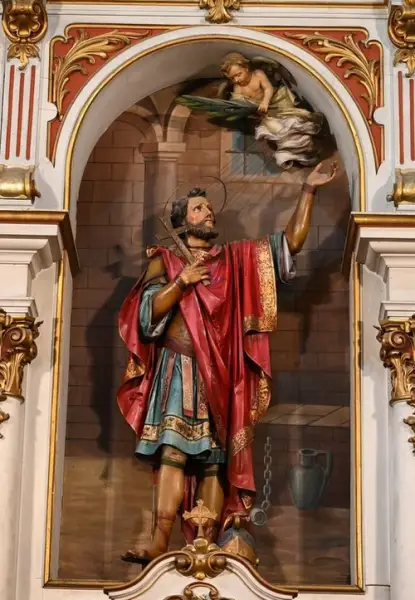
Iconography has not always treated Demetrius fairly. In his own tradition he appears as he lived and died: vested as a deacon or lector, wearing the white toga with the red stole of his order, sometimes carrying the palm branch of victory or a crucifix, and occasionally shown with a scorpion beside him. A later and quite different image, the young legionary in Roman armor, belongs to Thessalonikian tradition and, as the sources note, attaches wrongly to the martyr of Sirmium. The confusion is part of a larger entanglement: Demetrius of Sirmium is frequently mistaken for Demetrius of Thessaloniki, the far more famous military saint of the same era, and scholars still debate whether the two cults preserve the memory of one man or two. For the church of Serbia the distinction matters less than the witness itself. The deacon who died for the books of the faith remains, on his April and October feasts, a distinct and luminous figure of the Pannonian church's earliest generation.
§ Iconography
Timeline
- 270
Born at Sirmium in the Roman Empire, the son of a military officer
§ Life
- 9 Apr 304
Condemned for keeping the Christian texts; suffers martyrdom on April 9 by order of Governor Probus
§ Life
- 9 Apr 304
Seven consecrated virgins and the deacons Donatus and Fortunatus die the same day
§ Life
- 426
Over the ground where he fell, the prefect Leontius builds a Greek-plan basilica with three aisles, finished by 441
§ Basilica
- 505
The basilica is destroyed during the Avar siege of Sirmium
§ Basilica
The Record
- Patron of
- Sremska Mitrovica and the Diocese of Syrmia, Serbia·Deacons·The persecuted·Pannonia·Crusades·University of Zadar
- Symbols
- Deacon's dalmatic or white toga with red stole·Palm branch·Crucifix·Scorpion beside him
- Canonization
- Pre-congregation; ancient cult centered on the basilica erected at his martyrdom site
Prayer
Bibliography
Show 6 sources
- Andrić, Stanko. Bazilijanski i benediktinski samostan sv. Dimitrija u Srijemskoj Mitrovici.
- Milanović, M. "Poreklo hrišćanstva u Srbiji (7): Čiji je Dimitrije?" Vesti online. Retrieved 1 December 2023.
- "USKRS U SRIJEMSKOMITROVAČKOJ KATEDRALI." Srijemska Biskupija. Archived from the original on 13 December 2023.
- Marić, Marica (26 October 2023). "Sv. DEMETRIJE SRIJEMSKI." Portal Veterani. Retrieved 1 December 2023.
- Vasilić, Branko. Sirmium-Sremska Mitrovica.
- Badurina, Anđelko. Leksikon Ikonografije Liturgike i Simbolike Zapadnog Krscanstva.
Profile text adapted from the Wikipedia article, licensed CC BY-SA 4.0.
Pray with this saint every day
Save St. Demetrius of Sirmium to your favorites, read the full profile, and get feast-day reminders in the Saints app.
Get the Saints AppFree on the App Store for iPhone and iPad