
c. 270 – 306·Feast October 26
St. Demetrius of Thessaloniki
Great-Martyr and Myrrh-Streaming Protector of Thessalonica
Overview
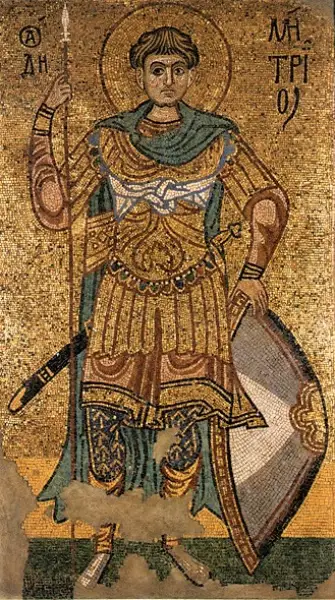
Saint Demetrius of Thessalonica, honored in the East as the Great-Martyr Demetrius the Myroblyte, the myrrh-streamer, was a Greek Christian who died in the persecutions of the early fourth century and became one of the most beloved saints of the Orthodox world. Born to pious Christian parents at Thessalonica in 270, he is described by his hagiographers as a young man of senatorial family who rose to serve as proconsul of the Thessalonica district. Around 306, in the course of the persecutions under Emperor Galerius, he was put to death by being run through with spears, a manner of execution that his earliest surviving images faithfully record. Thessalonica suffered repeated Slavic attacks in the centuries after his death, and the saint was credited with delivering the city time and again, so that he came to be imagined as a soldier and honored among the greatest of the military saints, paired with George of Lydda. His great basilica, the Hagios Demetrios, still anchors the veneration of the city's patron, whose relics famously emit a sweet-flowing myrrh.
The Complete Life
A Senatorial Son of Thessalonica
Written memory of Demetrius came late: not until the ninth century were the first full lives of the saint put together, even though his likeness appears in images far older, and a collection of his posthumous miracles, the Miracles of Saint Demetrius, was already circulating in the seventh. According to those early hagiographies, the saint was born in 270 at Thessalonica, the great Macedonian port of the Roman Empire, to parents who were pious Christians. Those lives further credit him with impressive birth and office: sprung from the senatorial class, he rose to govern the district of Thessalonica as its proconsul. If the rank is historical, it makes his fate all the more remarkable, for a proconsul occupied one of the empire's own magistracies and owed its gods public honor. The century of his birth had seen the church pass through fire into sunlight and back; by the time Demetrius reached manhood, the tetrarchic emperors were preparing the final assault on Christianity, and a Christian magistrate stood in an impossible position between his faith and his office.
§ Life
Martyrdom Under Galerius
Around the year 306, during the Christian persecutions carried out under Emperor Galerius, Demetrius was executed at Thessalonica by being run through with spears. The death was neither casual nor secret; it matched his depiction in seventh-century mosaics, which preserve the memory of a man killed by the weapons of the state in the open. The manner of his passion is in fact one of the oldest facts about him, older than any surviving written life. Later ages would dress the story in elaborate romance, but the core the earliest tradition transmits is stark: a Christian of Thessalonica, holding high office, refused the emperor's demand and died for it in his own city. In the Roman Catholic Church he is most often called Demetrius of Sirmium, with memorials on April 9 and October 8, and scholars continue to debate whether the martyr of Thessalonica and the martyr of Sirmium were a single man or two saints whose memories flowed together over the centuries.
§ Life
The Empty Ciborium and the Flowing Myrrh
Strange as it sounds, the great shrine of Thessalonica appears to have held no body for four hundred years. Most scholars accept that Demetrius had no physical relics in the early centuries of his cult; in their place stood an unusual empty shrine, the ciborium, built inside the Hagios Demetrios. Only later did remains purporting to be the saint's come to light at Thessalonica, and the church's first response was doubt: around 610 Archbishop John, author of the opening book of the Miracles, openly declared the bones spurious. What settled the matter was the phenomenon that gave the saint his most famous title. The relics began to emit a liquid of strong scent, a flowing myrrh, and the community accepted them as genuine; from that flowing the saint took the name Myroblyte, the myrrh-streamer. Whatever the archaeology, the myrrh of Demetrius became one of the celebrated sacramentals of Orthodoxy, and pilgrims to the crypt of the Hagios Demetrios still venerate the saint whose presence the city has never doubted.
§ Relics
From Local Martyr to City Defender
How a martyred official became a soldier-saint is one of the instructive stories of Byzantine religion. The Bollandist Hippolyte Delehaye proposed the hypothesis most scholars follow: that Demetrius's veneration was transferred from Sirmium when Thessalonica replaced that city as the main military base of the region in 441-442, bringing the martyr's cult with the army's headquarters. His vast basilica rose at Thessalonica in the mid-fifth century, and the city embraced him as its patron. Then came the age of invasions. As Slavic peoples moved into the Balkans, Thessalonica endured repeated attacks and sieges, and the saint was credited with delivering the city time after time by miraculous intervention. Deliverance in war reshaped the memory of the man: traditions arose that cast him as a soldier of the Roman army, and the proconsul martyr became an important military martyr, second in the East perhaps only to George himself. Veneration followed the armies and the emperors outward from Greece into the Slavic world, where his name would be given to tsars and peasants alike.
§ Evolution during the Byzantine Empire
Crusader, Farmer, and City Icon
Few saints have gathered so many constituencies. Disputes between Bohemond I of Antioch and Emperor Alexios I Komnenos appear to have led to Demetrius being adopted as patron of crusading, and in the Greek countryside of the Middle Ages he was honored as patron of agriculture, peasants, and shepherds, a role the historian Hans Kloft traces to the pagan goddess Demeter, whose rural rites drifted to the Christian saint after the Eleusinian Mysteries died out in the fourth century. In Russia he became patron of the Rurik dynasty; the Saturday before his feast grew into Demetrius Saturday, a day of prayer for the dead first kept for the soldiers who fell at Kulikovo in 1380. His iconography tells the same story of growth, from a young man in senatorial dress with the tablion across his chest, to a tenth-century infantryman, to the bearded rider on a red horse who spears the gladiator Lyaeus, defeated through his prayers by his disciple Nestor. Bulgarians keep his feast as Dimitrovden, Serbs as Mitrovdan, and the names Dimitri, Dimitris, and Dumitru carry him through half of Europe.
§ During the Crusades
Timeline
- 270
Born at Thessalonica in Macedonia to pious Christian parents
§ Life
- 306
Run through with spears at Thessalonica during the persecutions of Emperor Galerius
§ Life
- 441
Thessalonica replaces Sirmium as the main military base of the region; scholars following Delehaye hold that the saint's veneration transferred there
§ Transfer to Thessalonica; gaining of military attributes
- 450
Hagios Demetrios, the saint's very large basilica, rises in Thessalonica in the mid-fifth century
§ Transfer to Thessalonica; gaining of military attributes
- 610
Archbishop John compiles the first book of the Miracles and publicly dismisses the newly appeared relics as inauthentic
§ Relics
- 1099
From the late eleventh century he is a patron of the Rurik dynasty; Iziaslav I of Kiev founds the first East Slavic monastery in his honour
§ Veneration in Orthodox world outside Greece
- 1207
In hagiographic legend he appears in the camp of Tsar Kaloyan during his siege of Thessalonica and pierces him with a lance
§ Iconography
- 1380
After the Battle of Kulikovo the Orthodox Church institutes Demetrius Saturday, later extended to all the departed
§ Veneration in Orthodox world outside Greece
The Record
- Patron of
- Thessaloniki·Siberia·Sremska Mitrovica and Kosovska Mitrovica·Calgary·Soldiers·Crusades (Roman Catholic tradition)·Agriculture, peasants and shepherds·Construction industry in Bulgaria·Winter, snow and cold
- Symbols
- Armour of a Roman soldier·Spear·Riding a red horse·Spearing the gladiator Lyaeus
- Canonization
- Pre-congregation; venerated as a Great-Martyr in Eastern Orthodoxy from late antiquity
Prayer
Bibliography
Show 7 sources
- Roth, Paul W. (1993). Soldatenheilige. Graz, Vienna, Cologne: Verlag Styria. ISBN 3-222-12185-0.
- Kloft, Hans (2010). Mysterienkulte der Antike. Götter, Menschen, Rituale. Munich: C.H. Beck. ISBN 978-3-406-44606-1.
- Bauer, Franz Alto (2013). Eine Stadt und ihr Patron. Thessaloniki und der Heilige Demetrios. Regensburg: Schnell & Steiner. ISBN 978-3-7954-2760-3.
- Lapina, Elizabeth (2009). "Demetrius of Thessaloniki: Patron Saint of Crusaders." Viator 40 (2): 93–112.
- Russell, Eugenia (2010). St Demetrius of Thessalonica; Cult and Devotion in the Middle Ages. Oxford: Peter Lang. ISBN 978-3-0343-0181-7.
- Skedros, James C. (1999). Saint Demetrios of Thessaloniki: Civic Patron and Divine Protector 4th-7th Centuries CE. Trinity Press International.
- Woods, David (2000). "Thessalonica's Patron: Saint Demetrius or Emeterius?" Harvard Theological Review 93 (3): 221–234.
Profile text adapted from the Wikipedia article, licensed CC BY-SA 4.0.
Pray with this saint every day
Save St. Demetrius of Thessaloniki to your favorites, read the full profile, and get feast-day reminders in the Saints app.
Get the Saints AppFree on the App Store for iPhone and iPad