
d. early 4th century·Feast January 21 (Toba 13)
St. Demiana
Virgin Martyr with the Forty Virgins of Egypt
Overview
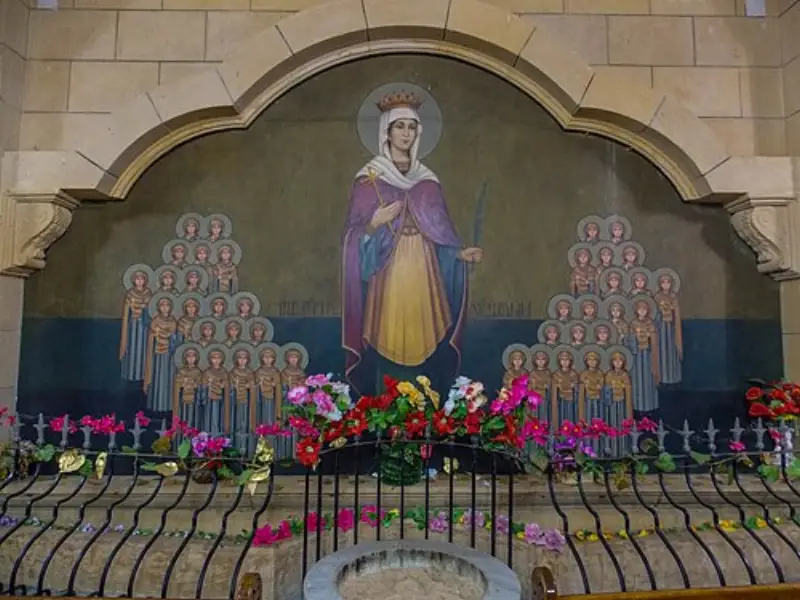
Saint Demiana, also spelled Dimyanah or Damiana, stands at the head of the female martyrs of the Coptic Orthodox Church, remembered with the forty virgins who died beside her at the dawn of the fourth century. She was the only child of Mark, governor of el-Borollos and neighboring districts in the Nile Delta, and after her mother's early death her father raised her with devoted care as a Christian. At fifteen she refused an arranged marriage, consecrating herself as a bride of Christ, and asked for a secluded palace in the wilderness where she could live with her companions apart from the world. When the persecutions of Diocletian reached Egypt, and after Demiana had persuaded her own father to return to the worship of Christ, the emperor sent an officer with a hundred soldiers to compel her sacrifice. She endured the squeezing press and further tortures, was healed in prison by an angel, and finally was beheaded with all forty of her virgins. Tradition counts three heavenly crowns hers: virginity, endurance, and martyrdom. Her monastery at Izbat Jimyanah remains a great center of Coptic pilgrimage.
The Complete Life
The Governor's Only Child
Near the end of the third century, in the Delta farmland of Roman Egypt, there lived a Christian official named Mark. He governed el-Borollos on the northern shore of Lake Burullus, together with el-Zaafaran, the village that would later take the name Izbat Jimyanah, and the region known as Wadi al-Saysaban near the Sebennytic branch of the Nile. Mark had one child, a daughter named Demiana, and he loved her dearly. The happiness of the household was early shadowed: Demiana's mother died while the girl was still young, and the widowed governor took upon himself her upbringing, doing his utmost to form her as a virtuous Christian. The loss may help explain the intensity of the bond between father and daughter that the story later displays, for Demiana would one day hold her father's own soul in her hands, persuading the lapsed official back to the worship of Christ. Of her childhood beyond this the sources say nothing, but they present a girl formed early in conviction, attached to her father, and unafraid of the world her family's rank had opened to her.
§ Life
A Bride of Christ at Fifteen
When Demiana was fifteen, Mark wished to marry her to one of his noble friends, a match that would have confirmed the family's standing in the province. She refused. Christ, she told him, had already taken her for his bride; celibacy and the service of the Lord would be her portion. Then came a request as bold as the refusal itself: that a secluded dwelling be built for her beyond the city's edge, where she and her companions might dwell far from the world's enticements. Mark consented, and for her raised a great palace in the wilderness. There Demiana gathered a company of forty virgins, and the settlement became a community of consecrated life decades before monasticism took formal shape in Egypt. Coptic icons make a point of depicting the forty-one women without the black monastic habit worn by nuns today, for the habit had not yet been devised; Demiana's palace was monasticism in embryo, founded by a young woman before the desert fathers had made the movement famous.
§ Life
Winning Her Father Back to Christ
One act of Demiana's carried consequences far beyond her wilderness household: she persuaded her father to return to the worship of Jesus. The story implies that Mark, the Christian governor, had yielded under the pressures of the Diocletianic era, as many officials did, and that his daughter's steadfastness brought him back. When Emperor Diocletian learned that it was Mark's daughter who had accomplished this, his fury fixed on her; the lapsed could be tolerated, but the one who turned them back became an example to be destroyed. The officer dispatched to her palace was instructed first to flatter, offering riches and glory if she would worship the idols of the state, and then, on refusal, to threaten, torture, and finally behead her and her virgins so that other Christians might take warning. In this way the girl in the wilderness palace became, in the empire's eyes, the most dangerous Christian in the Delta: a testimony that conversion of heart, even of the powerful, begins with the courage of a single unyielding soul.
§ Diocletian Persecutions
The Confession of the Trinity
The spirituality that shines through Demiana's acts is her confession, spoken when the officer relayed the emperor's command that she sacrifice to his gods. Her answer, preserved in the Synaxarium, invoked the one God of heaven and earth, Father, Son, and Holy Spirit, the creator without beginning or end, and declared that in the name of this Trinity she would die and by him live forever. Before the confrontation she had prayed that God would strengthen the faith of her companions, and when the soldiers appeared she gave the forty virgins their freedom, telling them to flee if they could not withstand torture, for only those willing to die for Christ should stay. Their unanimous answer, that they would die with her and love God with her, shows the community spirit she had formed. Tradition sums her spirit in the image of three crowns: the crown of virginity, the crown of endurance under torture, and the crown of martyrdom, a whole consecrated life sealed by blood.
§ Diocletian Persecutions
The Press, the Prison, and the Sword
Enraged by her defiance, the officer ordered Demiana placed in the hinbazeen, the squeezing press, until her blood poured onto the ground, and then cast into prison. There, the account relates, an angel appeared to her, touched her broken body with celestial wings, and restored her whole; returned to the torturers, she bore their renewed cruelties sustained by the faith that had carried her thus far. Neither bribery nor the press nor the prison accomplished the emperor's purpose, and the officer at last issued the order that ended the contest: Demiana and her forty virgins were to be beheaded. The sentence was carried out, and the wilderness palace founded for quiet consecration became a martyr's field. The Coptic Church keeps the anniversary of their death on January 21, the thirteenth day of the month of Toba, under the title of the martyrdom of St. Demiana and the forty virgins, ranking her the highest of Egypt's female martyrs for what she bore in that persecution.
§ Diocletian Persecutions
Helena's Church Over the Tomb
The cult of Demiana is anchored to her tomb from the imperial age. Under Emperor Constantine, his mother Helena made her way to the monastery palace and caused a church to rise over the grave. That first tomb church was consecrated by Pope Alexander I of Alexandria, the nineteenth patriarch of the See of St. Mark, on May 20, the twelfth of the Coptic month of Bashans, an event the church still commemorates annually as the consecration of St. Demiana's big church. The original building did not survive the centuries intact; it was destroyed and rebuilt several times, but always on the same ground, so that the basilica that stands today rises over the same earth as Helena's church. Every year, in the season between the fourth and twelfth of Bashans, corresponding to the middle of May, crowds of the faithful come to the shrine to ask the intercession of the martyr, as they have done for generations beyond counting.
§ The tomb of Demiana and the 40 virgins
Mother of Coptic Nuns
Demiana's afterlife in the Coptic Church has been extraordinary. She is honored as the founder of monasticism for Coptic Orthodox nuns, her wilderness community of forty virgins antedating the great organized convents by generations, and as the princess, the highest-ranking, of the church's female martyrs on account of what she endured. Her monastery at Izbat Jimyanah in the Dakahlia Governorate, a coenobitic convent for nuns bearing her name, was first restored under the Umayyad governor Hassan ibn Atahiyah around 745 and formally consecrated in its modern form by Pope Shenouda III on September 24, 1978; four of its nine churches are dedicated to her. Her life survives in Arabic sources of great antiquity, a lineage of manuscripts running from the disciple of Julius of Aqfahs in the fourth century through sixth-century transcriptions to the eighteenth-century copies the nuns translated into English. In 2014 police foiled a car bomb plot against the monastery, a reminder that her witness still has adversaries; and by the testimony of a Greek Orthodox metropolitan her vita has entered the Synaxarium of the Greek Church as well.
§ Founder of monasticism for Coptic Orthodox nuns
Timeline
- 745
First restoration of her monastery is carried out under Umayyad governor Hassan ibn Atahiyah
§ Restoration of Demiana's monastery
- 24 Sep 1978
Her monastery is formally consecrated as a coenobitic convent for nuns by Pope Shenouda III
§ Restoration of Demiana's monastery
- May 2014
Security forces in Egypt foil a planned car bombing targeting her monastery
§ Restoration of Demiana's monastery
In Their Own Words
If you are willing to die for Christ's sake then you may stay, but if you cannot withstand the torments of the soldiers then hurry and escape now.
We will die with you and love God with you.
Cursed be the messenger and he who sent him ... As for me, I worship my Lord and Savior Jesus Christ, and his good father and the Holy Spirit ... and in his name I will die and by him I will live forever.
The Record
- Symbols
- Garments of a Christian virgin·Martyr's palm·Cross·Shown with her forty virgins
- Canonization
- Canonized early 4th century; venerated in the Coptic Orthodox Church and added to the Greek Orthodox Synaxarium
Prayer
Bibliography
Show 6 sources
- "Saint Demiana." St. Mary & St. Demiana Convent, convent.suscopts.org. Retrieved 2018-03-17.
- "Saint Demiana." www.copticchurch.net. Retrieved 2018-03-17.
- "Saint Demiana." www.stabanoub-dallas.org. Archived from the original on 2021-08-30. Retrieved 2018-03-17.
- "St. Demiana." St. Demiana and St. Athanasius Coptic Orthodox Church. Archived from the original on 2013-04-10.
- John, Peter, and Michael. The Synaxarium. Vol. 2. Trans. Nuns of Saint Demiana's Monastery. Cairo: El-Mahaba Publisher, 1972. pp. 167–170.
- Saint Demiana's Monastery for Nuns. Life Story of the Chaste Saint Demiana and History of the Monastery. Trans. the nuns of Saint Demiana's monastery. Barrary-Belqas, Egypt, 2005. pp. 10–57.
Profile text adapted from the Wikipedia article, licensed CC BY-SA 4.0.
Pray with this saint every day
Save St. Demiana to your favorites, read the full profile, and get feast-day reminders in the Saints app.
Get the Saints AppFree on the App Store for iPhone and iPad