
d. c. 250 (accounts give 250, 258, or 270)·Feast October 9
St. Denis of Paris
Cephalophore Bishop, Martyr and Apostle of Gaul
Overview
Saint Denis of Paris, Dionysius in Latin, was a third-century missionary bishop whose martyrdom made him the apostle and eternal patron of the French capital. Sent from Italy to convert Gaul, according to his hagiographies, in the company of the missionary bishops dispatched under Pope Fabian, he settled on the Île de la Cité at Lutetia and became the city's first bishop. With his inseparable companions, the priest Rusticus and the deacon Eleutherius, he converted so many that the alarmed pagan priesthood stirred the Roman governor to arrest the missionaries; after a long imprisonment all three were beheaded on the highest hill of Paris, the future Montmartre. Denis is the most celebrated cephalophore in Christian history: the legend tells that the decapitated bishop lifted his head and walked for miles, preaching a sermon on repentance, until he fell where the great abbey of Saint-Denis later rose. Venerated since antiquity as one of the Fourteen Holy Helpers and patron of France and Paris, he gave his name to the royal burial church of the French kings and to the battle cry of their armies.
The Complete Life
A Missionary from Italy
The name Denis is the French form of the Latin Dionysius, itself from the Greek Dionysios, but the man who bore it to Paris remains wrapped in the mists of the early church. The earliest document telling the story of his life and death, the Passio SS. Dionysii Rustici et Eleutherii, dates from around the year 600, was long misattributed to the poet Venantius Fortunatus, and is frankly legendary in character; yet it keeps alive the connection the medieval church would not abandon: its claim that Denis left Italia for the evangelization of Gaul in the third century, ranking with the apostles to the Gauls said to have been dispatched, six others beside them, on Pope Fabian's orders. Gregory of Tours, writing in the sixth century, is more measured, reporting simply that the bishop of the Parisii ended his life beneath the sword. Some accounts placed his death under Domitian and confused him with Dionysius the Areopagite, the convert of Paul; assuming his historicity, scholars now judge it more likely that he suffered in the persecution of Emperor Decius, shortly after the year 250.
§ Life
First Bishop of Paris
Denis came to a city smaller and humbler than the capital it would become. In Roman times the town proper stood on the higher Left Bank ground, apart from the Seine, with only a small settlement on the Île de la Cité midstream, and there Denis fixed his seat with his two inseparable companions, Rusticus and Eleutherius, who would die with him. The task awaiting him was daunting: Decius's persecution had driven the town's tiny congregation nearly out of existence, and the church of Paris had to be rebuilt from almost nothing. As its first bishop, Denis ministered to the survivors and reached out to the pagans around them, organizing what the tradition remembers as the apostolic planting of the faith in the region. Of his methods the early sources say little, but their fruit is described plainly: the missionaries converted so many people that the pagan priests, watching their congregations drain away, grew alarmed enough to seek the intervention of the Roman state against them.
§ Life
Arrest on the Île de la Cité
The missionary work of Denis and his companions was, in the judgment of the tradition, simply too effective. As pagans converted in growing numbers, the priests of the old religion saw their followers and their offerings diminish, and at their instigation the Roman governor moved against the Christians. Denis, Rusticus, and Eleutherius were arrested and thrown into prison, where they lay for a long time before their sentence was carried out. The imprisonment matters to the shape of the story: the tradition remembers a sustained contest between the bishop and the authorities rather than a sudden execution, a season in which the confessors waited and, by implication, continued to witness. When the end came it was public and exemplary, on the highest ground overlooking the city, where all Paris could see what Rome did to those who deserted its gods. The hill of their execution would carry the memory in its very name, disputed though the etymology remains between the Mountain of Martyrs and the older Hill of Mercury and Mars.
§ Martyrdom
The Martyrdom on Montmartre
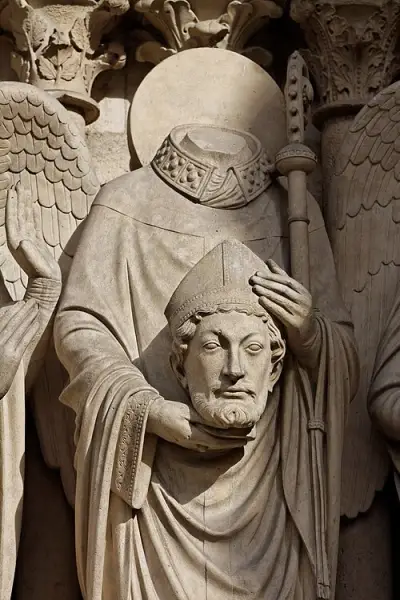
On the summit of the highest hill of Paris, a place that may have been sacred to the druids, Denis and his two clergy were executed by beheading, most probably during the Decian persecution after AD 250, though later chronicles give 258 or even 270. What followed made the saint immortal. The legend, told in full in the Golden Legend and in Butler's Lives of the Saints, relates that the headless bishop lifted his severed head in his hands and traveled miles away from the hilltop, preaching repentance without pause along the road, until at last he fell. He is the most famous of the cephalophores, the head-carriers of hagiography. The spot where he stopped preaching became his grave, marked first by a small shrine and destined to grow into the Basilica of Saint-Denis, burial place of the kings of France. Another account says his corpse was thrown into the Seine and recovered that same night by his converts, who buried it themselves; either way, the city had received a patron it would never again surrender.
§ Martyrdom
From Grave to Royal Basilica
Veneration of Denis began almost at the moment of his death. The bodies of the three martyrs were buried where they fell, and a local Christian woman raised a chapel over the site; by the close of the fifth century the Vita of Saint Genevieve attests a shrine there, and it was Genevieve herself, assisted by the people of Paris, who began the construction of the first basilica at the grave. King Dagobert I later built the first Royal Basilica, following a Merovingian family custom of burial at Saint-Denis that had begun when Chilperic I interred his mother, Queen Aregunda, beside the martyr. In 754 Pope Stephen II carried Denis's veneration to Rome, and soon the cult was prevalent throughout Europe. Abbot Fulrad erected a successor church after 750, and in 1140-44 the great Abbot Suger rebuilt Saint-Denis in the new architectural style and translated the relics of Denis, Rusticus, and Eleutherius to rest beneath the high altar. The feast of October 9, kept since at least the year 800, was formally added to the Roman Calendar by Pope Pius V in 1568.
§ Veneration
Montjoie! Saint Denis!
Few saints have been woven so deeply into the identity of a nation. Denis came to be regarded as the patron of the French people themselves, while Saint Louis patronized the monarchy; his name became the war cry of the French armies, Montjoie! Saint Denis!, and the oriflamme that led France to battle was the banner blessed at his grave. In traditional Catholic practice he is one of the Fourteen Holy Helpers, invoked especially against headaches and diabolical possession, and together with Genevieve he watches over Paris. His cephalophore legend shaped Western art: he is depicted headless and mitred, carrying his own head, with artists divided over where to place the halo and whether to show the whole head or only the crown of the skull, the relic claimed in the Middle Ages by the canons of Notre-Dame in their long dispute with the abbey. Even the learned confusion of Denis with Dionysius the Areopagite, promoted by Abbot Hilduin around 836, testifies to the prestige of his house; historiographers agree the identification is unfounded, but it made Saint-Denis for centuries one of the proudest abbeys of Christendom.
§ Depiction in art
Timeline
- 250
Arrested at the urging of alarmed pagan priests and, after long imprisonment, beheaded with his two companions on Paris's tallest hill
§ Martyrdom
- 250
Buried on the spot where he died, where a local Christian woman soon raises a chapel over his grave
§ Veneration
- 580
Dowager Queen Aregunda, mother of Chilperic I, is laid to rest beside the martyr, beginning a Merovingian royal burial custom
§ Veneration
- 750
Fulrad, abbot from 749 or 750, erects a successor church closely tied to the Carolingian rise to the throne
§ Veneration
- 754
Pope Stephen II carries his veneration to Rome, after which the cult spreads across Europe
§ Veneration
- 9 Oct 800
His feast, kept with companions Rusticus and Eleutherius, is attested as celebrated from at least this year
§ Feast
- 814
Louis the Pious brings to France writings attributed to Dionysius the Areopagite, feeding later confusion about the bishop's identity
§ Confusion with Dionysius the Areopagite
- 836
Abbot Hilduin of Saint-Denis writes an Areopagitica for Louis the Pious asserting the unfounded link to the Areopagite
§ Confusion with Dionysius the Areopagite
- 1144
Suger's rebuilding of the abbey finished; the relics of Denis, Rusticus and Eleutherius are moved beneath the new high altar
§ Veneration
- 1568
Pope Pius V formally inserts the observance of 9 October into the Roman Calendar
§ Feast
In Their Own Words
Beatus Dionysius Parisiorum episcopus diversis pro Christi nomine adfectus poenis praesentem vitam gladio immente finivit.
The Record
- Patron of
- Paris·France·Against headaches·Against frenzy and strife·Against hydrophobia·Against diabolical possession
- Symbols
- Carrying his severed head in his hands·Bishop's mitre·City·Furnace
- Canonization
- Pre-congregation; ancient cult, spread to Rome by Pope Stephen II in 754; feast added to the Roman Calendar by Pope Pius V in 1568
Prayer
Bibliography
Show 6 sources
- Baynes, T. S., ed. (1878). "St Denis." Encyclopædia Britannica. Vol. VII (9th ed.). New York: Charles Scribner's Sons. p. 79.
- Delehaye, Hippolyte (1911). "Denis, Saint." Encyclopædia Britannica. Vol. 8 (11th ed.). pp. 21–22.
- "St. Denis." The Catholic Encyclopedia. Vol. 4. New York: Robert Appleton Company, 1908.
- Pirlo, Paolo O., SHMI (1997). "St. Denis." My First Book of Saints. Sons of Holy Mary Immaculate—Quality Catholic Publications. pp. 238–239. ISBN 971-91595-4-5.
- Gregory of Tours (1988). Glory of the Martyrs. Trans. Raymond Van Dam. Liverpool: Liverpool University Press. ISBN 0-85323-236-9.
- Spiegel, Gabrielle M. (1975). "The cult of Saint Denis and Capetian kingship." Journal of Medieval History 1 (1): 43–69.
Profile text adapted from the Wikipedia article, licensed CC BY-SA 4.0.
Pray with this saint every day
Save St. Denis of Paris to your favorites, read the full profile, and get feast-day reminders in the Saints app.
Get the Saints AppFree on the App Store for iPhone and iPad