
died c. 484·Feast December 6
St. Denise, Dativa, Leontia, Tertius, Emilianus, Boniface, Majoricus, and Servus
Martyrs of the Vandal Persecution in Proconsular Africa
Overview
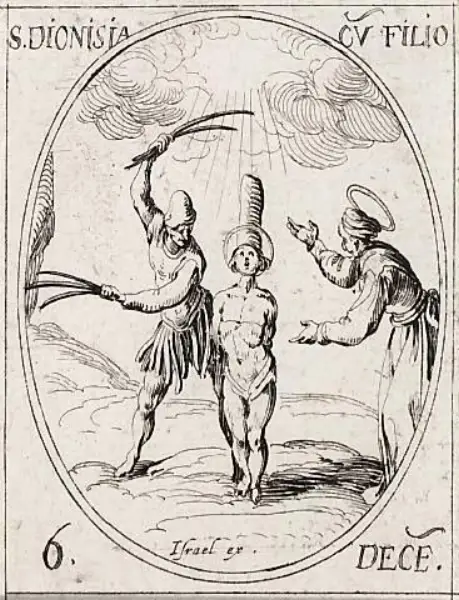
Denise, Dativa, Leontia, Tertius, Emilianus, together with Boniface, Majoricus, and Servus, make up a group of Catholic martyrs put to death in the late fifth century, around 484, during the persecution of Trinitarian Christians carried out in Proconsular Africa by the Arian Vandals. The earliest account of their suffering comes from Victor of Vita, who recorded the violence unleashed under the Arian king Hunneric. Denise, the figure at the center of the group, was a noblewoman of notable beauty who had been widowed; she endured a savage whipping at the hands of the authorities before dying at the stake together with her young son Majoricus and her sister Dativa. With them suffered Leontia, daughter of Bishop Germanus of Perada; Emilianus, a physician and Dativa's brother-in-law; Tertius, a monk of Byzacena, both of whom were flayed alive; and Boniface, surnamed Sibidense, generally identified as bishop of Sicilibba. Servus, martyred at Tuburbium, and Victoria, tortured at Cucusa, were also honored with this company on the same feast. Their memory was preserved in the martyrologies of Ado, Florus, and Usuard, and the Roman Martyrology keeps their feast on December 6.
The Complete Life
A Company Tested Under the Arian Vandals
The persecution that claimed this company of martyrs broke out in Proconsular Africa in the late fifth century, when the Arian Vandals who had seized the Roman province turned against the Trinitarian Christians in their midst. King Hunneric drove the assault, and the sufferings of the church in Africa under his reign were set down by the contemporary writer Victor of Vita, whose account preserves the memory of these martyrs. Denise stood at the head of the group: a noblewoman celebrated for her beauty, she had already known the sorrow of widowhood when the persecutors laid hold of her. Around her gathered her own son Majoricus, still a little child, and her sister Dativa, so that one household gave several witnesses to the faith. Beside them stood companions drawn from different states of life. Leontia was the daughter of Bishop Germanus of Perada. Emilianus, called Emilius or Emelius in some sources and Emilianus according to Usuard, practiced medicine and was joined to the family by marriage as Dativa's brother-in-law. Tertius embraced the monastic life in Byzacena. Boniface, surnamed Sibidense, is generally identified with the bishop of Sicilibba in Proconsular Africa. The company thus joined mothers and children, a physician, a monk, and a bishop, a sign that the persecution spared no rank of the church.
§ Saints Denise, Dativa, Leontia, Tertius, Emilianus, Boniface, Majoricus, and Servus
The Martyrdoms of 484
The sufferings inflicted on this company were varied and cruel. Denise was first brutally whipped by the authorities; when she would not yield, she was put to death at the stake, and there she died together with her little son Majoricus and her sister Dativa, one family standing side by side in the flames. Emilianus the physician and Tertius the monk were condemned to a different torment: both were flayed alive. Of Boniface and Leontia the tradition records simply that they were killed in the same persecution. Two further figures were joined to their memory because they suffered in the same wave of violence and were honored on the same feast. Servus, also called Servius, was martyred at Tuburbium; he was hung and repeatedly dropped from ropes, and finally dragged through the streets of the town. Victoria, or Victrix, was tortured at Cucusa, where she was hung by the wrists above a fire. Her husband begged her to renounce her faith and think of her young children, but she would not. Taking her for dead, the authorities left her lying on the ground; according to the legend she afterwards recovered, declaring that a young maiden had miraculously cured her. Around 484, in these torments, the company won the crown the church has ever since assigned to them.
§ Saints Denise, Dativa, Leontia, Tertius, Emilianus, Boniface, Majoricus, and Servus
Enrollment Among the Ancient Martyrs
This company belongs to the ages of the church before formal causes of canonization existed, and they have always been honored as martyrs by pre-congregation acclamation. Their cult is ancient: it appears in the martyrologies of a number of old churches and in those collections linked with Ado, Florus, and Usuard, the great compilers of the early medieval West. The Roman Martyrology commemorates the feast of the group on December 6, though the record there is not uniform for every member: Servius's name is entered on December 7, and Victoria's name is entirely omitted from the Martyrology, even though popular devotion kept her with the company. A later witness to the spread of the legend is the Legendarium belonging to the convent of canons regular at Böddeken, which preserves the story in a codex of the fifteenth century now associated with the Biblioteca Teodoriana at Paderborn. The survival of the group in these lists, from late antiquity through the Middle Ages and into the printed Roman Martyrology, shows a devotion continuous with the earliest African testimony of Victor of Vita, and their feast has remained December 6 in the Catholic calendar.
§ Veneration
Remembrance and Devotion Through the Centuries
The memory of these martyrs has lived on in several distinct streams. Artistically, the scene of mother and child dying together seized the imagination of Jacques Callot, whose engraving Saint Denise and Her Son, made in the 1630s, fixed the image of Denise and Majoricus for later generations. Liturgically, their names passed from the ancient martyrologies of Ado, Florus, and Usuard into the Roman Martyrology, which keeps their feast on December 6, with Servius separately remembered on December 7. Regionally, one member of the company won a devotion all his own: in the late Middle Ages a cult grew up devoted to Emilianus alone, and it flourished especially at Naples. There, at the end of the fourteenth century, the local society of pharmacists chose him as their patron, taking Peregrine of Auxerre as a companion patron, and a church was raised in his honor in the city. That a physician-martyr should have been adopted by healers of the body gave his cult a particular fit, and it made Naples the chief center of memory for this African company. For persecuted Christians, the group as a whole has remained an emblem of endurance under a hostile power.
§ Veneration
Timeline
- 484
Put to death under the Arian king Hunneric in the Vandal persecution of Trinitarian Christians in Proconsular Africa
§ Introduction
- 1399
At the close of the 14th century, Emilianus is chosen patron of a Neapolitan society of pharmacists, with Peregrine of Auxerre
§ Veneration
- 1400
The Böddeken Legendarium preserves the group's legend in a fifteenth-century codex kept at Paderborn
§ Veneration
- 1630
Jacques Callot engraves Saint Denise and Her Son, portraying Denise with her child Majoricus, in the 1630s
§ Introduction
The Record
- Patron of
- Persecuted Christians
- Symbols
- Martyr's palm·Crown of martyrdom
- Canonization
- Pre-congregation: venerated as martyrs from antiquity by the Catholic Church.
Prayer
Bibliography
Show 5 sources
- Ambrasi, Domenico (1 Feb 2001). "Santi Dionisia, Dativa, Leonzia, Terzo, Emiliano, Bonifacio, Maiorico e Servo Martiri". Santi e beati.
- "Latin Saints of the Orthodox Patriarchate of Rome". orthodoxengland.org.uk.
- "Santa Dionisia y compañeros mártires". mercaba.org.
- John Sanidopoulos (Dec 6, 2017). "Holy Martyrs Dionysia, Dativa, Emilianus, Boniface, Leontia, Tertius, and Majoricus (+484)". Mystagogy Resource Center.
- "The Lives of the Fathers, Martyrs, and Other Principal Saints". J. Duffy. 1866 – via Internet Archive.
Profile text adapted from the Wikipedia article, licensed CC BY-SA 4.0.
Pray with this saint every day
Save St. Denise, Dativa, Leontia, Tertius, Emilianus, Boniface, Majoricus, and Servus to your favorites, read the full profile, and get feast-day reminders in the Saints app.
Get the Saints AppFree on the App Store for iPhone and iPad