
c. 590 – 679·Feast June 19
St. Deodatus of Nevers
Bishop of Nevers and hermit of the Vosges
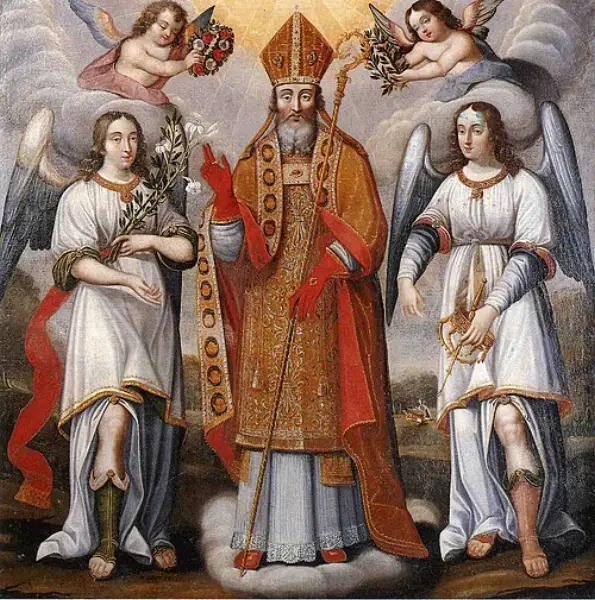
Overview
Deodatus of Nevers, whose name survives in the forms Dié, Didier, Dieudonné, Déodat, and Adéodat, was a seventh-century bishop who abandoned his episcopal office to pursue the solitary life in the mountains of eastern Gaul. Born around 590, he governed the see of Nevers from 655 and took part in the Council of Sens in 657. Less than a decade into his episcopate he resigned, recommending a successor to his clergy, and withdrew through the mountain passes to the Forest of Haguenau, where he lived as a hermit alongside figures such as Arbogast and Florentius. He later moved deeper into the Vosges, where a lord named Hun granted him land on which he founded the monastery of Jointures, first under the Rule of Saint Columban and later under that of Saint Benedict. Tradition holds that he died around 679 in the arms of Hidulphus, bishop of Trier. Canonized by Pope Leo IX in 1049, he is called upon to obtain rain and to guard the faithful from storms, from malign spirits, and from pestilence; and the town of Saint-Dié grew up around his monastery.
The Complete Life
Birth and Rise to the Episcopate
Deodatus came into the world around the year 590, and his origins were remembered as distinguished: the sources describe him as born to an illustrious family of western France, though tradition also preserves the possibility that his birthplace was in Ireland. Under the many names by which he is known — Dié, Didier, Dieudonné, Déodat, and Adéodat — he would become one of the memorable churchmen of seventh-century Gaul. His early advancement culminated in the year 655, when he was appointed bishop of Nevers, an important see on the Loire. As bishop he exercised the ordinary responsibilities of his office during a turbulent century, and in 657 he attended the Council of Sens, joining his fellow bishops in the conciliar life of the Frankish church. These years gave him standing among the leading clerics of his age, yet within a decade of his consecration he would demonstrate that episcopal rank mattered to him far less than the pursuit of holiness, a conviction that would soon carry him out of his cathedral city and into the mountain wilderness of the Vosges.
§ Exploits
From Bishop's Throne to Mountain Hermitage
In 664, after less than ten years governing the diocese, Deodatus resolved to lay down his office. He acted with canonical propriety: before leaving, he proposed to his priests that they select his own replacement, and only then did he depart the world of episcopal administration altogether. His withdrawal took him on foot through the mountain passes to the Forest of Haguenau, a wild region suited to the eremitical life he now embraced. In these years he formed friendships with kindred spirits of the ascetic movement, notably the saints Arbogast and Florentius, whose company strengthened his own resolve. One episode from this period binds him to another holy family: he baptized the son of Saint Hunna, a woman herself honored as a saint, and the child received the same name as the bishop who christened him. That younger Deodatus would grow up to become a monk at Ebersheim and would also be venerated as a saint, a striking testimony to the spiritual fruitfulness of the older man's ministry even after he had surrendered his diocese. The baptism shows a hermit still serving the church through grace rather than office.
§ Exploits
Founding the Monastery of Jointures
Seeking ever greater solitude, Deodatus eventually retired deeper into the Vosges mountains. There providence intervened through a noble patron: Hun, lord of the Val de Galilee, bestowed on the wandering bishop a tract of territory suitable for monastic settlement. The donation was no private arrangement but received formal confirmation from King Childeric II, giving the new foundation a secure legal footing in the Merovingian world. On this land Deodatus established the monastery known as Juncturae, remembered in later centuries simply as Jointures. From its earliest days the community was placed under the Rule of Saint Columban, the austere discipline brought to the continent by the Irish missionary movement with which Deodatus's own story is intertwined. In time that rule gave way to the Rule of Saint Benedict, which would shape the monastery's life for generations. Jointures became the enduring fruit of Deodatus's second vocation: what began as one man's search for silence hardened into an institution of prayer, and the settlement around it would one day grow into a town that still bears the saint's name.
§ Exploits
A Holy Death
The closing chapter of Deodatus's life is preserved in a single touching tradition: that his last moments were spent cradled by Saint Hidulphus, the bishop of Trier. The picture is a fitting one for a man whose whole later life was passed among the episcopal friends of the ascetic movement — Arbogast, Florentius, and now Hidulphus — men who combined high office in the Frankish church with a hunger for the desert. He died on June 19, around the year 679, in the Vosges region where he had spent his final decades. The monastery of Jointures, the community he had founded on Hun's donated land, stood as the witness of his last years and the natural guardian of his memory. Whatever the exact circumstances of his passing, his death in the company of a brother bishop underscores the communal affection that surrounded the solitary: the hermit of the Vosges had not cut himself off from the church, but had found in the wilderness a deeper communion with its holiest servants.
§ Exploits
Canonization and Cult
Deodatus was formally canonized in 1049 by Pope Leo IX, a pope from the upper Rhine region who had ample opportunity to know the cult of the Vosges saint. The canonization gave official recognition to a devotion that had flourished locally for centuries. He is venerated in both the Roman Catholic and Eastern Orthodox churches, and his feast is kept on June 19, the anniversary of his death. Medieval art remembers him through a distinctive emblem: he is depicted with his hand stretching toward thunder clouds, an image drawn from his role as a heavenly intercessor in storms. The devotional tradition that grew around him is practical and protective. Faithful clients invoke him to obtain rain in time of drought, and they pray for his aid against thunderstorms, against evil spirits, and against plague — the great terrors of medieval rural life. A reliquary made for his remains and a depiction of his consecration survive as witnesses to the artistic and devotional care his cult inspired in the regions where he lived and worked.
§ Veneration
The Town of Saint-Dié
The most visible monument to Deodatus is the town of Saint-Dié, which grew up around the monastery of Jointures in the Vosges. The settlement took the saint's name as its own, and the name endures in Saint-Dié-des-Vosges to the present day. The connection, however, is not without scholarly complication: some sources link the place name instead to an earlier saint, Deodatus of Blois, who died in 525, and the two figures have been intertwined in the local tradition of the region. That ambiguity has not diminished the standing of the bishop of Nevers, whose cult was strong enough to attract the attention of Pope Leo IX in the eleventh century. His memory was tended by hagiographers across the centuries, appearing in the Acta Sanctorum of the Bollandists and in the learned studies of later scholars such as Charles Pfister, who traced the legends of Saint Dié and Saint Hidulphe. Today he remains a patron for those who pray for rain and protection from storms, and an example of a bishop who found holiness by surrendering the very office through which he first served God.
§ Veneration
Timeline
- 590
Born about this year into an illustrious family of western France, though Irish birth is also suggested
§ Exploits
- 655
Appointed bishop of Nevers
§ Exploits
- 657
Takes part in the Council of Sens among the bishops of the Frankish church
§ Exploits
- 664
Resigns his see after urging his clergy to choose a successor, and withdraws to a hermit's life in the Forest of Haguenau
§ Exploits
- 19 Jun 679
Dies on June 19, around this year, traditionally in the arms of Hidulphus, bishop of Trier
§ Exploits
- 1049
Canonized by Pope Leo IX, giving formal recognition to his centuries-old cult
§ Veneration
The Record
- Major works
- Foundation of the monastery of Jointures (Juncturae) in the Vosges
- Patron of
- invoked for rain·against thunderstorms·against evil spirits·against plague
- Symbols
- depicted with hand stretching to thunder clouds
- Canonization
- Canonized in 1049 by Pope Leo IX
Prayer
Bibliography
Show 6 sources
- Husenbeth, Frederick Charles. Emblems of Saints: By which They are Distinguished in Works of Art, Longman, Green, Longman, and Roberts, 1860, p. 45
- Drake, Maurice and Drake, Wilfred. Saints and Their Emblems, T. W. Laurie Limited, 1916, p. 34
- O'Hanlon, John. Lives of the Irish Saints, Vol. 6, 1873, p. 739
- Butler, Alban. The Lives of the Saints. Vol. VI: June. 1866
- Papenbroch, Daniel van (1701), "De Sancto Deodato, primum episcopo Nivernensi," in: Acta Sanctorum Junii, Volume 3 (Antwerp: Apud Viduam Henrici Thieullier, 1701), pp. 869-884
- Pfister, Charles (1889). "Les légendes de saint Die et de saint Hidulphe," in: Annales de l'Est vol. 3 (Nancy: Derger-Levrault, 1889), pp. 377-408; 536-588
Profile text adapted from the Wikipedia article, licensed CC BY-SA 4.0.
Pray with this saint every day
Save St. Deodatus of Nevers to your favorites, read the full profile, and get feast-day reminders in the Saints app.
Get the Saints AppFree on the App Store for iPhone and iPad