
c. 466 – 560·Feast April 5
St. Derfel
Warrior of Camlan Who Became a Welsh Abbot
Overview
Derfel, remembered in Welsh as Derfel Gadarn, Derfel the Mighty, was a sixth-century Celtic Christian monk whose legend reaches back through the religious life into the age of Arthurian warfare. Reputedly born around 466, he belonged by medieval genealogy to the family of Hywel, a legendary Brythonic king of Brittany, and was counted brother to Saints Tudwal and Arthfael and cousin to Saint Cadfan. Local tradition made him one of the seven warriors of King Arthur who survived the Battle of Camlan, a survivor not of fortune but of his own strength, as the poets sang. After the catastrophe of that battle, Welsh tradition unanimously sends him into the religious life: a possible season as a wandering hermit, then the monastery of Llantwit, then the founding of the church of Llandderfel in Gwynedd, which still bears his name, and finally the abbacy of Ynys Enlli, Bardsey Island, where he succeeded his cousin Cadfan. He died there of natural causes on 6 April 560. For centuries he was honored at Llandderfel and Llanfihangel Llantarnam by streams of pilgrims, and the wooden image of the warrior-saint, burned in London in 1536, remains one of the Reformation's most vivid stories.
The Complete Life
Kin of Kings and Cousins of Saints
The family that medieval Wales gave to Derfel placed him at the crossing point of royal and sanctified blood. The genealogical tract Bonedd y Saint, in its late recension, makes him one of the sons of Hywel, a legendary Brythonic king whose realm was set in Brittany, and the same Welsh tradition numbers him among the brothers of two other saints, Tudwal and Arthfael, likewise reputed children of Hywel. Through this holy kindred he was cousin to Saint Cadfan, the abbot whose successor he would one day become on the island of Bardsey. Welsh genealogy of this kind served more than curiosity: it wove the great saints of the sixth century into a single family of holiness, showing that sanctity ran in the bloodlines of the Brittonic peoples from Wales to Armorica. Derfel's reputed birth around the year 466 placed his childhood in the generation after the end of Roman Britain, amid the wars of the emerging British kingdoms. It was, in the memory of the Welsh, the very age of Arthur, and it is as a soldier of that age that tradition first shows him, a young man of strength and courage whose path would lead, by a road of blood and battle, to the peace of the monastery.
§ Family
The Survivor of Camlan
The Battle of Camlan, the last and fatal conflict of King Arthur's reign, stands at the heart of Derfel's legend. Local tradition holds that he was a warrior of Arthur, and Welsh memory is precise about his distinction: he was one of only seven of Arthur's warriors to come away from Camlan alive, and of the six others, three were said to have become saints like himself. The medieval poets dwelt on the manner of his survival. While the rest escaped through good fortune, Derfel, the tradition insists, survived by his strength alone, and the bards sang of his prowess in the field. Tudur Penllyn praised the wonder of his spear-work and the splendor of his arms, and Lewys Glyn Cothi imagined him in the thick of Camlan, dividing steel with his weapons while men fell around him. Yet the whole weight of Welsh tradition agrees on what followed: after Camlan, Derfel abandoned war for the religious life. A possible stint as a wandering hermit marks the passage from soldier to servant of God, a season of solitude in which the mighty arm learned stillness; then he entered the monastery of Llantwit, the great school of the Celtic church, where the hero of a hundred fights took his place among the singing brethren.
§ Life
Founder in Gwynedd, Abbot of Bardsey
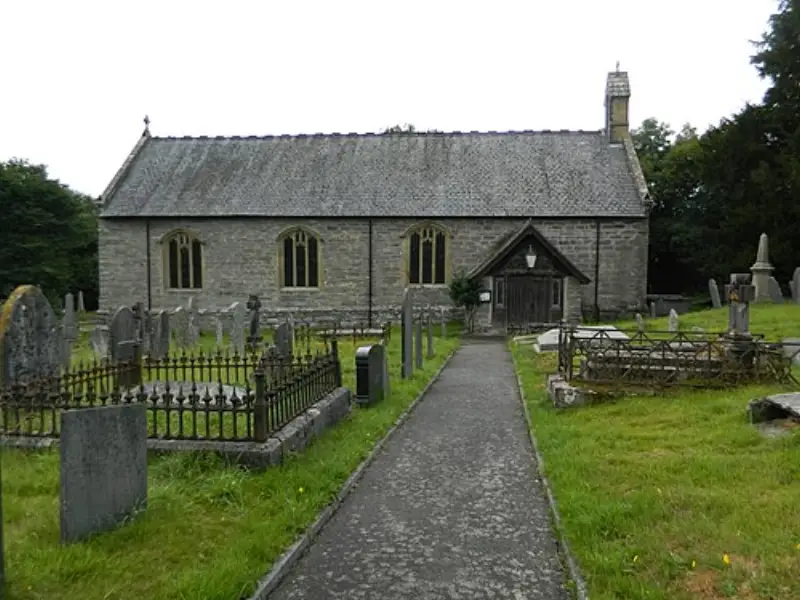
Derfel's monastic career left two enduring monuments. The first is Llandderfel in Gwynedd, the church named for him and said to have been founded by his own hand; it became the center of his cult and remains, under its ancient dedication, a living parish in the hills of Merioneth. The second is the abbacy of Ynys Enlli, Bardsey Island, the holy island off the Llyn peninsula whose graves of the saints earned it the name of the island of twenty thousand saints. There Derfel served as abbot, succeeding his cousin Saint Cadfan, so that the succession from warrior to contemplative ran through a family of saints. On Bardsey the survivor of Camlan completed the transformation that Welsh tradition so loves: the strong arm that had divided steel now governed a community of prayer at the edge of the sea. His double foundation, on the mainland and the island, linked the pastoral care of a Welsh valley with the rigorous holiness of the monastic isle, a pattern typical of the sixth-century Celtic church at its height. When he died, his memory remained fixed at both places, and pilgrims would walk for centuries to the church at Llandderfel where his image kept watch.
§ Life
Death on the Holy Island
Derfel's passing came in peace, it is said, on 6 April 560, at Ynys Enlli, the island abbey he governed at the far edge of Wales. For a warrior of the Arthurian age, whose companions had fallen in battle and whose youth had been spent amid the wars of the Britons, to die old, honored, and in his bed on a holy island was itself a kind of legend: strength, the tradition implies, had been transmuted at last into peace. His death date was carefully preserved, and his feast came to be kept on 5 April, the eve of the day of his passing. The distinction mattered to the communities that honored him; a saint who had survived Camlan and then given decades to the cloister offered the Welsh church a patron who understood both the sword and the psalter. At his death he left behind the church of Llandderfel on the mainland, the abbey of Bardsey under his discipline, and a memory so vivid that later generations would depict him not as a monk with a crosier but as a mailed horseman, arms in hand. He had entered the religious life as the mightiest of Arthur's survivors; he left the world as an abbot whose gentleness outlasted every battle of the age.
§ Life
The Image, the Fire, and the Wooden Horse
For centuries after his death, Derfel was venerated at two churches in particular: Llanfihangel Llantarnam, which claimed a relic of the saint, and St Derfel's Church at Llandderfel, which held a great wooden effigy of him. Pilgrims made their way to both places, and the effigy made his iconography unmistakable: where most saints stand with book and crosier, Derfel was carved as a warrior in full armour, mounted on a horse, the hero of Camlan who had become a servant of God. The English Reformation turned that image into one of the period's darkest memorials. On the order of Thomas Cromwell the Llandderfel figure was removed and dismantled, and it is said to have been used in 1536 to burn John Forest, Franciscan friar and confessor to Queen Catherine, at Smithfield in London. A prophecy had long circulated that the image would one day burn down a forest, and the martyrdom of Forest, whose name echoed the prophecy, was held to have fulfilled it. Part of the image survived the flames: the wooden statue of Derfel's horse remains at Llandderfel to the present day. The saint's afterlife extends even into modern fiction, for a fictionalized Derfel Cadarn is the central character of Bernard Cornwell's Warlord Chronicles, which retells the Arthurian story of Dark Age Britain.
§ Veneration
Timeline
- 466
Reputedly born around this year, by tradition a son of Hywel, the legendary Brythonic king of Brittany.
§ Family
- 6 Apr 560
Died of natural causes on Bardsey Island on 6 April 560, as abbot of Ynys Enlli.
§ Life
In Their Own Words
Derfel in war, he would work his spear wondrously, steel covering is the garment, brave is the appearance.
The Record
- Major works
- Church of Llandderfel, Gwynedd·Abbacy of Ynys Enlli (Bardsey Island)
- Symbols
- warrior in full armour riding a horse
- Canonization
- Pre-congregation canonization; venerated in the Eastern Orthodox, Roman Catholic, and Anglican churches
Prayer
Bibliography
Show 4 sources
- "Welsh History Month: St Derfel and the Stag - icon or idol?", WalesOnline, May 2, 2013.
- "Saint Derfel Gadarn". CatholicSaints.Info, 30 May 2020, retrieved 5 April 2024.
- Suggett, Richard (1996). "Festivals and Social Structure in Early Modern Wales". Past & Present (152): 79–112. ISSN 0031-2746.
- "Three Saints, Two Wells & a Welsh Parish" by Tristan Gray Hulse, archived from the original on 27 May 2013.
Profile text adapted from the Wikipedia article, licensed CC BY-SA 4.0.
Pray with this saint every day
Save St. Derfel to your favorites, read the full profile, and get feast-day reminders in the Saints app.
Get the Saints AppFree on the App Store for iPhone and iPad