
died c. 607·Feast May 23
St. Desiderius of Vienne
Martyred archbishop who opposed Queen Brunhilda
Overview
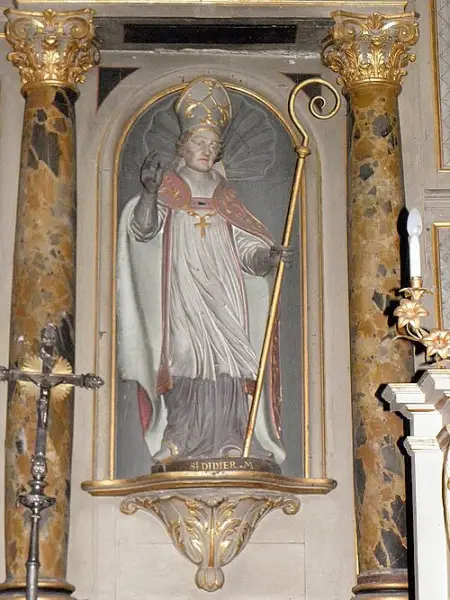
Desiderius of Vienne, who died around 607, was an archbishop of Vienne and a chronicler whose conflicts with the Merovingian court cost him both his see and his life. Born at Autun in Gaul, nothing is known of his early years; he enters history as the metropolitan of Vienne, a serious churchman who took such care over the training of his clergy that he had them schooled in the pagan classics, an interest that drew a rebuke from Pope Gregory the Great. In 603 he collided with secular power when he attacked the legitimacy of the children of Brunhilda of Austrasia. Brunhilda allied with Aridius, bishop of Lyon, and Desiderius was deposed from his archbishopric. Some years later, at the order of King Theuderic II of Burgundy, he was stoned to death, winning the martyr's crown. The church honored him as a saint in both East and West, and his story attracted distinguished hagiographers: a life of the martyred archbishop was written in the seventh century by the Visigothic king Sisebuto, and a later life came from the pen of Ado of Vienne. His memory is kept in the Roman Martyrology and in the calendars of the Eastern churches.
The Complete Life
Origins Wrapped in Silence
Tradition is unusually blunt about the obscurity of Desiderius's beginnings: nothing is known about his early years. He is said to have been born at Autun, the ancient Augustodunum of Gaul, a city celebrated for its schools and its senatorial aristocracy, but no date of birth, family, or formation has come down to him. What can be inferred is drawn entirely from the man who later appears in history: an archbishop of Vienne, one of the great metropolitan sees of the Rhone valley, and a writer styled a chronicler. Two further traits emerge from the anecdote of his later career. He cared deeply about the intellectual formation of his clergy, to the point of having them schooled in the pagan classics — the poets, historians, and orators of antiquity — an educational program bold enough to provoke correspondence from Pope Gregory the Great himself. Whatever his origins made him, the archbishop who emerged at Vienne was a man of learning, discipline, and independence of mind, qualities that would soon place him on a collision course with the most formidable woman in the Frankish kingdoms.
§ Life
Archbishop, Scholar, and a Papal Rebuke
As archbishop of Vienne, Desiderius concerned himself above all with the quality of his clergy. He provided schooling for his priests, and in doing so he introduced them to the pagan classics of Latin literature. The program provoked a famous response: Pope Gregory the Great rebuked him for his interest in the ancient authors, in a letter the pope's concern for the purity of Christian teaching evidently outweighed his admiration for Desiderius's pedagogical zeal. The exchange makes Desiderius one of the early witnesses to the long Western debate over classical learning, a debate in which this martyred archbishop stands on the side of the schools. Alongside his work as an educator he bore the title of chronicler, indicating that he wrote a work of history in the tradition of the Gallic chroniclers. No date is recorded for his elevation to the see of Vienne; his story resumes only in 603, when his episcopate was interrupted by politics. A prelate willing to school his clergy in Virgil's heirs proved equally willing to tell a Merovingian queen uncomfortable truths, and the second habit proved the more dangerous.
§ Life
Conflict with Brunhilda and Martyrdom
In 603 Desiderius attacked the legitimacy of the children of Brunhilda of Austrasia, the aged queen mother whose long dominance over the Frankish courts of her grandsons made her the most dangerous adversary in Gaul. His motive is not recorded beyond the fact of his attack on the children's legitimacy; whatever ecclesiastical or moral grounds lay behind it, Brunhilda responded with political force. She combined her efforts with Aridius, bishop of Lyon, and together they secured Desiderius's deposition from the archbishopric of Vienne. The alliance of an offended queen with a compliant bishop stripped a metropolitan of his see — a cautionary display of how Merovingian ecclesiastical politics worked. The story did not end with deposition. Some years later, at the order of King Theuderic II of Burgundy, Desiderius was stoned to death. The manner of his killing, a mob execution by stones rather than a formal sentence of the sword, and the interval between his fall and his death, suggest a man whose enemies could not rest while he lived. The church counted him a martyr: a bishop who died not for a private quarrel but, as tradition judged, in defense of the faith and the laws of God.
§ Life
Veneration in East and West
Desiderius was honored as a saint without any formal canonization, by the ancient custom of the church that keeps the memory of martyrs. He is venerated in the Roman Catholic Church and in the Eastern Orthodox Church, and his cult found liturgical expression on more than one date: the Roman Martyrology and the Eastern churches mark 23 May, while the Catholic tradition also records a feast on 11 February, and some Catholic sources celebrate him on 26 May. The diversity of dates reflects the spread of his cult across different regions and rites rather than any disagreement about the essentials of his story — an archbishop martyred at the order of Theuderic II around 607. Veneration of a Merovingian bishop-martyr by a Visigothic king is the more striking evidence of how widely his reputation traveled. In both East and West he is remembered under the title of hieromartyr, a bishop who sealed his ministry with blood, and his name has been carried in the martyrologies from the early medieval period to the present day.
§ Veneration
The Lives of Saint Desiderius
The story of Desiderius attracted two notable hagiographers. In the seventh century a hagiographical life of the martyred archbishop was written by Sisebuto, the Visigothic king of Spain, a rare instance of a reigning monarch composing the saint's life of another kingdom's bishop; scholars such as Jacques Fontaine have studied Sisebuto's Vita Desiderii as an example of the political function of Visigothic hagiography, and it stands among the monuments of seventh-century Latin literature. A later life was written by Ado of Vienne, the ninth-century archbishop of the same see, who thus honored a distant predecessor of his own church and helped carry Desiderius's memory into the medieval martyrologies. Modern historians have continued to use his story: Edward James's account of the origins of France and the studies gathered in Sainted Women of the Dark Ages both touch on his conflict with Brunhilda, and his clash with Gregory the Great over the classics is cited in histories of Latin literature. The interest in the pagan classics for which Gregory rebuked him has aged better than the rebuke: Desiderius is now remembered as a learned and courageous bishop, martyred by the mighty he had refused to flatter.
§ Veneration
Timeline
- 603
Denounces the legitimacy of Brunhilda of Austrasia's children and is deposed after she allies with Aridius, bishop of Lyon.
§ Life
- 607
Stoned to death some years after his deposition, on the orders of King Theuderic II of Burgundy.
§ Life
The Record
- Major works
- Chronicle (he is described as a chronicler)·Schooling of his clergy in the pagan classics, which provoked Gregory the Great's letter
- Patron of
- patron of bishops in conflict with unjust rulers·patron of classical learning among the clergy
- Symbols
- stones of martyrdom·archbishop's pallium
- Canonization
- Pre-congregation canonization, venerated as a martyr since antiquity
Prayer
Bibliography
Show 5 sources
- Edward James, The Origins of France (1982), p. 139
- Jo Ann McNamara, John E. Halborg, E. Gordon Whatley, Sainted Women of the Dark Ages (1992), p. 121
- The Roman Martyrology, May 23
- Gian Biagio Conte, Latin Literature: A History (1994 translation), p. 718
- Bryan Ward-Perkins, The Fall of Rome: And the End of Civilization (2006), p. 166; Jacques Fontaine, "King Sisebut's Vita Desiderii and the Political Function of Visigothic Hagiography." in Visigothic Spain (1980). ed. Edward James
Profile text adapted from the Wikipedia article, licensed CC BY-SA 4.0.
Pray with this saint every day
Save St. Desiderius of Vienne to your favorites, read the full profile, and get feast-day reminders in the Saints app.
Get the Saints AppFree on the App Store for iPhone and iPad