
1712-1752·Feast January 14
St. Devasahayam Pillai
Lay Martyr and Convert, Patron of the Laity in India
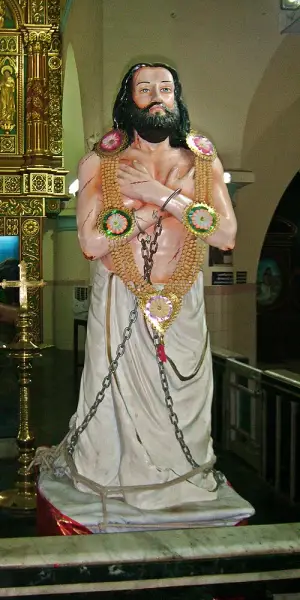
Overview
Neelakanta Pillai was born on 23 April 1712 into an affluent Hindu Nair family of Nattalam in the kingdom of Travancore; his father was a temple priest who taught him Sanskrit and Vedanta, and he was raised, by matrilineal custom, in his uncle's house. Entering palace service as a young man, he rose to high office under Ramayyan Dalawa, the Dewan. There he met Eustachius De Lannoy, the Dutch commander captured at the Battle of Colachel in 1741 who had gone on to lead the Travancore army; De Lannoy's faith drew him, and in 1745 Neelakanta was baptized a Catholic at Vadakkankulam, taking the name Lazar — Devasahayam, 'help of God'. His wife received baptism with him. The conversion of a palace official was intolerable to the court: accused before the Dewan, Devasahayam was stripped of office and imprisoned for three years while European powers pressed for his release. Ordered into exile, he was instead seated backward on a buffalo and paraded through south Travancore as a criminal, beaten daily with eighty stripes, rubbed with pepper, and denied clean water. Released into the hills near Aralvaimozhy, he lived as a praying hermit until, on 14 January 1752, soldiers fired on him five times at Kattadimalai. Villagers recovered his body and carried it to St. Xavier's church at Kottar, where it still rests.
The Complete Life
Early Life
Neelakanta Pillai was born on 23 April 1712 at Nattalam in the kingdom of Travancore, into an affluent Hindu Nair family — the Pillai title marking the highest rank of the Nair caste in Kerala. His father, Vasudevan Namboodiri, was a Brahmin priest at the Adikesava Perumal temple at Thiruvattar, who taught his son Sanskrit and Vedanta; his mother, Devaki Amma, came from Thiruvattar. By the matrilineal custom of the Nairs, the boy was raised in his maternal uncle's household rather than his father's. The family stood close to the royal palace of Maharaja Marthanda Varma, and as a young man Neelakanta entered palace service, where his ability carried him into the conduct of state affairs under the Dewan Ramayyan Dalawa, the Dewan — the chief minister — of Travancore.
§ Early life
Conversion and Vocation
The turn of Neelakanta's life came through the strange career of a Dutch officer. At the Battle of Colachel in 1741, Travancore forces defeated a Dutch East India expedition; its commander, Eustachius De Lannoy, was captured, pardoned on condition of service, and rose to command the very Travancore army that had beaten him, retraining it on European lines. Working together at court and in the army's affairs, De Lannoy and Pillai became close, and the officer's Christian faith engaged the official. In 1745 Neelakanta was received into the Catholic Church at Vadakkankulam, where the Jesuits kept a mission, taking in baptism the name Lazar — rendered into Tamil and Malayalam as Devasahayam, 'help of God.' His wife Bhargavi Ammal was baptized with him as Gnanapoo Ammaal; fearing reprisal, she took up residence at Vadakkankulam, and other members of his family later followed them into the Church.
§ Conversion to Christianity
Mission and Ministry
Devasahayam's witness was that of a converted layman of rank. The sources do not record him as a preacher or founder; they record a court official who continued in the palace world he knew, now openly Christian, and who became the occasion of the kingdom's reckoning with the fact that its own officers could leave the religion of their castes. For a Nair of the highest rank — and an office-holder besides — apostasy from Hinduism was treated in Travancore as an offense against the order of society, punishable by loss of place and by arrest. Church chroniclers report that the Brahmin chief priest, feudal lords, royal household members, and Nair leaders brought charges against him to the Dewan, alleging precisely his abandonment of Hindu belief.
§ Orders based on accusations and charges
Trial and Final Years
Stripped of his portfolio and imprisoned, Devasahayam spent three years in jail while European powers pressed the king for his release. The original order — deportation across the border at Kuzhumaikkad — was altered to a harsher route: he was seated backward on a buffalo, the posture and mount of a condemned criminal, and paraded through the populated south of Travancore toward the Aralvaimozhy pass near the capital, his body painted with red and black spots. The procession lasted days. At each stage he was beaten with eighty stripes, pepper was rubbed into his wounds and nostrils, he was exposed to the sun and given stagnant water. At Puliyoorkurichi, tradition holds, water gushed from rock where he knelt to pray — the spring shown in the church there today; a neem tree to which he was tied at Peruvilai is credited with healing leaves. Released into the forested hills beyond Aralvaimozhy, he lived as a praying man visited by villagers, until on 14 January 1752, at Kattadimalai, soldiers sent against him are said to have been unable to fire until he blessed the gun and returned it; five shots killed him. Local people recovered the body and carried it to St. Xavier's church at Kottar, where it was buried near the altar.
§ Death
Canonization
A bishop of Cochin reported the martyrdom to Rome as early as 1756, but the formal cause waited two and a half centuries. In 2004 the Diocese of Kottar, with the Tamil Nadu Bishops' Council and the Conference of Catholic Bishops of India, recommended the process; some Hindu organizations objected, arguing there was no religious persecution in the period and that Pillai died for sedition, though documents of his own era show that conversion by court officials was indeed not tolerated. Pope Benedict XVI authorized the martyrdom decree on 28 June 2012, and Cardinal Angelo Amato presided at his beatification at Nagercoil on 2 December 2012 — the first Indian layman outside religious life raised to that rank. A miracle recognized on 21 February 2020 cleared the way for canonization, and Pope Francis declared him a saint in St. Peter's Square on 15 May 2022: the first Indian Catholic saint who was neither a priest nor a religious. In 2025 he was named Patron of the Laity in India.
§ Canonization process
Legacy
Devasahayam Pillai's canonization reframed several things at once. For the Church in India he is the saint of the laity — a married civil servant, not a missionary or religious — and his patronage of the laity was granted precisely to honor that. For the history of Travancore his case stands as documentary evidence that conversion carried catastrophic civil consequences there, whatever later denial of persecution. His tomb at Kottar, now the cathedral of Nagercoil, and the sites along his forced procession — the spring at Puliyoorkurichi, the neem at Peruvilai, the hill of Kattadimalai — form a living pilgrimage route in Kanyakumari district, and his feast on 14 January draws devotees across religious lines.
§ Death
Timeline
- 23 Apr 1712
Born into a Hindu Nair family at Nattalam in Travancore and named Neelakanta Pillai
§ Early life
- 1741
Dutch captain Eustachius De Lannoy is captured after the Battle of Colachel and enters the service of Travancore
§ Conversion to Christianity
- 1745
Converted to Catholicism through De Lannoy's teaching, taking the name Devasahayam, the Malayalam form of Lazarus
§ Conversion to Christianity
- 1745
Baptized at the village church of Vadakkankulam by an Italian Jesuit, his wife receiving baptism alongside him
§ Baptism
- 14 Jan 1752
Shot by soldiers on the hills of Kattadimalai near Aralvaimozhy; his body is recovered and buried at the Kottar church
§ Death
- 1756
The Bishop of Cochin reports the martyrdom to the Vatican in his ad limina account
§ Canonization process
- 1780
Kariattil Ouseph Malpan petitions Rome to open the cause of his canonization
§ Canonization process
- 1984
Laypeople of the Kottar diocese, including members of the Nagercoil Catholic Club, revive efforts to obtain his beatification
§ Canonization process
- 2004
The Tamil Nadu and Indian bishops' conferences formally recommend him for beatification at the diocese's request
§ Canonization process
- 28 Jun 2012
Pope Benedict XVI authorizes a decree recognizing his martyrdom, granting him the title Venerable
§ Canonization process
- 2 Dec 2012
Beatified in Nagercoil by Cardinal Angelo Amato as papal delegate, the first Indian layman raised to that rank
§ Beatification and declaration as a martyr
- 21 Feb 2020
Pope Francis recognizes a miracle obtained through his intercession, clearing the way to sainthood
§ Canonization
- 15 May 2022
Canonized by Pope Francis in St. Peter's Square alongside eight other blesseds
§ Canonization
- 16 Jul 2025
A decree issued under Pope Leo XIV names him Patron of the Laity in India, with full liturgical rights
§ St. Devasahayam as a Patron of Laity in India
- 14 Jan 2026
The patronage decree is solemnly promulgated during a Eucharistic celebration at the Shrine of Devasahayam Mount Parish
§ St. Devasahayam as a Patron of Laity in India
The Record
- Patron of
- The laity in India ( decree of 16 July 2025)·Converts facing rejection from family and community·The Church in India
- Symbols
- Seated backward on a water buffalo (his humiliation parade)·Red and black spots painted on his body·Rock spring at Puliyoorkurichi that quenched his thirst
- Canonization
- Declared Venerable by Pope Benedict XVI on 28 June 2012; beatified as a martyr at Nagercoil on 2 December 2012; canonized by Pope Francis in St Peter's Square on 15 May 2022. Named Patron of the Laity in India by decree of 16 July 2025
Prayer
Bibliography
Show 12 sources
- ↑ Blessed Devasahayam Pillai , Star Quest Production Network. Retrieved 4 December 2012.
- ↑ Decrees of the Congregation for the Causes of Saints Archived 24 September 2015 at the Wayback Machine , Syro Malabar Church, 1 July 2012. Retrieved 4 December 2012.
- ↑ "Devasahayam Pillai becomes first Indian layman to be declared saint by Pope Francis - The Hindu" . The Hindu . 17 May 2022. Archived from the original on 17 May 2022 . Retrieved 17 May 2022 .
- ↑ Amalagiri Anthonymuthu, "Vedasatchi Devasahayam Pillai Virivaana Varalaaru" (in Tamil) , Nanjil Book Stall, Nagercoil, 1988, 3rd Edn., 2006, p. 15.
- 1 2 3 Rosario Narchison J, "Martyr Devasahayam: A Documented History", Bishop's House, Nagercoil, 2002.
- ↑ "News Digest" . www.indianchristianity.com . Retrieved 9 June 2021 .
- ↑ V. Nagam Aiya, The Travancore State Manual Vol. 1, 1906
- ↑ "Church in India: Devasahayam's canonization a "historic moment" - Vatican News" . 13 November 2021.
- 1 2 3 4 5 6 7 8 Agur, C. M., Church History of Travancore , Madras, 1903, Reprint: Asian Educational Services, New Delhi, 1990, Part II, Chapter V. ISBN 81-206-0594-2
- 1 2 History of the Diocese Archived 11 May 2012 at the Wayback Machine , Roman Catholic Diocese of Kottar , 2010. Retrieved 2012-05-25.
- ↑ Devasahayam, M. G. (11 July 2022). "Saint Devasahayam's anti-caste struggle angered Brahmins and Nairs, not his conversion" . ThePrint . Retrieved 8 May 2024 .
- 1 2 Church beatifies India's first 'lay' martyr , Business Standard , 2 December 2012. Retrieved 4 December 2012.
Profile text adapted from the Wikipedia article, licensed CC BY-SA 4.0.
Pray with this saint every day
Save St. Devasahayam Pillai to your favorites, read the full profile, and get feast-day reminders in the Saints app.
Get the Saints AppFree on the App Store for iPhone and iPad