
c. 283 – 303·Feast January 27
St. Devota
Virgin martyr and patroness of Corsica and Monaco
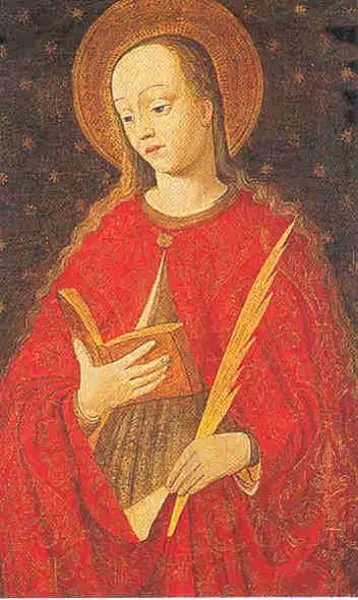
Overview
Devota stands as patroness of both Corsica and Monaco, a young virgin martyred in the persecution of the emperors Diocletian and Maximian. Tradition places her birth around 283 at Mariana in northeastern Corsica, where she served God in the household of the senator Eutychius. When the prefect Barbarus arrived to enforce the imperial sacrifice and the senator refused to surrender her, he was poisoned, and Devota was imprisoned, tortured, and put to death at Mariana, by rack or by stoning, around the year 303. The governor ordered her body burned, but Christians rescued it from the flames and placed it aboard a ship bound for Africa for burial. According to the legend, a storm arose and a dove appeared to guide the vessel to the coast at Les Gaumates, in present-day Monaco, where a chapel was raised in her honour. Her cult grew deep roots on the Riviera: the Sainte-Dévote Chapel in Monaco is first recorded about 1070, her relics were defended and venerated by the Grimaldi dynasty, and from 1874 a burning fishing boat has been launched in her honour each year on the eve of her feast. She is sometimes identified with Julia of Corsica, whose Latin title Deo devota, 'devoted to God', may have been misread as a personal name. Corsica proclaimed her principal patroness in 1820, and her cult was formally approved in 1984.
The Complete Life
A Daughter of Mariana
Tradition holds that Devota was born around the year 283 at Mariana, a town in northeastern Corsica, and there she spent her short life. She entered the household of a senator named Eutychius, and within it she lived as a consecrated virgin, a young woman who had resolved to belong wholly to God. Her story belongs to the generation of Corsican Christians who faced the great persecution launched by the emperors Diocletian and Maximian, the last and most systematic attempt to destroy the church within the empire. Some scholars have questioned whether her story preserves a separate figure at all: some scholars have linked her with another Corsican martyr, Julia, whose Latin epithet Deo devota, 'devoted to God', was in time misread as her actual name. Her legend also resembles those told of other saints of the western Mediterranean, such as Reparata and Torpes of Pisa, a family resemblance that suggests shared local traditions of martyrdom. Whatever the historical core, the memory preserved at Mariana is of a Corsican woman whose devotion to God cost her everything, and whose body, borne over the sea, bound the island to the coast of what would become Monaco in a cult that has lasted seventeen centuries.
§ Legend
Devoted to God in a Senator's House
The account of Devota's life turns on a single decision: as a young virgin she determined to devote herself entirely to the service of God, refusing the ordinary path of marriage and the claims of family and state upon her. Within the household of Senator Eutychius she lived out that consecration, and the senator himself sheltered her, harbouring a Christian in his house at a time when such shelter was itself a crime. Her very name became an emblem of this consecration, whether she bore it from birth or whether, as some scholars argue, the Latin description of a woman devoted to God was gradually transformed into her identity. In an age when the imperial cult demanded sacrifice from every subject, the private resolve of a young woman to serve God alone was a public and dangerous act. When the prefect Barbarus reached Corsica with his fleet and learned that the senator was hiding a Christian, he insisted that she be surrendered and forced through the sacrifice owed to the imperial cult. Eutychius refused to give her up. Rather than confront the senator directly, Barbarus arranged for him to be poisoned, and with the protector of the household removed, Devota was seized and imprisoned for her faith.
§ Legend
Martyrdom at Mariana
Devota's witness was accomplished in suffering rather than in preaching. Imprisoned by the agents of the prefect Barbarus, she was tortured for her refusal to deny Christ and forced sacrifice, and she was put to death at Mariana itself, the sources describing her end as death by the rack or by stoning. She died around the year 303, in the wave of persecution that sought to compel the whole empire back to the old gods. Her death did not end her story but began the second life of her memory. The provincial governor, understanding that the bodies of martyrs became objects of veneration, ordered that her remains be burned so that no tomb could gather the faithful. Once again Christians intervened: they snatched her body from the fire and, rather than bury it where it could be seized, placed it aboard a ship bound for Africa, believing it would receive proper burial in a safer land. The pilot was Gratianus, and with him sailed Benedict, a priest, and Apollinaris, his deacon. A storm overtook the vessel, and in the legend's most cherished image a dove came down and steered the vessel to the shore of Les Gaumates on the Monaco coast, where a chapel dedicated to Saint George stood, and where a chapel in her honour was then built.
§ Legend
From the Flames to the Sea
The final chapter of Devota's earthly life is inseparable from what happened to her body after death. Having endured imprisonment and torture, she suffered martyrdom at Mariana around 303; the governor then sought to erase even her memory by fire, ordering her corpse to be burnt so that it could not be honoured. The Christians of Mariana defied the order, rescued the body from the flames, and entrusted it to the sea. On the vessel, in the charge of the pilot Gratianus and accompanied by the priest Benedict and his deacon Apollinaris, the martyr began her last voyage toward Africa. The storm that struck the boat threatened to defeat the plan, but the legend tells that a dove came down and led the craft safely to the cove of Les Gaumates, within the territory of present-day Monaco, where it landed near a chapel of Saint George. There the Christians buried their treasure, and a chapel was raised over the place in her honour. From the earliest layers of her story, then, Devota is remembered as a virgin who died for her consecration, a body guarded by the faithful against the power of the state, and a passage over the waves under the sign of a dove, an image that has ever since marked her as a protector of those who go down to the sea.
§ Legend
Cult and Recognition
Devota belongs to the company of martyrs venerated from the earliest times without formal process, her canonization resting on the devotion of the communities that kept her feast. Her cult became especially important to Monaco and the Grimaldi dynasty, and reports of miracles were recorded at her tomb; during the Moorish incursions her relics were moved for safety to the monastery of Cimiez and later returned to Monaco. In Corsica, between 1727 and 1751 petitions sought Rome's recognition of Devota as the island's patron, but the requests were turned down because the evidence for her existence was judged scanty. The devotional current nonetheless continued: in 1820 Corsica's first diocesan bishop named both Devota and Julia principal patrons of the island, and in 1984 the bishop of Ajaccio formally approved her cult. The new Roman Martyrology keeps her memory on January 27 as a virgin and martyr of Mariana in Corsica. She is venerated in the Roman Catholic and Orthodox churches, and her feast has become the principal religious feast of the Principality of Monaco, celebrated each year in the presence of the princely family.
§ Diffusion of cult in Corsica
Patroness of Monaco and Corsica
The Legend of Saint Devota is counted among the oldest traditions of the Principality of Monaco, shaping its religion, folklore, history, literature, art, music, coins, and stamps. The Sainte-Dévote Chapel, first mentioned about 1070, became a priory in the thirteenth century, was acquired by Honoré I in 1536, and has served as the parish church since 1887; today the opening bend of the Monaco Grand Prix course carries its dedication. In the sixteenth century Devota was invoked against the Genoese and the Pisans, and the survival of Monégasque independence was credited to her protection; the end of the plague of 1631 and the expulsion of the Spanish in 1641 were likewise attributed to her, and a captured Spanish galley was rebaptized 'Devota' in thanksgiving. Under Honoré II she became the patroness of Monaco, her effigy appearing on the principality's coins. Since 1874, on the eve of her feast, a symbolic fishing boat has been carried in procession to Port-Hercule and set alight, followed by fireworks. In Corsica, Pasquale Paoli founded a short-lived Order of Saint Devota in 1757, and a church was dedicated to her in 1893. Her image has appeared on postage stamps in 1944 and 1992, on a commemorative €5 silver coin in 2004 marking the seventeenth centenary of her death, and in Louis Notari's A legenda de Santa Devota of 1927, the first book written in the Monégasque language.
§ Legacy
Timeline
- 283
Born at Mariana in northeastern Corsica, according to the traditional account of her life.
§ Legend
- 303
Martyred at Mariana during the Diocletian persecution, by being racked or stoned to death.
§ Legend
- 303
Her body, rescued from burning, is carried by boat to Les Gaumates on the Monaco coast, guided by a dove.
§ Legend
- 1070
The Sainte-Dévote Chapel at Monaco is first mentioned, belonging to the abbey of Saint Pons.
§ Sainte-Dévote Chapel
- 1070
Antinope, captain of a Florentine ship, tries to steal her reliquary, but a violent wind blocks his escape.
§ Veneration in Monaco
- 1536
The Sainte-Dévote Chapel is acquired by Honoré I, Lord of Monaco, binding her cult to the Grimaldi house.
§ Sainte-Dévote Chapel
- 1631
The end of an outbreak of plague is attributed to Devota's intercession.
§ Veneration in Monaco
- 17 Nov 1641
The expulsion of the Spanish from Monaco on this night is credited to her protection, and a captured galley is rebaptized 'Devota'.
§ Veneration in Monaco
- 1687
Part of her relics crosses the sea from Monaco to the Jesuit church of Sant'Ignazio on Corsica.
§ Diffusion of cult in Corsica
- 1757
Pasquale Paoli founds a short-lived Order of Saint Devota during the Corsican independence movement.
§ Diffusion of cult in Corsica
- 1820
Corsica's first diocesan bishop names Devota and Julia the island's principal patron saints.
§ Diffusion of cult in Corsica
- 1874
Begins the custom of burning a symbolic fishing boat in Port-Hercule on the eve of her feast.
§ Feast day
- 1893
A church is dedicated to Saint Devota on the island of Corsica.
§ Diffusion of cult in Corsica
- 1927
Louis Notari composes A legenda de Santa Devota, the first book written in the Monégasque language.
§ Veneration in Monaco
- 1984
Her cult is approved by the bishop of Ajaccio; the Roman Martyrology commemorates her on January 27.
§ Diffusion of cult in Corsica
- 2004
A €5 silver commemorative coin marks the 1700th anniversary of her death.
§ Legacy
In Their Own Words
At Mariana, on the island of Corsica, in memory of Saint Devota, virgin and martyr.
The Record
- Patron of
- Corsica·Monaco·the House of Grimaldi·Mariana, Corsica·mariners
- Symbols
- palm·crown of roses·dove·boat·coat-of-arms of the Principality of Monaco·a maiden in a boat on the sea with a dove flying ahead of it
- Canonization
- Pre-congregation canonization as a martyr; her cult was approved by the bishop of Ajaccio in 1984
Prayer
Bibliography
Show 5 sources
- Arduino, Fabio. "Santa Devota", Santa e Beati
- Baring-Gould, Sabine. The Lives of the Saints. J. Hodges, 1877
- Dunbar, Agnes Baillie Cunninghame. "St. Devota", A Dictionary of Saintly Women. Bell, 1904
- Jameson, Anna. Sacred and Legendary Art. Longman, Brown, Green, 1857, p. 648
- Shevchenko, Anastasia V. "The Festival of Saint Devota: Tradition, Identity and Modernity in Monaco." Folklore: Electronic Journal of Folklore 97 (2025): 95-116
Profile text adapted from the Wikipedia article, licensed CC BY-SA 4.0.
Pray with this saint every day
Save St. Devota to your favorites, read the full profile, and get feast-day reminders in the Saints app.
Get the Saints AppFree on the App Store for iPhone and iPad