
c. 400 – before 486·Feast March 29
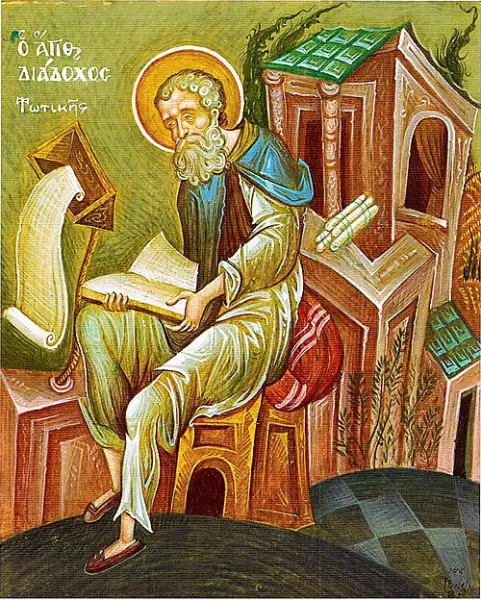
St. Diadochos of Photiki
Fifth-century bishop and mystical ascetic writer
Overview
Diadochos of Photiki was a fifth-century Christian ascetic and bishop whose writings entered the Philokalia and shaped Orthodox spirituality for a millennium. Born around 400, he was raised to the episcopal throne of Photiki, a modest town of the province of Epirus Vetus in the Greek northwest. He attended the Council of Chalcedon in 451, standing with the doctrine that council defined, and he spent his episcopate guarding his flock against the Messalian heresy then circulating from Mesopotamia. His best-known work, On Spiritual Knowledge and Discrimination, usually called the Hundred Chapters, took shape as a response penned for his monks to those strange doctrines; it reveals both a bishop anxious for orthodoxy and a man of deep prayer describing the life in Christ from within. His teaching drew on Evagrius Ponticus and Macarius of Egypt, weaving together the practice of stillness, the experience of grace felt in the heart, and sober vigilance against the demons. Most likely he numbered among the Epiran notables carried off in the Vandal raid of 467 to 474; the prisoners were set free in North Africa near Carthage, after which all trace of him disappears, so that his death, sometime before 486, is of unknown date and place. Scholars credit him with deep influence on Maximos the Confessor, John Climacus, Symeon the New Theologian, and the fourteenth-century Hesychast movement, and, through Julianus Pomerius, on Western spirituality as well.
The Complete Life
Origins in Epirus
Diadochos came into the world around the year 400, in the generation after the great ascetic teachers of the Egyptian desert had begun to shape Christian spirituality across the Greek-speaking world. Nothing certain survives about his family, his education, or the place of his birth; his life first becomes visible when he appears in the church of Epirus. The province of Epirus Vetus, in the northwestern corner of present-day Greece, was his adopted home, and within it the small town of Photiki, whose episcopal throne he eventually occupied. The church he served had been formed in a region where Greek culture and Latin administration met, and its bishops took their place among the notables of the land, a circumstance that would later determine the manner of his disappearance from history. His formation in the ascetical tradition can be traced through his own writing, which shows intimate acquaintance with the teaching of Evagrius the Solitary and Macarius of Egypt, the two masters whose ideas of hesychia, of bodily experienced grace, and of the fierce combat against the demons informed his whole spiritual doctrine. Beyond this, the record is silent: like many bishops of his century, Diadochos enters history through his office, his council membership, and his books, not through biography.
§ Life
Bishop of Photiki and Father of Chalcedon
Diadochos's vocation carried him from ascetic practice to pastoral rule: he became bishop of Photiki, a modest see in Epirus Vetus, and in that office combined the care of a flock with the life of a teacher of prayer. In 451 he sat with the fathers at Chalcedon, appearing in the acts under the title of Bishop of Photiki and confessing the doctrine there defined concerning the person of Christ. In all his work he appears as a champion of that Chalcedonian teaching, and this fidelity was not a merely formal orthodoxy: it expressed itself in his writings, where the confession of Christ guards the door of every spiritual experience. As a bishop he showed himself anxious for the orthodoxy of his people. The Messalian sect, also known as Euchites, had carried strange doctrines out of Mesopotamia, and it was against this corruption of prayer that Diadochos directed his principal work, composed for the monks under his care. His concern was precise rather than polemical: he distinguished the authentic desert tradition of Macarius of Egypt, who worked to rescue those misled by ambiguous teaching, from the unorthodox doctrine itself, and he wrote so that his flock would not confuse the two.
§ Life
Teacher of Stillness Against the Messalians
The mission of Diadochos's later episcopate found its form in his writing. The book for which he is best remembered, On Spiritual Knowledge and Discrimination — the Hundred Chapters, sometimes titled the Gnostic Chapters — he composed for his monks as an answer to the Messalian heresy then spreading out of Mesopotamia. The title 'Gnostic' in this usage points not to the ancient heretical sects but to theoria, the knowledge of God in its biblical sense, and the book sets out to teach how true knowledge of God is reached through purified prayer rather than imagined experience. In its hundred chapters the bishop appears both as a guardian of doctrine and as a man of prayer who lives in union with God, learning the life in Christ from within and longing to pass on its goodness to his readers. The work drew on his two great influences: from Evagrius he took the disciplined doctrine of stillness and thought, and from Macarius the conviction that grace is sensible to the heart; combining these, he armed his monks against a heresy that counterfeited exactly these experiences. Through Julianus Pomerius's work On the Contemplative Life, Diadochos's teaching crossed into the Latin West, extending his mission far beyond the small Greek see he governed.
§ Writings
The Doctrine of Stillness and Love
The spirituality of Diadochos rests on hesychia, the stillness in which the mind guards itself and remembers God without ceasing. From Evagrius the Solitary and Macarius of Egypt he inherited both the intellectual discipline of watchfulness and the warmth of experienced grace, and he joined them in a doctrine of the fight against the demons fought with sobriety rather than imagination. In the Hundred Chapters he distinguishes sharply between discourse born of worldly wisdom, which provokes self-esteem and hunger for human praise, and spiritual discourse, which fills the soul with light and the mind with the love of God; the sure sign of fitness to speak about God is fervent remembrance of him in untroubled silence when speech is over. At the centre of his teaching stands love: whoever loves himself cannot love God, while the man whom God's overflowing richness has freed from self-love seeks not his own glory but the glory of his Creator. Such a soul senses God's love in every commandment and is glad in its low estate, for glory belongs to God's majesty while lowliness unites man to him. This is the mind of John the Baptist, 'He must increase, but we must decrease', turned into a programme of the interior life.
§ The Hundred Chapters
Captivity and Vanishing
The end of Diadochos's life is wrapped in the misfortunes of his province. Between 467 and 474, Vandal raiders operating from their North African kingdom struck the coasts of Epirus, and Diadochos was most likely among the group of Epiran notables carried off into captivity. The group was eventually set free in North Africa, somewhere in the region of Carthage, and from that point every member of it disappears from the historical record. Whether the aged bishop died in African exile, on the journey home, or quietly in some unknown place cannot now be determined; when and where he died cannot now be said; scholarship fixes only that he was no longer living by the year 486. It is a strange ending for a man whose words would travel so far: the bishop who taught that the soul should seek God's glory and not its own ended his life in obscurity, unrecorded and uncommemorated by any chronicle of his passing. The fate also explains the modest footprint of his career in the acts of his time; the council subscription of 451 and the survival of his book are nearly all the external testimony that remains.
§ Life
Influence Through the Philokalia
Diadochos's enduring monument is his place among the authors of the Philokalia, the great anthology of Orthodox mystical teaching, where On Spiritual Knowledge and Discrimination appears in the first volume of the standard English edition. Scholars acknowledge his deep influence on the greatest figures of Byzantine spirituality: Maximos the Confessor drew on his doctrine, John Climacus and Symeon the New Theologian stand in his lineage, and the Hesychast movement of the fourteenth century, culminating in Gregory Palamas, carries his teaching of stillness and sensible grace into its mature form. His reach extended westward as well: Julianus Pomerius, who died in 498, absorbed his thought into the work On the Contemplative Life, through which Diadochos's ideas entered Latin spiritual literature. In the modern era his standing has grown with the circulation of the Philokalia itself; his text is printed in critical editions such as E. des Places's Diadoque de Photicé in the Sources Chrétiennes series and in the complete English translation by Cliff Ermatinger, and his chapters on silence, self-love, and the remembrance of God are among the most quoted passages of the collection. He is commemorated in Eastern Orthodoxy on 29 March as a bishop and confessor of the fifth century.
§ Writings
Timeline
- 400
Born around this year, probably in Epirus; nothing certain is recorded of his family or early formation.
§ Life
- 451
Took part in the Council of Chalcedon as Bishop of Photiki, the small Epirote town in his charge.
§ Life
- 467
Most likely captured with a group of Epiran notables during a Vandal raid, which fell somewhere between this year and 474.
§ Life
- 474
By about this time the captive group had been freed in North Africa near Carthage, after which all traces of him disappear.
§ Life
- 486
Assumed to have died before this year, though his exact date and place of death remain unknown.
§ Introduction
In Their Own Words
Spiritual discourse always keeps the soul free from self-esteem, for it gives every part of the soul a sense of light, so that it no longer needs the praise of men.
Whoever loves himself cannot love God; but if, because of 'the overflowing richness' of God's love, a man does not love himself, then he truly loves God.
For glory befits God because of His majesty, while lowliness befits man because it unites us with God.
No one can love God consciously in his heart unless he has first feared Him with all his heart. Through the action of fear the soul is purified and, as it were, made malleable and so it becomes awakened to the action of love.
The eye of the soul cannot be led astray when its veil, by which I mean the body, is refined to near-transparency through self-control.
Timely silence, then, is precious, for it is nothing less than the mother of the wisest thoughts.
With tears we sow seeds of prayer in the earth of the heart, hoping to reap the harvest in joy.
The Record
- Major works
- On Spiritual Knowledge and Discrimination (the Hundred Chapters), written for his monks against the Messalians·Writings included in Volume I of The Philokalia
- Canonization
- Pre-congregation; venerated in Eastern Orthodoxy with a feast on 29 March
Prayer
Bibliography
Show 4 sources
- E. des Places, Diadoque de Photicé (Sources Chrétiennes 5: 2nd edition, reprinted with additions, Paris, 1966)
- Following the Footsteps of the Invisible: The Complete Works of Diadochus of Photike. Tr. by Cliff Ermatinger. Collegeville (MN), 2010 (Cistercian Studies - Cistercian Publications)
- GEH Palmer; Philip Sherrard; Kallistos Ware, eds. (1979), The Philokalia: The Complete Text, vol. I, London: Faber and Faber Ltd., pp. 251
- Jacques Paul Migne, Patrologia Graecae
Profile text adapted from the Wikipedia article, licensed CC BY-SA 4.0.
Pray with this saint every day
Save St. Diadochos of Photiki to your favorites, read the full profile, and get feast-day reminders in the Saints app.
Get the Saints AppFree on the App Store for iPhone and iPad