
c. 1400 – 1463·Feast November 13
St. Didacus of Alcalá
Franciscan lay brother and missionary of the Canaries
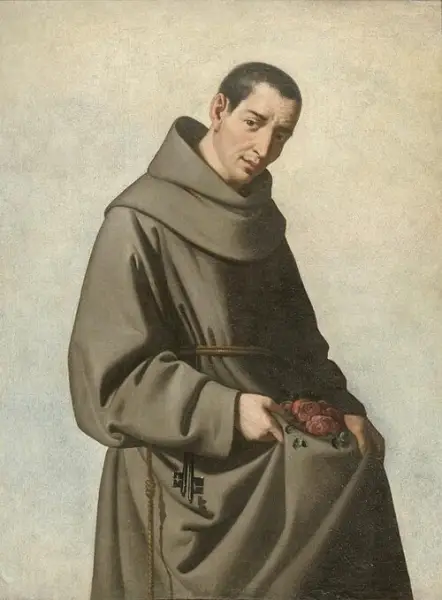
Overview
Didacus of Alcalá, known in Spanish as Diego de Alcalá or Diego de San Nicolás, was a Spanish Franciscan lay brother who numbered among the earliest friars sent to evangelize the Canary Islands after their conquest. His birth came around 1400 at San Nicolás del Puerto, to a family poor in goods but rich in devotion, he embraced the hermit life as a child before seeking admission to the Observant branch of the Friars Minor, in which he was received as a lay brother. He worked at manual trades to support his brethren, preached in the villages around Córdoba, Cádiz and Seville, and was sent to the Canary Islands, where he was appointed Guardian of the Franciscan community on Fuerteventura — a rare office for a lay brother — and defended the indigenous Guanche people against the colonizers. Recalled to Spain, he went to Rome for the Jubilee of 1450 and nursed victims of an epidemic there for three months. He spent his final years at the Friary of Santa María de Jesús in Alcalá in penance, solitude and contemplation, and died there on 12 November 1463. He was canonized in 1588, the first Franciscan lay brother raised to the altars.
The Complete Life
A Poor Family of San Nicolás del Puerto
Didacus was born around the year 1400 at San Nicolás del Puerto, a small village in the Kingdom of Seville, to parents of little wealth but deep faith. The piety of his home showed itself early in his own life: as a child he embraced the eremitical ideal, and as he grew older he put himself under the guidance of a hermit priest whose dwelling stood near his home town. For a time he led the life of a wandering hermit, moving through the countryside in prayer and solitude. Yet he felt himself called to something more stable and more communal, and he sought entry into the reformed branch of the Friars Minor, the Observants, at their house in Albaida. From there he was sent to the friary of Arruzafa near Córdoba, a house founded in 1409 that had grown into a principal seat of the Order's reform throughout the peninsula, and there he was received as a lay brother. Because he was not ordained, he gave himself to the manual trades by which he supported the brotherhood, accepting the humblest forms of service as his share in the Franciscan life.
§ History
A Lay Brother in the Reformed Order
As a friar at Arruzafa, Didacus combined labour with the apostolate of the word. During his years in that region he journeyed to the villages surrounding Córdoba, Cádiz and Seville, preaching to the people of the countryside, and a strong devotion to him persisted in those towns long after his death. When the Order extended its missionary outreach, he was chosen for the new foundation overseas and sent to the friary at Arrecife on the island of Lanzarote in the Canaries, a land conquered by Jean de Béthencourt only about forty years earlier, where the native Guanche people were still being introduced to Christianity. There he was assigned the office of porter, the brother who receives visitors and guards the door, a post of humility and of constant contact with the poor. In 1445 his abilities were recognized in a striking way: he was named Guardian of the friars on the island of Fuerteventura, where the Observants soon established the Friary of St. Bonaventure. Though custom barred lay brothers from holding that office, his great zeal, prudence and sanctity were judged to justify the choice.
§ Missionary
Missionary to the Canary Islands
Didacus's years in the Canary Islands placed him at the frontier of the Spanish Church, where evangelization and colonization arrived together and did not always serve the same interests. As Guardian on Fuerteventura he took the side of the indigenous islanders against the colonizers, and the stand he made on their behalf precipitated his recall to Spain in 1449. His zeal for the native people cost him his post, but it remains the clearest evidence of the sanctity his superiors had seen in him. In 1450, back in Spain, he travelled to Rome for the holy year that Pope Nicholas V had proclaimed and for the canonization of Bernardine of Siena, one of the pillars of the Franciscan Order. The city was crowded not only with pilgrims but with thousands of friars who had come for the celebration, and in the midst of these gatherings an epidemic broke out. Didacus offered himself for the hardest work at hand: he became infirmarian and devoted three months to nursing the sick in the friary beside the Basilica of Santa Maria in Ara Coeli, where his biographers tell of many wonders worked for those under his care through his intercession.
§ Missionary
Penance, Solitude and Contemplation
The spirituality of Didacus was formed in the eremitical world of his boyhood and perfected in the hidden life of the friary. From his earliest years he had sought God in solitude, first as a child hermit near his native village and then under the guidance of a hermit priest; the desire for recollection never left him. As a religious he expressed the same longing through obedience and labour, working at manual trades for the support of the brethren and accepting offices of service such as porter and infirmarian. When his superiors sent him after his Roman stay to the Friary of Santa María de Jesús in Alcalá, he found there the form of life to which his whole journey had been tending: the years that remained to him were given to penance, solitude and contemplation. The miracles remembered of him belong to this hidden holiness — roses found in place of the bread he carried to the poor, cures granted at his tomb, and the care he never refused to the sick and the hungry. After his death his body was reported to have remained incorrupt, free of rigor mortis and giving off a pleasant odour, signs the faithful read as the fragrance of a life given wholly to God.
§ Missionary
The Last Years at Alcalá
Recalled a second time to Spain, Didacus was sent by his superiors to the Friary of Santa María de Jesús in Alcalá de Henares, and there he settled for good. The wandering hermit of San Nicolás del Puerto, the porter of Lanzarote, the Guardian of Fuerteventura and the infirmarian of Rome now passed his days in the quiet round of prayer and penance that he had long desired. It was in this friary that he died, on 12 November 1463, at about sixty-two years of age, of an abscess. Devotion to him did not end at the friary gate. Between 1485 and 1514 a chapel, the Ermita de San Diego, was raised in his birthplace to enshrine his remains in the town of his origin, and it remains his principal shrine. His tomb at Alcalá became a place of recourse for the great of Spain: King Henry IV of Castile, tormented by an injured arm after a fall from his horse, was healed after kissing the saint's body and feeling its hand laid upon his wound; and in 1562 the body of Didacus was carried to the bedside of Don Carlos, Prince of Asturias, who had been found unconscious and paralyzed after falling down a staircase, and whose recovery followed a dream in which the saint told him he would not die.
§ Missionary
Raised to the Altars by Sixtus V
Didacus was canonized by Pope Sixtus V on 10 July 1588 at Saint Peter's Basilica, the first of the lay brothers of the Order of Friars Minor to be so honoured. The recognition crowned a cult that had already spread through Spain and beyond, nourished by the miracles reported at his tomb and by the devotion of the towns where he had preached. His feast day is kept on 13 November, since the anniversary of his death, 12 November, came to be occupied first by the feast of Pope Martin I and later by that of Josaphat Kuntsevych, at once Basilian monk, Eastern Catholic bishop and martyr. In the United States the Franciscan Order and the Diocese of San Diego celebrate his feast on 7 November, because 13 November belongs in that country to Saint Frances Xavier Cabrini. The canonized lay brother thus received, in the reformed calendar, a place his humility would scarcely have claimed in life: the poor brother of Arruzafa and Alcalá had become a saint of the universal Church, invoked from Seville to the Pacific coast of North America.
§ Veneration
From a Village Hermit to the City of San Diego
Few saints of the fifteenth century have left a name across so wide a map. The Franciscan mission that bore his name on the coast of Alta California grew into the City of San Diego, and Didacus is the saint to whom that mission was dedicated; he is honoured today as co-patron of the Roman Catholic Diocese of San Diego and patron of Franciscan lay brothers, the humble rank he held all his life. In art he became a favourite subject: Bartolomé Estéban Murillo painted several representations of him, including the saint in ecstasy before the cross and the saint feeding the poor, and scenes of the miracle of the roses and of his miraculous meals were treated by painters from Niccolo Betti to Maerten de Vos and Bernardo Strozzi. The strange survival of a sixteenth-century clockwork automaton of a praying monk, now held by the Smithsonian Institution and exhibited at the Metropolitan Museum of Art in 2020, has been traced by some scholars to a model of Didacus commissioned from Juanelo Turriano, mechanic to Charles V, perhaps made so that Philip II could share the story of his son's recovery with his people. A chapel in his birthplace, an American city, and the memory of the Guanche missions all keep alive this brother of the poor.
§ Veneration
Timeline
- 1400
Born into a poor but pious family at San Nicolás del Puerto in the Kingdom of Seville.
§ History
- 1445
Named Guardian of the friars on Fuerteventura in the Canaries, where the Observants founded the Friary of St. Bonaventure.
§ Missionary
- 1449
His defense of the indigenous islanders against the colonizers brought about his return to Spain.
§ Missionary
- 1450
Recalled to Spain, he travelled to Rome for the Jubilee Year and the canonization of Bernardine of Siena.
§ Missionary
- 1450
Served three months as infirmarian at the friary of Santa Maria in Ara Coeli during a Roman epidemic.
§ Missionary
- 12 Nov 1463
Died at the Friary of Santa María de Jesús in Alcalá de Henares.
§ Missionary
- 1485
The Ermita de San Diego rose in his native village across the years 1485 to 1514 to house his remains.
§ Missionary
- 19 Apr 1562
Don Carlos, Prince of Asturias, fell down a staircase that night and was healed after praying beside Didacus's relics.
§ Miracles
- 10 Jul 1588
Canonized by Pope Sixtus V at Saint Peter's Basilica, the first Franciscan lay brother so honoured.
§ Veneration
The Record
- Major works
- Friary of St. Bonaventure, Fuerteventura, founded by the Observant Franciscans during his guardianship
- Patron of
- Co-patron of the Roman Catholic Diocese of San Diego·Patron of Franciscan lay brothers
- Symbols
- Franciscan habit·Cross·Lily·Roses gathered in his cloak
- Canonization
- Canonized 10 July 1588 by Pope Sixtus V at Saint Peter's Basilica
Prayer
Bibliography
Show 10 sources
- "Saint Didacus of Alcalá: 'Blue-Collar' Franciscan". Commission on the Franciscan Intellectual Tradition, 08 November 2021.
- "San Diego (St. Didacus)". Roman Catholic Diocese of San Diego.
- Donovan, Stephen. "St. Didacus." The Catholic Encyclopedia, Vol. 4. New York: Robert Appleton Company, 1908.
- Sa-onoy, Modesto P. Parroquia de San Diego. Today Printers and Publishers, Bacolod, Philippines, pp. 176–177.
- "Heritage Building: Ermita de San Diego" (in Spanish). Instituto Andaluz del Patrimonio Histórico.
- "Saint Didacus". Franciscan Media.
- Bright, William (1998). 1500 California Place Names: Their Origin and Meaning. Berkeley: University of California Press. p. 130. ISBN 9780520212718.
- Halavais, Mary H. (1999). "Rev. of La Historia de San Diego de Alcala. Su vida, su canonizacion y su legado by Thomas E. Case". The Journal of San Diego History. 45 (4). San Diego Historical Society.
- Tabor, Margaret Emma (1908). The Saints in Arts: With Their Attributes and Symbols Alphabetically Arranged. Frederick A. Stokes. p. 59.
- King, Elizabeth (Spring 2002). "Clockwork Prayer: A Sixteenth-Century Mechanical Monk". Blackbird. 1 (1).
Profile text adapted from the Wikipedia article, licensed CC BY-SA 4.0.
Pray with this saint every day
Save St. Didacus of Alcalá to your favorites, read the full profile, and get feast-day reminders in the Saints app.
Get the Saints AppFree on the App Store for iPhone and iPad