
c. 313 – 398·Feast 6 Paoni (Coptic calendar)
St. Didymus the Blind
Alexandrian theologian and dean of its school
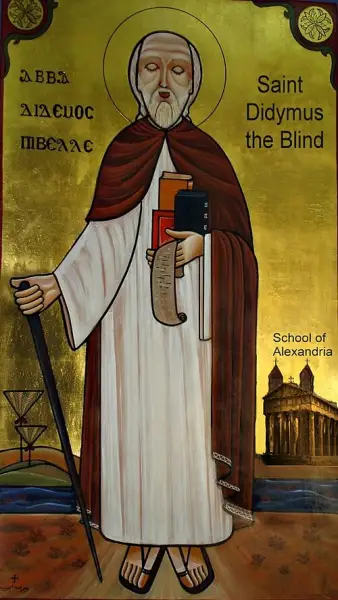
Overview
Didymus the Blind was a Christian theologian of the Church of Alexandria, where his teaching occupied close to fifty years. Sighted no longer after his fourth year, before he had ever been taught to read, he became one of the most learned men of his century through an extraordinary memory, recalling and contemplating information while others slept. Faithful to Origen as a disciple, he opposed Arian and Macedonian teachings and was regarded as an orthodox Christian teacher, greatly respected and admired until at least 553. Rufinus described him as a teacher in the Church school approved by Bishop Athanasius; later scholars came to see him as head of the Catechetical School of Alexandria. He remained a layman all his life and numbered Palladius, Rufinus and Jerome among his pupils; Jerome called him 'Didymus the Seer'. He experimented with carved wooden letters to help blind people read, an approach compared to modern Braille, and was the first Alexandrian Christian to read the Hermetica as prophecy uttered by pagans of Christ's coming. In 553 the Second Council of Constantinople condemned his works, together with those of Origen and Evagrius Ponticus, though not his person, and many of his writings were lost. Some commentaries and essays survive, and papyrus codices found near Tura in 1941 greatly increased knowledge of his work.
The Complete Life
Blindness and a Memory Like a Concordance
Didymus lost his sight in his fourth year, before any letters had been learned, and yet the loss of his sight became the measure of his genius rather than the limit of his life. Deprived of the ordinary path into letters, he excelled in scholarship because of an incredible memory: he stored up and pondered knowledge through the hours when others slept, and later readers said he had a mind like a concordance, able to summon the sacred text in all its parts. None of his contemporaries, however critical of his methods, denied that his blindness left unhindered his remarkable ability to recall Scripture. Nor did he merely endure his disability; he set about overcoming it for others as well. He devised methods by which the sightless could read, trying out carved wooden letters that resembled the Braille systems in use today, an achievement for which modern students of ophthalmology have called him an unknown precursor of Louis Braille and Helen Keller. He was a loyal follower of Origen from his earliest formation, and against the teachings of the Arians and the Macedonians he set the faith of the Alexandrian Church that had formed him.
§ Early life and education
A Teacher Approved by Athanasius
Rufinus calls him a teacher of the Church's school, one approved by Bishop Athanasius and by other learned churchmen, and later scholars believed that he headed the Catechetical School of Alexandria — though it is possible that the school as an institution did not exist in his time, and that Rufinus referred to a different school. Whatever the precise structure of his office, the substance is beyond doubt: for roughly fifty years he taught in the Church of Alexandria, and his reputation stood for intelligence and a gift for instruction. Unusually for a man of such standing, he remained a layman all his life, and among the learned ascetics of his age few stood higher. Notes of his lectures, together with the questions his students posed, reveal that the same educated pupils returned to his teaching again and again, forming a circle of disciples that reached far beyond Egypt. As a teacher he engaged in discussion with Jews, pagans, Manichees and fellow Christian teachers, and learned from them all, an openness that belonged to the Alexandrian tradition of seeking truth wherever it could be found. His pupils included Palladius, Rufinus and Jerome, and each carried the imprint of his teaching into the wider Church.
§ Teacher in Alexandria
The Work of a Christian Scholar
Didymus's literary mission was as wide as the learning of his age. He was the first Christian of Alexandria to treat the Hermetica as prophecy of Christ's coming spoken through pagans, reading even the books of the gentiles in the light of the Gospel. Rufinus, his pupil for eight years, drew upon Didymus's commentary when rendering Origen's De principiis into Latin; Jerome acknowledged, across the prefaces of his many books, how much Didymus had given to his thought, requested his commentaries, and considered him a mentor, calling him 'Didymus the Seer'. The treatise On The Holy Spirit, written in Greek before 381 and preserved in Jerome's Latin translation, was probably his; the Commentary on the Catholic Epistles is dubiously attributed to him, and the treatise Against the Manichees probably his. Amid the Trinitarian controversies he upheld the doctrine of the Trinity without wavering, arguing that Christ's body and soul were human while Christ himself was sinless. The rediscovery of 1941 revealed the depth of his biblical work: the codices from Tura hold his commentaries on Zechariah, on Genesis 1–17, on part of Job, and — their authenticity uncertain — portions on Ecclesiastes and Psalms 20–46, works in which long passages of Scripture are examined while speculation, which he judged to be sophistry, is carefully avoided.
§ Works
An Ascetic of the Mind
The spirituality of Didymus was the spirituality of the learned ascetic: an ascetic whose learning was without peer in his age, he united the discipline of the scholar with the discipline of the soul. His approach to Scripture was wholly directed to the movement of the person toward virtue, which he saw as emerging from the reader's interaction with the sacred text. He interpreted the Scriptures allegorically, seeing symbols everywhere — the mountains of Zechariah, for example, he explained as representing the two Testaments of the Bible — while refusing the free speculation he considered sophistry. His theology was thoroughly Trinitarian: he made God completely transcendent, capable of being spoken of only by images and apophatic means, and repeatedly emphasized that God's essence is beyond essence, describing the deity even as 'without quantity'. Influenced by the Cappadocian Fathers, he began from the three hypostases in their independent reality, with the Father as the root of the Divinity, the Spirit proceeding from the Father, and the Son generated, and he stressed above all the equality of the divine persons. In his teaching on the atonement he dwelt on the ransom paid and on the image and likeness restored, and he pictured the Day of the Lord as the soul's inward enlightenment.
§ Thought
The Close of a Half-Century of Teaching
Didymus taught in Alexandria for about half a century, and the last phase of his life was spent as the first had been, in teaching, writing and ascetic discipline. Among the works of his maturity was a commentary on Origen's First Principles, in which, Jerome says, he laboured to draw an orthodox teaching on the Trinity out of Origen's theology, even while assuming the soul's pre-existence and apocatastasis. He also answered the questions of his friends in short treatises: On The Death of Young Children, a treatise no longer extant, was written for Tyrannius Rufinus to settle his anguished question 'Why do infants die?', and Jerome hands on the answer Didymus gave. His commentary on Zechariah shows him in his old age still a thoroughly intertextual reader of Scripture, moving from his text to a wide variety of other passages, familiar with the philosophy of the Stoics, Epicureans and Pythagoreans, and citing the deuterocanonical books along with Barnabas, the Shepherd of Hermas and the Acts of John. He died at Alexandria around the year 398, after a lifetime in which blindness had never been permitted to stand between him and the books he could not see.
§ Works
Honoured East and West, Condemned and Kept
Down to 553 at least, Didymus was regarded as a teacher of orthodoxy, held in wide respect and admiration. In that year the Second Council of Constantinople condemned his works, together with those of Origen and Evagrius Ponticus, but explicitly not his person; the Third Council of Constantinople in 680 and the Second Council of Nicaea in 787 again linked him with Origen and condemned them together. The anathemas attributed to the council of 553 struck at a form of apocatastasis, the pre-existence of the soul, a heterodox Christology, and a denial of the real and lasting resurrection of the body — teachings that had come to be associated with Origenism, and whose association with Didymus cost his writings their future: many of them ceased to be copied in the Middle Ages and were lost. Yet the memory of his sanctity proved durable. Several Oriental Orthodox Churches refer to him as Saint Didymus the Blind: he is venerated in Coptic Orthodoxy and Syriac Orthodoxy, his feast is kept on 6 Paoni in the Coptic Church, and the Serbian Orthodox Prologue of Ohrid still records 'St. Didymus the Blind' among its saints and assigns his commemoration to October 18.
§ Second Council of Constantinople
A Forgotten Father Recovered
The fate of Didymus's reputation is inseparable from the fate of his books. After the condemnation of his writings, many of them ceased to be copied through the Middle Ages and perished; of the lost compositions a partial list survives in the citations of ancient authors, including On Dogmas, On The Death of Young Children, Against the Arians and the First Word. Modern knowledge of him was transformed in 1941, when a group of sixth- or seventh-century papyrus codices came to light in a munitions dump at Tura in Egypt, lying south of Cairo, restoring his commentaries on Zechariah and Genesis and part of his Job. Within the Commentary on Zechariah he stands revealed as a thoroughly intertextual reader, drawing seldom upon the historical books, whose character accorded ill with his allegorical method, and his hermeneutics met mixed reactions among his peers: Jerome remained baffled by his use of what he considered apocryphal works, and Diodore of Antioch found his approach gratuitous and arbitrary. A Latin commentary attributed to him even suggests that 2 Peter was forged, though it is doubtful he wrote it, since his other writings treat the letter as canonical. He has also entered fiction, portrayed in Ki Longfellow's novel Flow Down Like Silver, Hypatia of Alexandria, and remains a patron of the blind.
§ Works
Timeline
- 313
Born around this year; he lost his eyesight as a small child, before ever being taught to read.
§ Early life and education
- 381
Composed the treatise On the Holy Spirit in Greek sometime before this year; Jerome preserved it in Latin translation.
§ Works
- 398
Died around this year, having taught in Alexandria for roughly half a century as a lifelong layman.
§ Teacher in Alexandria
- 553
The Second Council of Constantinople condemned his works, together with those of Origen and Evagrius Ponticus, though not his person.
§ Second Council of Constantinople
- 680
The Third Council of Constantinople again linked his name with Origen and condemned the two together.
§ Second Council of Constantinople
- 787
The Second Council of Nicaea likewise associated him with Origen in a further condemnation.
§ Second Council of Constantinople
- 1941
Papyrus codices of his biblical commentaries, copied in the sixth or seventh century, were found near Tura, Egypt.
§ Works
In Their Own Words
had not sinned much [in the pre-existence], and therefore it was enough punishment for them just to have touched their bodily prisons
Being the source of goodness, God, even after our failures, calls us anew, not effacing entirely from our mind the knowledge of good, even if we have turned away from virtue through sin.
The Record
- Major works
- On The Holy Spirit·Commentary on Zechariah·Commentary on Genesis 1–17·Commentary on Job (part)·On Dogmas (lost)·On The Death of Young Children (lost)·Against the Arians (lost)·Against the Manichees (probably authentic)·On The Trinity (attribution debated)·Commentary on the Catholic Epistles (dubious attribution)·Commentary on Origen's First Principles (lost)
- Patron of
- The blind
- Canonization
- Venerated by popular recognition in the Coptic and Syriac Orthodox churches; no formal canonization recorded
Prayer
Bibliography
Show 14 sources
- Young, Frances M.; Teal, Andrew (2010). "Didymus the Blind". From Nicaea to Chalcedon: a guide to the literature and its background (2nd ed.). London: SCM Press. pp. 91–101. ISBN 9780334029939.
- Cross, F. L.; Livingstone, E. A., eds. (2009). "Didymus the Blind". Oxford Dictionary of the Christian Church. Oxford University Press. ISBN 9780199566716.
- Chisholm, Hugh, ed. (1911). "Didymus". Encyclopædia Britannica. Vol. 8 (11th ed.). Cambridge University Press. p. 208.
- Lascaratos, John; Marketos, Spyros (1994). "Didymus the Blind: An unknown precursor of Louis Braille and Helen Keller". Documenta Ophthalmologica. 86: 203–208. doi:10.1007/BF01203564.
- Fowden, Garth (1993). The Egyptian Hermes: a historical approach to the late Pagan mind. Princeton, NJ: Princeton University Press. pp. 179 ff. ISBN 9780691024981.
- Layton, Richard A. (2004). Didymus the Blind and His Circle in Late-Antique Alexandria. Urbana and Chicago: University of Illinois. ISBN 0252028813.
- "Didymus the Blind". Catholic Encyclopedia – via newadvent.org.
- Ellingsen, Mark (2015). African Christian Mothers and Fathers: Why They Matter for the Church Today. Cascade Books. p. 165. ISBN 978-1606085509.
- Florovsky, Georges (1987). The Eastern Fathers of the Fourth Century. Nordland Publishing Company. ISBN 9783905238075.
- Didymus (2006). "Introduction". Commentary on Zechariah. Translated by Hill, Robert C. Washington, D.C.: Catholic University of America Press. pp. 3–24. ISBN 978-0-8132-1211-1.
- Ehrman, Bart (2012). Forgery and Counterforgery: The Use of Literary Deceit in Early Christian Polemics. Oxford University Press. p. 88. ISBN 9780199928033.
- Ehrman, Bart (1983). "The New Testament Canon of Didymus the Blind". Vigiliae Christianae. 37 (1): 9–11. doi:10.2307/1583151.
- Jerome. Apology Against Rufinus (Book III), 28.
- Longfellow, Ki (2009). Flow Down Like Silver, Hypatia of Alexandria. Belvedere, California: Eio Books. ISBN 9780975925591.
Profile text adapted from the Wikipedia article, licensed CC BY-SA 4.0.
Pray with this saint every day
Save St. Didymus the Blind to your favorites, read the full profile, and get feast-day reminders in the Saints app.
Get the Saints AppFree on the App Store for iPhone and iPad