
c. 429 – late 5th century·Feast November 21
St. Digain
Welsh prince of Dumnonia and church founder
Overview
Digain, also known as Dygain, was a fifth-century Welsh saint and a Prince of Dumnonia, the kingdom that corresponds to the English West Country today. He was said to be a son of Constantine Corneu, King of Dumnonia, and was born around the year 429. Three brothers are attributed to him — Erbin, who was himself accounted a saint, Meirchion and Drustan — and possibly a sister whose name has not survived. His lasting foundation was the church of Llangernyw in the county of Conwy in Wales, a name meaning 'the church of the Cornishman', which tradition holds he founded and which still bears his dedication as St Digain's Church. The medieval site was chosen beside an already venerable yew, the famous Llangernyw yew. His sainthood rests on his confession of the faith: he was a confessor, one whose remarkable virtue and witness through writings and preaching confessed Christ without the crown of martyrdom. His feast day is kept on 21 November, and he is honoured in both the Roman Catholic Church and the Eastern Orthodox Church. The record of his life is thin, preserved largely in tradition rather than in contemporary documents.
The Complete Life
A Prince of Dumnonia
Tradition makes Digain ap Constantine a son of Constantine Corneu, the king of Dumnonia, and assigns his birth to about the year 429. Dumnonia was the Brittonic kingdom covering what is now the English West Country, a realm still holding to its Christian inheritance in the generations after the end of Roman rule in Britain. The royal house into which he was born produced more than one holy name: three brothers were credited to him — Erbin, Meirchion and Drustan — and Erbin was himself sainted and is himself remembered in the Welsh church calendars, and possibly a sister, of unknown name. The sources for his life are late and traditional, and even his birth date is marked in the record as uncertain, but the outline they preserve is consistent: a prince of the Dumnonian royal line who crossed from the world of kingship into the world of the Church. It was from Dumnonia that his dedications and his fame travelled westward across the sea into Wales, where the church that bears his name still stands in the county of Conwy, and where the memory of the Cornishman, as his church's name declares, has endured for well over a thousand years.
§ Life
The Church of the Cornishman
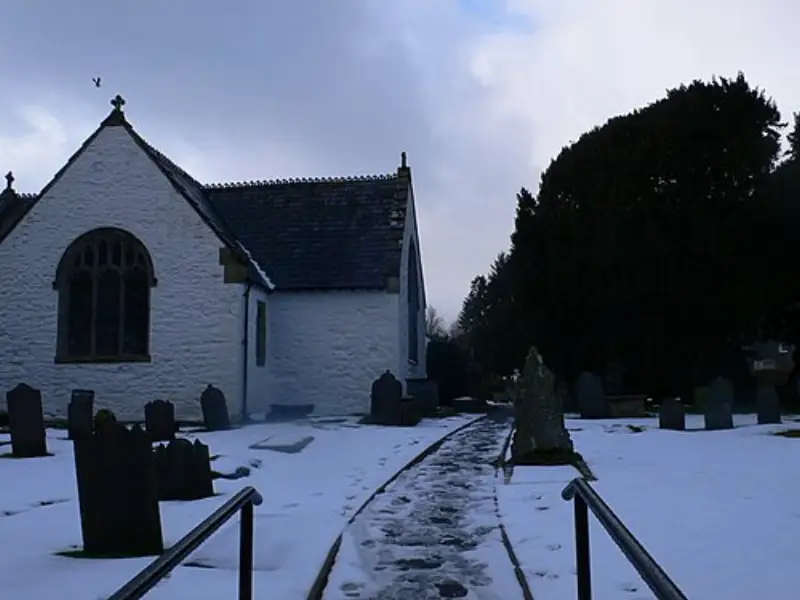
Tradition holds that Digain founded the church that bears his name at Llangernyw, a place-name meaning 'the church of the Cornishman', in the county of Conwy in Wales. The dedication preserves in a single word the story of its founder: a saint from the old kingdom of Dumnonia, on the Cornish side of the Severn, remembered in a Welsh valley by the people who took him for their own. Its site was chosen beside a yew already ancient, the celebrated Llangernyw yew, one of the venerable trees of Britain, so that the foundations of Digain's church stand in the shade of a living thing far older than any kingdom. St Digain's Church remains the chief monument of his cult. His sainthood was of the kind the early Church called a confession: he was a confessor, one of remarkable virtue who confessed the faith through writings and preachings, distinguished from the martyrs not by the lesser worth of his witness but by its peaceful form. His feast day is 21 November, and he is honoured in the Roman Catholic Church and the Eastern Orthodox Church alike, a faint but enduring trace of the princely saints of fifth-century Britain.
§ Sainthood
The Record
- Major works
- St Digain's Church, Llangernyw
- Canonization
- Pre-congregation confessor; honoured in the Roman Catholic and Eastern Orthodox churches
Prayer
Bibliography
Show 2 sources
- "Eastern Conwy Churches Survey: Church of St Digain, Llangernyw". Archived 10 December 2010 at the Wayback Machine. Retrieved on 2008-02-25.
- Bunson, Matthew, Stephen & Margaret. Our Sunday Visitor's Encyclopedia of Saints. Our Sunday Visitor, 1998. ISBN 0879735880, p. 249.
Profile text adapted from the Wikipedia article, licensed CC BY-SA 4.0.
Pray with this saint every day
Save St. Digain to your favorites, read the full profile, and get feast-day reminders in the Saints app.
Get the Saints AppFree on the App Store for iPhone and iPad