
died between 298 and 311·Feast August 16
St. Diomedes of Tarsus
Physician martyr among the Holy Unmercenaries
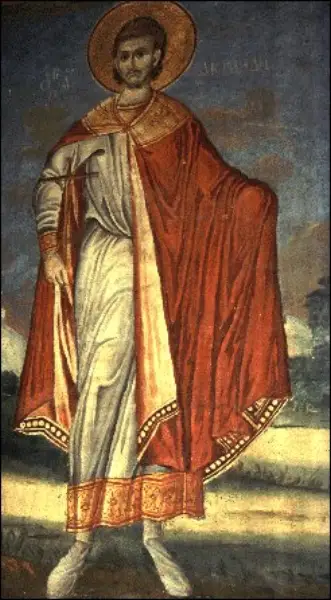
Overview
Diomedes of Tarsus, also called Diomede, is venerated as a Greek Christian saint and martyr and belongs to the ranks of the Holy Unmercenaries, the saints who healed without payment. He was born at Tarsus in Cilicia, in what is now the Mersin Province of Turkey, and practised medicine as his profession while pursuing a second and more arduous calling as a zealous Christian evangelist. He travelled a great deal, preaching the faith in the cities of Asia Minor in the era of the last persecutions. His journey ended at Nicaea, where the emperor Diocletian ordered his arrest. On the road toward Nicomedia, between his place of seizure and the capital of the persecution, Diomedes paused to pray and died there, so that the soldiers escorting him carried his severed head onward as proof that the celebrated physician had been taken. A later source recounts that when the head was brought before the emperor, all present were blinded, and their sight returned only after the body had been given back and prayer had been offered. He is honoured on 16 August by the Roman Catholic and Eastern Orthodox churches, a fresco of him adorns the monastery of Hilandar on Mount Athos, and his name travels as far as the Bering Strait, where the Diomede Islands preserve his memory.
The Complete Life
The Physician Who Preached
Diomedes united in one life the two healing callings of the early church: medicine practiced with skill and the gospel preached without fear. He was born at Tarsus, the Cilician city that had already given the church its greatest missionary, and there he trained as a physician. Among the Christians of his era such a profession carried a special ideal, embodied in the company of saints called the Holy Unmercenaries, healers who took no fee for their art and whose cures were understood as works of charity done for Christ; Diomedes is venerated as one of them. But his ambition outran the boundaries of a single practice. He is described as a zealous Christian evangelist, and he travelled a good deal, carrying his preaching from place to place through the towns of Asia Minor in the closing decades of the third century, the very years in which the emperor Diocletian was preparing the final assault on the church. Every stop on his medical rounds was also a mission. The combination made him conspicuous: a celebrated doctor whose cures drew crowds and whose words drew converts was precisely the sort of Christian the imperial government wished to silence when the persecution came.
§ Life
Arrest at Nicaea and Death on the Road
The travelling physician's road ended at Nicaea, the city of Bithynia where Diocletian himself resided in the years of the persecution. When Diomedes arrived there, the emperor ordered his arrest. Under escort toward Nicomedia, the administrative capital where condemned Christians were to be dealt with, the martyr came to a halt along the way, paused to pray, and died. The manner of his end, dying in prayer on the road rather than under the executioner's hand, gave his captors an awkward task: the soldiers took his head and carried it onward as proof that the celebrated Christian of Tarsus had truly been seized. A later source preserves a miraculous sequel: when the head was brought into the emperor's presence, all who saw it were blinded, and their sight was restored only after the saint's body had been returned and the company had prayed. Whatever weight one gives that tradition, the church retained the essential memory: the healer who had raised others died quietly himself, commending his spirit to God between the place of his arrest and the place of judgment, sometime in the years between 298 and 311.
§ Life
From Mount Athos to the Bering Strait
Diomedes is commemorated on 16 August in the Roman Catholic and Eastern Orthodox churches, and his cult has travelled remarkably far for a martyr whose acts are so briefly recorded. At the monastery of Hilandar on Mount Athos, the heart of Orthodox monasticism, a fresco of the saint Physician of Tarsus looks down from the church wall, keeping his image before the monks. The most distant monument to his memory lies at the opposite end of the world: the Diomede Islands in the Bering Strait, between Siberia and Alaska, take their name from this saint, because Vitus Bering sighted them on 16 August 1728, the very day on which the Russian Orthodox Church celebrated the memory of Saint Diomedes within the feast of the Saviour, and so named the islands for him. The church also knows another saint of the same name, a second Diomedes celebrated on 2 September, who with Julian, Philip, Theodore, Eutychian, Hesychius, Leonides, Philadelphus, Menalippus, and Pantagapes suffered martyrdom by burning, drowning, beheading, or crucifixion at an unknown date and site. The two must not be confused: the physician of Tarsus remains the better known, his feast fixed in the height of summer and his name fixed on the map of the Pacific.
§ Named after him
Timeline
- 298
Arrested at Nicaea on Diocletian's orders, he died in prayer on the road to Nicomedia sometime between 298 and 311, and the soldiers took his head as proof of capture.
§ Life
- 16 Aug 1728
Vitus Bering sighted and named the Diomede Islands on the feast day of Saint Diomedes.
§ Named after him
In Their Own Words
It is said that when his head was taken to the emperor, that all were blinded, and only after his body has been returned and they had prayed, was their sight restored.
The Record
- Patron of
- one of the Holy Unmercenaries, the saints who healed without seeking payment
- Canonization
- Pre-congregation martyr, venerated in the Roman Catholic and Eastern Orthodox churches from the earliest centuries
Prayer
Bibliography
Show 2 sources
- "Orthodox Saints and Feasts: The Holy Unmercenaries"
- "Martyr Diomedes the Physician of Tarsus, in Cilicia". oca.org. Orthodox Church in America
Profile text adapted from the Wikipedia article, licensed CC BY-SA 4.0.
Pray with this saint every day
Save St. Diomedes of Tarsus to your favorites, read the full profile, and get feast-day reminders in the Saints app.
Get the Saints AppFree on the App Store for iPhone and iPad