
died c. 360·Feast May 25
St. Dionysius of Milan
Exiled bishop who defended Nicaea at Milan
Overview
Dionysius occupied the bishopric of Milan between 349 and 355, dying in exile about the year 360, one of the Italian prelates who paid for their fidelity to the Creed of Nicaea under the Arian-leaning emperor Constantius II. Probably of Greek origin and a friend of the emperor before his election, he led the church of Milan in the decade when the clash between Arians and Nicene Christians reached its crisis in the West. In 355, at Pope Liberius's request, Constantius summoned a synod at Milan in the newly built Basilica Nova, intending it to settle the quarrel; instead the overwhelming Arian majority turned it into a tribunal against Athanasius of Alexandria. When Eusebius of Vercelli arrived and demanded that all bishops subscribe immediately to the Nicene faith, Dionysius joined him and the papal legate Lucifer of Cagliari in signing the act of faith, while the Arian bishop Valens violently shredded the document. The emperor, unaccustomed to independence from his bishops, transferred the council to his own palace and treated the three signatories harshly; Dionysius was exiled to Caesarea in Cappadocia, and the Arian Auxentius was installed in his place at Milan. He died in exile between 360 and 362. His relics were in Milan by 744, were translated to the Cathedral in 1532, and he is venerated on 25 May.
The Complete Life
Before the Episcopal Throne
Almost nothing is known about Dionysius before his election to the see of Milan, an obscurity that makes his later stand the more striking. The sources record that he was probably of Greek origin, a detail that places him among the eastern-born clergy and intellectuals who moved through the fourth-century church, and that before his elevation he enjoyed the friendship of the emperor Constantius II himself. That friendship makes the rest of his story remarkable: the emperor whose favour he possessed was an adherent of Semi-Arian doctrines, sympathetic to the party that wished to dilute the Nicene confession, and most bishops found the temptation to accommodate irresistible. Dionysius was elected bishop of Milan in 349, succeeding Eustorgius I in one of the most important sees of the Latin West, the city where the imperial court resided during these years. The historical moment could hardly have been more charged: the church was rent by the clash between the Arians and the supporters of the faith defined at Nicaea, and the bishop of the emperor's own city stood where the two parties met. Nothing else of his family, formation, or early career survives in the records.
§ Life
Bishop of the Imperial City
Dionysius governed Milan from 349 to 355, six years that spanned the decisive confrontation between the imperial court and the Nicene faith in the West. Milan was no ordinary diocese: the emperor often resided there, and the bishop of Milan preached within earshot of the court whose theological preferences shaped episcopal careers across the empire. Dionysius at first seemed ready to go along: when Pope Liberius persuaded Constantius to convene a synod at Milan in 355, held in the newly erected Basilica Nova, and the assembly moved to condemn Athanasius of Alexandria, not for heresy but for alleged lese-majesty against the emperor, Dionysius appeared prepared to join the Arian majority. The arrival of Eusebius of Vercelli, the great confessor of the Nicene cause whose enforced absence the council's managers had arranged, changed everything. Eusebius refused to discuss anything but the faith and demanded that the bishops subscribe immediately to the Creed of Nicaea. Dionysius chose that moment to reveal where he stood: together with Eusebius and the papal legate Lucifer of Cagliari he signed the act of faith, while the Arian bishop Valens of Mursia violently shredded the document in their presence. The signature divided the council and sealed the bishop's fate.
§ Life
The Synod of Milan and the Shredded Creed
The synod of 355 was meant by Pope Liberius to reconcile the warring parties of the church, but it failed every hope invested in it. The Arian bishops were present in overwhelming numbers, the one bishop whose testimony might have turned the assembly, Eusebius of Vercelli, was kept away until the Arian case seemed secure, and the accused, Athanasius of Alexandria, was charged not with doctrinal error but with an offence against the emperor. Into this managed proceeding Eusebius introduced an unmanageable demand: that the council subscribe at once to the Nicene faith before any other business. Dionysius, the local bishop whose cathedral hosted the gathering, joined the demand, signing alongside Eusebius and Lucifer of Cagliari. The gesture was public, dramatic, and irreversible. Constantius II, a ruler unaccustomed to independence on the part of bishops, responded by moving the synod to his palace, where he could supervise its conclusions, and by grievously maltreating the three signatories. All three were exiled; Pope Liberius himself was banished shortly afterward. Dionysius was sent to Caesarea of Cappadocia, far from his Milanese flock, and the emperor installed the Arian Auxentius in his place as bishop of Milan. The see of Ambrose's future was thus seized for the Arian cause, and its lawful bishop began his last journey eastward.
§ Life
Exile in Cappadocia and Death
Dionysius spent his final years in exile at Caesarea of Cappadocia, the metropolitan city of that eastern province and a place where other banished churchmen had been confined before him. He never returned to Milan. He died in exile between the years 360 and 362, while Auxentius occupied his see and the Arian party governed the church of the imperial city. A late and historically unfounded tradition sought to attach to him the Milanese family of the Mariani, one of those genealogical embellishments that gathered around the tombs of the saints, but of his actual circumstances in Cappadocia the sources say nothing: no letters, no acts of endurance, no companions are recorded. What the church remembered was simpler and sufficient, that the bishop who had signed the creed under the emperor's eyes kept it to the end, far from his church, and died without recanting. In this he shared the fate of Eusebius of Vercelli and Lucifer of Cagliari, his fellow signatories, and of Pope Liberius, and the company of Western bishops broken by Constantius for the sake of Nicaea. His death in the East left his body in foreign ground, awaiting the day when Milan would ask for its bishop back.
§ Life
A Saint of the Ancient Church
Dionysius is honoured as a saint in both the Catholic Church and the Eastern Orthodox churches, his cult resting on the ancient veneration of a confessor who suffered for the faith rather than on any formal process. His feast is celebrated on 25 May, and the Greek Synaxaristes commemorates the holy Dionysius, bishop of Milan, on the same day. The character of his sanctity was fixed by the events of 355: he belongs to the ranks of episcopal confessors of the Nicene faith, those bishops who accepted exile, imprisonment, or death rather than subscribe to the formulations of the Arian party, a company that in his own generation included Eusebius of Vercelli, Lucifer of Cagliari, and Hosius of Corduba. The church of Milan, which had seen him sign the act of faith in his own basilica and had then watched the emperor install a stranger in his place, kept his memory with special devotion. The reverence was not confined to Milan: the Eastern churches, whose synods and calendar preserved the memory of the Nicene struggle, enrolled him among the saints of 25 May, and his cult has continued in both communions without interruption since late antiquity.
§ Veneration
Relics and Remembrance in Milan
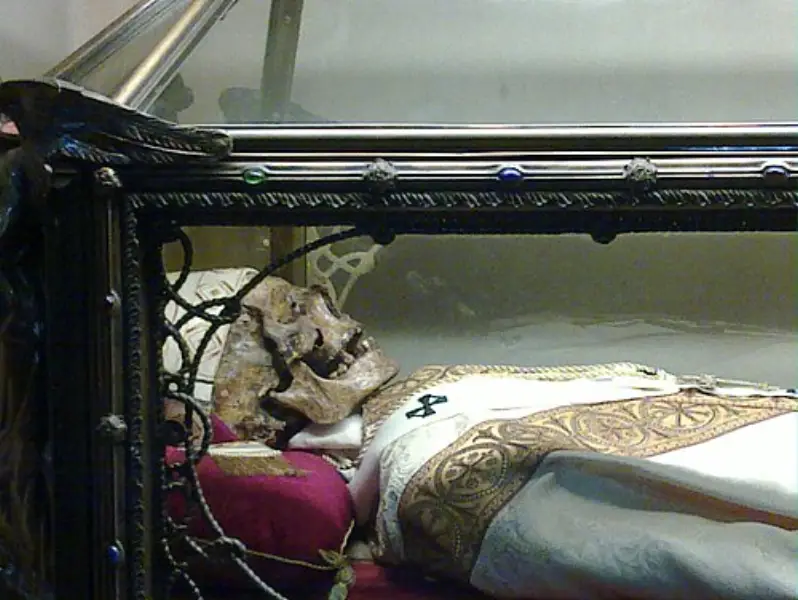
The bodily legacy of Dionysius traces a long journey home. Late tradition, almost certainly unhistorical, holds that Ambrose dispatched envoys around 375-376 to recover the body of his exiled predecessor and translate it to Milan; even if the detail cannot be verified, a primary source establishes that the relics of Dionysius were already in Milan by the year 744. A shrine in his honour rose beside Porta Venezia, was levelled in 1549, replaced on a nearby site, and at last torn down in 1783 to open space for new gardens. In 1532 the body of the saint had been translated into the Cathedral of Milan, where a relic of Saint Dionysius remains venerated today. His cult has also taken root in the parochial life of the region: three parishes in Lombardy are dedicated to Saint Dionysius, namely San Dionigi in Pratocentenaro in Milan, San Dionigi in Premana, and San Dionigi in Carcano of Albavilla. In the historical memory of Milan he stands in the line of its bishops between Eustorgius I and the intruder Auxentius, the lawful pastor whose throne was seized and whose return was achieved only through his relics, the confessor-bishop whose fidelity prepared the ground on which Ambrose would later build.
§ Veneration
Timeline
- 349
Elected bishop of Milan, succeeding Eustorgius I.
§ Life
- 355
Pope Liberius asked Emperor Constantius II to convene a synod at Milan, held in the newly erected Basilica Nova.
§ Life
- 355
Signed the act of Nicaean faith with Eusebius of Vercelli and Lucifer of Cagliari after the Arian bishop Valens shredded the document.
§ Life
- 355
Exiled to Caesarea of Cappadocia on the emperor's order and replaced at Milan by the Arian Auxentius.
§ Life
- 360
Died in exile at Caesarea, between 360 and 362 according to the sources.
§ Life
- 376
By late tradition, Ambrose sent a delegation around 375-376 to recover Dionysius's body and translate it to Milan.
§ Veneration
- 744
A primary source records that the relics of Dionysius were already in Milan by this year.
§ Veneration
- 1532
The body of Dionysius was translated into the Cathedral of Milan.
§ Veneration
- 1549
A shrine dedicated to Dionysius near Porta Venezia in Milan was destroyed; it was later rebuilt nearby.
§ Veneration
- 1783
The rebuilt shrine near Porta Venezia was definitively demolished to make room for new gardens.
§ Veneration
The Record
- Canonization
- Pre-congregation; honoured as a saint in the Catholic and Eastern Orthodox churches, with his feast on 25 May
Prayer
Bibliography
Show 5 sources
- Cazzani, Eugenio. Vescovi e arcivescovi di Milano. Massimo, Milano, 1996. pp. 16–17
- Ruggeri, Fausto (1991). I Vescovi di Milano. Milano: NED. pp. 10–11
- Tolfo, Maria Grazia. "San Dionigi". Storia di Milano. Retrieved 10 October 2011
- Pasini, Cesare (1988). "Dionigi, santo (sec. IV)". Dizionario della Chiesa Ambrosiana. Vol. 2. Milano: NED. pp. 1054–1055
- Great Synaxaristes: Ὁ Ἅγιος Διονύσιος Ἐπίσκοπος Μιλάνου. 25 Μαΐου. ΜΕΓΑΣ ΣΥΝΑΞΑΡΙΣΤΗΣ
Profile text adapted from the Wikipedia article, licensed CC BY-SA 4.0.
Pray with this saint every day
Save St. Dionysius of Milan to your favorites, read the full profile, and get feast-day reminders in the Saints app.
Get the Saints AppFree on the App Store for iPhone and iPad