
c. 190 – 264·Feast April 8 (13 Paremhat in the Coptic tradition)
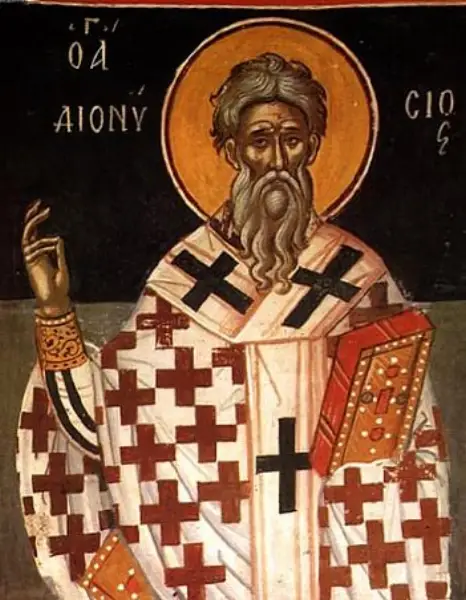
St. Dionysius of Alexandria
Bishop, Administrator and Scholar of Third-Century Alexandria
Overview
Dionysius the Great led the church of Alexandria as its fourteenth pope and patriarch, holding the throne of St. Mark from 28 December 248 to 22 March 264. A native of the city, born about 190 to a wealthy polytheist family, he converted to Christianity as a young man after a vision he understood as a command to study and refute the heresies confronting the early Christians. He joined the Catechetical School of Alexandria, studied under Origen and Pope Heraclas, and eventually directed the school before succeeding Heraclas on the apostolic throne of St. Mark. His patriarchate spanned the darkest crises of the third-century Church: the mob violence of 249 in Alexandria, the Decian persecution, which drove him into hiding and then exile in the Libyan desert, the Novatian controversy over the lapsed, the Plague of Cyprian, in which he and his clergy nursed the sick and dying, and renewed persecution under Valerian, which cost him imprisonment and exile. He championed mercy for those who had fallen away, supported Pope Cornelius against Novatian, and defended the autonomy of the African churches. Eusebius and Basil of Caesarea called him 'the Great', and the Catholic Encyclopedia ranked him, after Cyprian of Carthage, first among the bishops of his century, and judged him a master of church governance rather than a pioneering thinker.
The Complete Life
Early Life and Conversion
Dionysius was born around the year 190 in Alexandria, the intellectual capital of Roman Egypt, into a family that was wealthy and polytheist. As a youth he devoted himself to reading and made a careful study of the traditions of the pagans among whom he had been raised. His turn to Christianity came at a comparatively young age and, by his own later account, through a vision from God commanding him to master and refute the errors then unsettling the Christian communities. That commissioning set the pattern of his whole life: he would be a reader, an examiner and a defender of the faith. After his conversion he entered the Catechetical School of Alexandria, the great center of Christian learning in the ancient world, where he sat under two of its most famous masters, Origen and Pope Heraclas. In time he rose to lead the school himself and to serve as a presbyter of the church, succeeding Heraclas as its head in 231. When Heraclas died in 248, Dionysius was chosen to fill his place, and was enthroned on 28 December 248 as pope of Alexandria, patriarch of the church founded by Mark the Evangelist.
§ Early life
Vocation as Pope of Alexandria
Dionysius proved a more able administrator than a speculative theologian, though his pen was never idle. Our knowledge of his episcopate comes largely from the large body of correspondence he carried on with bishops and clergymen across the third-century Church, of which only one complete letter survives; the rest are preserved as excerpts in the pages of Eusebius. Those letters included interpretations of the Gospel of Luke, the Gospel of John and the Book of Revelation, showing a bishop who combined pastoral governance with scriptural teaching. He inherited the throne of St. Mark at the moment the empire's old order was breaking against the Church. Within a year of his consecration, Alexandria exploded into anti-Christian violence, and the imperial persecutions that followed would twice drive him from his city. Through those years he exercised the office of a shepherd in its most demanding form: keeping contact with his scattered clergy, adjudicating disputes of discipline and doctrine that reached from Rome to Africa, and holding the greatest see of the East steady amid collapse. It was for this steadiness that his contemporaries honored him, and that Eusebius, Basil of Caesarea and later historians of the Church gave him the surname 'the Great'.
§ Life as Pope of Alexandria
Persecution, Plague and Mercy
In 249 a polytheist mob loosed a major persecution on Alexandria, and hundreds of Christians, refusing to renounce their faith, were stoned, burned, hacked down or beaten. Dionysius survived that outbreak and the civil war that followed. In January 250 the new emperor Decius decreed legal persecution; terrified Christians offered token sacrifices, bought false certificates, or fled into the desert, where most perished of exposure, hunger, thirst or violence. The prefect Aurelius Appius Sabinus marked the bishop himself for death, sending an assassin with orders to kill him on sight. Dionysius stayed hidden three days, then escaped on the fourth night with his servants and loyal brethren, slipped through a detachment of soldiers with two companions, and sheltered in the Libyan Desert until the persecution ended the next year. When the Novatian schism broke over the treatment of those who had lapsed, he stood with Pope Cornelius and commanded that no one asking for the Eucharist at the approach of death, not even a penitent who had apostatized, should go away without it. In 252, when the Plague of Cyprian struck Alexandria, he and his clergy tended the sick and dying. Under Valerian the persecutions returned, and he suffered imprisonment and exile; Gallienus's accession brought release, and the emperor's letter guaranteed the bishops their safety and their churches.
§ Life as Pope of Alexandria
Spirituality
The spirituality that emerges from Dionysius's letters is one of reading, discernment and mercy. His conversion had come through a vision commanding him to master the errors of the age, and he carried that charge into practice: in his letter to Philemon he admitted that he read heretical writings so as to refute them, recounting the divine assurance that he could judge and examine every matter rightly. He approached Scripture as the church's daily bread, expounding Luke, John and Revelation for his correspondents. Yet his holiness showed itself most clearly in crisis. He did not seek martyrdom recklessly, but neither did he abandon his post, hiding in Alexandria while the assassin searched and only then withdrawing to the desert in obedience to necessity rather than fear. Against the rigorism of Novatian he insisted that the sacrament of reconciliation had no closing hour, commanding that even the lapsed be given the Eucharist at the hour of death. When plague emptied the streets of helpers, he placed himself and his clergy among the dying. In the dispute between Pope Stephen and Cyprian he supported Stephen's position while defending the autonomy of the African churches, a temper of firmness without domination that became his mark.
§ Life as Pope of Alexandria
Final Years
The last years of Dionysius's patriarchate were years of restoration after Valerian's persecution. When Gallienus took over the empire he freed the believers held in prison and recalled those in exile, and he wrote a personal letter to Dionysius and the other bishops ensuring their safety and their right to reopen their churches, an imperial act of toleration that allowed the battered Alexandrian church to reassemble. During these same years Dionysius was drawn into the wider controversies of the Latin Church: in the dispute between Pope Stephen and Cyprian of Carthage over rebaptism and church discipline he supported Stephen's position, while upholding the autonomy of the African churches against centralizing pressure. He died on 22 March 264, after more than fifteen years on the throne of St. Mark, and was buried in the Church of the Cave at Alexandria, where his memory was kept by the church he had led through fire. He was succeeded as patriarch by Maximus. Most of what is known of him still comes from his letters, gathered and excerpted by Eusebius of Caesarea, who judged his episcopate worthy of the name 'Great'.
§ Life as Pope of Alexandria
Veneration
Dionysius was never formally canonized by any modern process; his cult arose in the ancient Church, and he is honored as a saint by pre-congregation acclamation in the three great communions that trace their faith to the early centuries: Catholicism, Eastern Orthodoxy and Oriental Orthodoxy. The Coptic Church, which counts him as the fourteenth pope of Alexandria, keeps his feast on 13 Paremhat, while the Roman Martyrology assigns his memory to 8 April. His tomb in the Church of the Cave at Alexandria was a place of local veneration from his death. He belongs to the ranks of the Church Fathers whom the Catholic Church venerates as saints, listed among the bishops and doctors of the third century whose writings and sufferings carried the faith through the age of persecutions. Later centuries continued to invoke his witness: Eusebius of Caesarea and Basil of Caesarea already spoke of him as 'Dionysius the Great', and the tradition he left behind, of a scholar-bishop who could read everything and fear nothing, became part of his enduring cult.
§ Introduction
Legacy
Dionysius left a double legacy: a corpus of letters that is one of the chief sources for the history of the third-century Church, and a reputation for administrative genius. Called 'the Great' by Eusebius and Basil of Caesarea, he was judged by the Catholic Encyclopedia to stand after Cyprian himself as the foremost bishop of the 200s, and, like Cyprian, to have been a ruler of genius rather than an original thinker. His intervention in the Novatian controversy helped set the Church's merciful course toward the repentant lapsed, and his mediation in the dispute between Pope Stephen and Cyprian preserved peace between Rome and the African churches. His memory crossed confessional and cultural boundaries: Basil of Caesarea wrote to Pope Damasus I of the aid Dionysius had sent to the church at Caesarea, a correspondence that Pope Pius IX would cite in his 1847 encyclical Praedecessores Nostros on aid for Ireland. English literature remembers him too, for John Milton in Areopagitica of 1644 turned to Dionysius's letter to Philemon, with its vision licensing the reading of every book, as an argument for the liberty of the press. His letters are still edited, translated and studied by historians of the ancient Church.
§ Legacy
Timeline
- 190
Born into a wealthy polytheist family in Alexandria, Roman Egypt
§ Early life
- 231
Succeeds Heraclas as leader of the Catechetical School and becomes a presbyter of the church
§ Early life
- 28 Dec 248
Succeeds Heraclas as Pope of Alexandria and Patriarch of the See of St. Mark
§ Early life
- 249
Survives a polytheist mob's persecution of Christians in Alexandria, in which hundreds are assaulted or killed
§ Life as Pope of Alexandria
- Jan 250
Decius issues a decree of legal persecution; Dionysius hides from Sabinus, then escapes to the Libyan Desert
§ Life as Pope of Alexandria
- 251
Supports Pope Cornelius against Novatian and orders the Eucharist refused to no one at the hour of death
§ Life as Pope of Alexandria
- 252
Ministers to the sick and dying with his clergy during the outbreak of the Plague of Cyprian in Alexandria
§ Life as Pope of Alexandria
- 22 Mar 264
Dies on this date after leading the church of Alexandria for about fifteen years, and is buried in the Church of the Cave
§ Introduction
In Their Own Words
Read any books what ever come to thy hands, for thou art sufficient both to judge aright, and to examine each matter.
The Record
- Major works
- Extensive correspondence with third-century bishops and clergy, preserved mainly in Eusebius·Interpretations on the Gospel of Luke, the Gospel of John and the Book of Revelation
- Patron of
- Invoked against heresy and for those wavering in faith
- Symbols
- Patriarchal vestments·Book of letters·Pallium of the See of St. Mark
- Canonization
- Pre-congregation; venerated in Catholicism, Eastern Orthodoxy and Oriental Orthodoxy
Prayer
Bibliography
Show 6 sources
- Chapman, John. "Dionysius of Alexandria." The Catholic Encyclopedia. Vol. 5. New York: Robert Appleton Company, 1909.
- Kiefer, James E., "Dionysius of Alexandria, Bishop and Scholar", Biographical sketches of memorable Christians of the past
- Butler, Alban. Lives of the Saints, Vol. XI, 1866
- Pope Pius IX, Praedecessores Nostros, 25 March 1847
- "Saint Dionysius of Alexandria | Christian theologian | Britannica". www.britannica.com.
- "Areopagitica: Text". The John Milton Reading Room.
Profile text adapted from the Wikipedia article, licensed CC BY-SA 4.0.
Pray with this saint every day
Save St. Dionysius of Alexandria to your favorites, read the full profile, and get feast-day reminders in the Saints app.
Get the Saints AppFree on the App Store for iPhone and iPad