
early–mid 2nd century; flourished c. 171·Feast April 8
St. Dionysius of Corinth
Bishop and Letter-Writer of the Early Greek Church
Overview
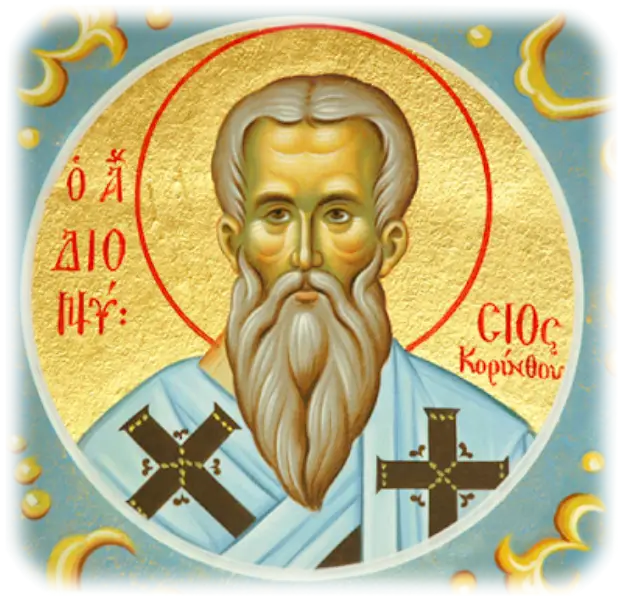
Dionysius of Corinth was bishop of the Greek city of Corinth around AD 171, during the reign of Marcus Aurelius. He is known to history only through Eusebius of Caesarea, who preserved accounts of his correspondence and placed his period of activity in the eleventh year of that emperor's reign. Eusebius knew a collection of seven Catholic letters Dionysius addressed to the churches of his day, together with a reply from Pinytus, bishop of Knossos, and a private letter of spiritual advice written to a Christian lady named Chrysophora. These letters taught orthodoxy, urged peace and union among the churches, warned against the distortions of heretics such as Marcion, and commended gentle treatment of those who had fallen into sin or error. His most important letter was the seventh, addressed to the Romans, in which he thanked Pope Soter for alms sent to Corinth and testified that Peter and Paul had both planted the faith at Corinth and been martyred together in Italy. In that letter he records that the Corinthians read Rome's letter on the Lord's day alongside the one they had received through Clement generations before, precious evidence for the early exchange of letters between apostolic churches. He died at Corinth in Achaia, and his feast is kept on April 8.
The Complete Life
Bishop of an Apostolic Church
Dionysius shepherded the church of Corinth, one of the great apostolic foundations of Greece, planted by Paul himself a century before. His dates are fixed indirectly: Hegesippus found Primus governing the Corinthian church around 150-155, and Bacchylus held the see during the Paschal controversy about 190-198, so Dionysius's episcopate of about 171 falls between them. Eusebius anchored his period of activity precisely in the eleventh year of Marcus Aurelius, and the surest mark of that dating is his correspondence with Pope Soter of Rome. His Church honors him as a bishop and confessor, and though he suffered no recorded martyrdom, the title reflects the endurance demanded of a Greek bishop in the age of Marcus Aurelius, when persecutions claimed bishops like Publius of Athens. Of his own life before the episcopate nothing survives; he enters history already in office, pen in hand, the visible link between the Corinthian church of the second century and the wider communion of churches stretching from Rome to Pontus and Crete.
§ Date
The Seven Letters
Dionysius exercised his episcopate chiefly through correspondence, and Eusebius knew a collection of seven Catholic letters from his hand. To the Lacedaemonians he wrote teaching orthodoxy and enjoining peace and union. To the Athenians he sent a stirring exhortation to live according to the Gospel, for he judged them in danger of apostasy, consoling them over their bishop Publius, lately put to death in the persecution under Marcus Aurelius and recalling that Dionysius the Areopagite had been the first bishop of their city. To the Nicomedians he wrote against Marcionism, defending the Church against the great heresy of his age. To Gortyna and the other dioceses of Crete he gave praise to their bishop Philip for his labors on the church's behalf, coupled with a warning against the distortions of heretics. To the church of Amastris in Pontus, writing at the request of Bacchylides and Elpistus, he addressed the bishop Palmas on marriage and celibacy and urged kindly handling of those who had slipped away into sin or error. To Pinytus of Knossus he suggested that the yoke of celibacy not be laid too heavily on the brethren, and Pinytus courteously replied, hoping the bishop would send his people stronger meat next time.
§ Date
Spirituality
The spirituality of Dionysius shines through the themes his letters returned to again and again: orthodoxy held with charity, union among the churches, and gentleness toward the fallen. He enjoined peace and union on the Lacedaemonians, stirred up the faith of the wavering Athenians, and recommended that those who had lapsed into sin or heresy be treated charitably rather than cast off. On marriage and celibacy his counsel was pastoral, urging that bodily discipline not be imposed beyond the strength of the brethren, a temperateness that drew from Pinytus of Knossus the respectful rejoinder that strong meat might now be given to those who had grown up on milk. He also practiced a spirituality of the written word: his private letter of spiritual advice to the lady Chrysophora shows a bishop who attended to the souls of individuals, not only of congregations. His letter to the Romans reveals a man of eucharistic gratitude, who kept the holy Lord's day with his people, heard Rome's letter read among them, and treasured it alongside the letter the Corinthians had received through Clement generations before, so that the communion of churches became for him a form of prayer.
§ Date
Legacy
Dionysius's chief legacy is documentary: through his letters the second-century Church speaks in its own voice. The seventh letter, to the Romans, is the only one from which extracts were preserved, and they have proved invaluable. In them Dionysius praises the ancient custom of the Roman church, which from the beginning did good to all the brethren and sent alms to many churches, relieving the poor and assisting the brethren in the mines, a custom Pope Soter maintained and increased, comforting visiting brethren like a father his children. He testifies that Peter and Paul, the planting of both Romans and Corinthians, taught alike in Corinth and alike were martyred at the same time in Italy, one of the earliest witnesses to their joint Roman martyrdom. And he records that the Corinthians read Soter's letter on the Lord's day together with the earlier one through Clement, early evidence for the public reading of episcopal letters in Christian worship. The whole corpus came down to Eusebius, who drew on it for his Historia Ecclesiastica; without that transmission Dionysius would be only a name between Primus and Bacchylides on the episcopal list. He is venerated in the Catholic and Eastern Orthodox Churches, with his feast on April 8.
§ Introduction
Timeline
- 150
Hegesippus, visiting Corinth in Pope Anicetus's time, finds Primus occupying its episcopal throne
§ Date
- 171
Eusebius's Chronicle places his floruit in the eleventh year of Emperor Marcus Aurelius, as bishop of Corinth
§ Date
- 171
Writes to Pope Soter, thanking the Romans for the alms and letter their bishop had sent to the Corinthians
§ Date
- 171
Composes letters to the churches of Lacedaemon, Athens, Nicomedia, Gortyna, Amastris and to Bishop Pinytus of Knossos
§ Date
- 190
Bacchylus now holds the Corinthian see amid the Paschal controversy of these years
§ Date
In Their Own Words
For this has been your custom from the beginning, to do good to all the brethren in many ways, and to send alms to many Churches in different cities, now relieving the poverty of those who asked aid, now assisting the brethren in the mines by the alms you send, Romans keeping up the traditional custom of Romans, which your blessed bishop, Soter, has not only maintained, but has even increased, by affording to the brethren the abundance which he has supplied, and by comforting with blessed words the brethren who came to him, as a father his children.
Today we have kept the holy Lord's day, on which we have read your letter, which we shall ever possess to read and to be admonished, even as the former one written to us through Clement.
The Record
- Major works
- Seven Catholic letters to the churches, known to Eusebius·Letter to the Romans (to Pope Soter), the only one from which extracts survive·Letter to the Athenians recording the martyrdom of Bishop Publius·Letter to the Nicomedians against Marcionism·Private letter of spiritual advice to Chrysophora
- Canonization
- Pre-congregation; venerated as a bishop and confessor in the Catholic and Eastern Orthodox Churches
Prayer
Bibliography
Show 3 sources
- Chapman, John. "St. Dionysius." The Catholic Encyclopedia Vol. 5. New York: Robert Appleton Company, 1909.
- Urdang, Laurence. Holidays and Anniversaries of the World. Detroit: Gale Research Company, 1985. ISBN 0-8103-1546-7.
- Herbermann, Charles, ed. (1913). "St. Dionysius". Catholic Encyclopedia. New York: Robert Appleton Company.
Profile text adapted from the Wikipedia article, licensed CC BY-SA 4.0.
Pray with this saint every day
Save St. Dionysius of Corinth to your favorites, read the full profile, and get feast-day reminders in the Saints app.
Get the Saints AppFree on the App Store for iPhone and iPad