
1st century AD·Feast October 3 (October 9 in the Church of England)
St. Dionysius the Areopagite
Athenian Judge, Convert of Paul and Bishop of Athens
Overview
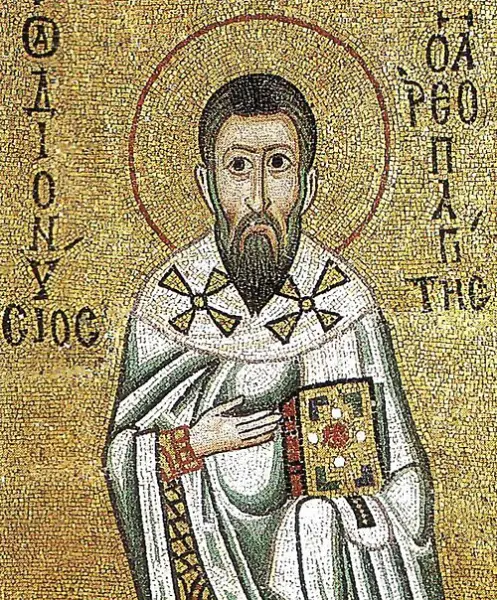
Dionysius the Areopagite was an Athenian judge who sat on the Areopagus, the noble court of Athens, in the first century. According to the Acts of the Apostles, he heard Paul the Apostle preach on the Areopagus about the unknown God, and he was among those who clave unto him and believed, together with a woman named Damaris. After his conversion he became the first Bishop of Athens, though some traditions count him the second, after Hierotheus. Venerated as a hieromartyr, he is honored by Catholics, Eastern Orthodox and Oriental Orthodox Christians alike, and he is the patron saint of Athens and the protector of judges and the judiciary, with his memory kept on October 3. His name became attached to one of the most consequential bodies of Christian writing ever produced: the Corpus Dionysiacum, four philosophical-theological treatises that transformed Neoplatonic categories into Christian mystical thought. Cited as apostolic authority from the sixth century onward and embraced across East and West, the corpus shaped centuries of theology and mysticism before Renaissance humanists, and finally the scholars Koch and Stiglmayr in 1895, demonstrated that it was written by a later, anonymous author now called Pseudo-Dionysius. The judge of Athens remains, nonetheless, a saint in his own right.
The Complete Life
A Judge Hears Paul
Dionysius belonged to the elite of first-century Athens: he was a member of the Areopagus, the venerable court that governed the city's religious and moral life from its rock beneath the Acropolis. In that capacity he was present, perhaps officially, when Paul the Apostle stood before the council and proclaimed the God whom the Athenians worshipped in ignorance, 'him I declare unto you'. The Acts of the Apostles records the outcome soberly: certain men clave unto Paul and believed, among them Dionysius the Areopagite and a woman named Damaris. For a judge of the Areopagus, conversion was no small step; it meant aligning himself with a persecuted eastern sect whose founder had been executed as a criminal, in a city still proud of its pagan philosophy and its ancient temples. Yet something in Paul's preaching reached him, and he traded his seat among the judges of Athens for the service of a faith the court had merely examined. The early Church remembered the decision well: Eusebius, writing his history of the Church, counted Dionysius among the distinguished converts of the apostolic age, and later tradition would place him, fittingly, in the episcopal chair of his own city.
§ Life
First Bishop of Athens
Once converted, Dionysius took up the episcopate as Athens' first bishop, shepherding the community born from Paul's Athenian preaching, though some traditions count him the second bishop, following Hierotheus. The Church came to venerate him as a hieromartyr, a bishop who won the martyr's crown, and his martyrdom was painted in the eleventh-century Menologion of Basil II among the great feasts of the liturgical year. From Athens his cult spread across the whole Christian world: he is venerated by the Catholic Church, the Eastern Orthodox Church and the Oriental Orthodox Churches. In the city of his birth his memory remains everywhere visible. Two large churches bear his name, one in the Kolonaki quarter on Skoufa Street and the other the Catholic Metropolis of Athens on Panepistimiou Street, and the pedestrian way that circles the Acropolis, passing directly beneath the rock of the Areios Pagos where he first heard the gospel, is named for him. His patronage reaches far beyond Greece, to Crotone in Italy, to Jerez de la Frontera and Ojén in Spain, to the Gargaliani of Messenia, and to the Cretan village of Dionysi, named for him and unique on Crete with a church in his honor.
§ Life
The Name That Launched a Mysticism
Paradoxically, the greatest spiritual influence bearing Dionysius's name was not written by him. By the early sixth century a collection of four philosophical-theological treatises, the Corpus Dionysiacum, which recast the categories of Neoplatonism into the shapes of Christian mysticism, was beginning to be cited and attributed to him by nearly all parties in the Christian East, Chalcedonians, Miaphysites and Nestorians alike. Hypatius of Ephesus objected that genuinely apostolic writings would have been known to the Fathers, but the corpus prevailed, consolidated by the notes of John of Scythopolis and the endorsement of Maximus the Confessor, and was cited as apostolic authority at the Lateran Synod of 649, Constantinople III and Nicaea II. Through the Middle Ages it nourished theologians from John of Damascus to Hugh of Saint Victor, and it ranked among the most frequently cited authorities for Thomas Aquinas in the West and Gregory Palamas in the East. Evelyn Underhill judged its influence second only to Augustine's, noting that in the fourteenth century the phrase 'Dionysius saith' carried weight like Scripture itself. Whatever the truth of the attribution, the name of the Athenian judge became inseparable from the summit of Christian mystical theology.
§ Reception of the Corpus Dionysiacum
Tradition, Martyrdom and Memory
The tradition of the Church holds that Dionysius died a martyr, and the iconography of the East shows him vested as a bishop, holding a Gospel Book, the emblem of the teaching he sealed with his blood. A ninth-century confusion, however, entangled his memory with another saint: Hilduin of Paris, in his Passio S. Dionysii, identified the Areopagite with Dionysius of Paris, the martyred third-century bishop of France, an identification that readers of his own day generally refused and that modern scholarship has set aside entirely. The literary question of his name was settled much later. Renaissance humanists Lorenzo Valla and Erasmus, and the reformer Martin Luther, first challenged the authenticity of the Corpus Dionysiacum, and in 1895 Hugo Koch and Joseph Stiglmayr demonstrated that it depended on the fifth-century Neoplatonist Proclus, fixing its composition in the fifth or sixth century; the modern consensus attributes the works to the anonymous author called Pseudo-Dionysius. Some religious writers, among them the Romanian theologian Dumitru Stăniloae and translator John Parker, have defended an early date, arguing from the corpus's self-identification as the work of Paul's disciple. The debate concerns the writings; the judge of Athens himself stands secure in the Acts of the Apostles and the universal calendar of the saints.
§ Scholarly overview
Veneration
Dionysius the Areopagite was never canonized by a formal process; he belongs to the saints of the apostolic age honored from the earliest centuries by the whole Church. He is venerated in the Catholic Church, the Eastern Orthodox Church and the Oriental Orthodox Churches, and in the East he bears the title of hieromartyr, bishop and martyr. His principal feast is kept on October 3, while the Armenian Apostolic Church commemorates him on the Thursday after the fifth Sunday after the feast of the Holy Cross, and the Church of England keeps October 9 under the 1662 Book of Common Prayer. As patron saint of Athens he is protector of judges and the judiciary, a patronage that honors his earthly profession as much as his episcopal office; his feast is celebrated with civic festivity in the Gargaliani of Messenia and in the village of Dionysi in the prefecture of Heraklion, Crete. His icon shows him vested as a bishop holding the Gospel Book, and his mosaic looks down from the monastery of Hosios Loukas. Few converts of the apostolic age are remembered so widely, in so many communions, across so many centuries.
§ Introduction
Legacy
Dionysius's legacy is double: the witness of his own life, and the vast literature that carries his name. As the recorded convert of Paul's Athenian sermon he remains, with Damaris, the face of the gospel's first success among the philosophers of Greece, and as first Bishop of Athens he stands at the head of one of the oldest episcopal lines in Christendom, remembered by Eusebius and by every later historian of the apostolic Church. As a literary patron he became, for nearly a millennium, the supreme authority of Christian mysticism: the corpus attributed to him was cited at great councils, glossed by Maximus the Confessor, quarried by Aquinas and Palamas, and translated into an influence that Evelyn Underhill placed second only to Augustine's. Even after the demonstration in 1895 that the treatises belong to a later anonymous author, the Areopagite's name remained fixed to the tradition of apophatic theology, hierarchy and divine darkness that the pseudonym carried. In Athens his memory is carved into the streets themselves, in the churches of Kolonaki and Panepistimiou and in the walkway beneath the Areopagus rock, where the judge who once weighed Paul's words is remembered by every pilgrim who walks the Dionysiou Areopagitou.
§ Modern references and legacy
Timeline
- 1
Lives in the first century as an Athenian judge sitting on the Areopagus court.
§ Introduction
- 1
Through Paul's preaching at the Areopagus he comes to faith in Christ, joining Damaris and other new believers.
§ Life
- 1
Becomes the first Bishop of Athens, though some traditions count him the second, after Hierotheus.
§ Life
- 532
Followers of Severus of Antioch cite the Corpus Dionysiacum; Hypatius of Ephesus rejects its authenticity
§ Reception of the Corpus Dionysiacum
- 649
The Lateran Synod cites the Dionysian writings as apostolic authority in doctrinal debate
§ Reception of the Corpus Dionysiacum
- 680
The Council of Constantinople III invokes the Dionysian writings as apostolic authority
§ Reception of the Corpus Dionysiacum
- 787
The Second Council of Nicaea invokes the corpus in support of iconography, Mariology and Christology
§ Reception of the Corpus Dionysiacum
- 800
In the ninth century Hilduin's Passio S. Dionysii mistakenly identifies him with the martyred bishop Dionysius of Paris.
§ Reception of the Corpus Dionysiacum
- 1895
Hugo Koch and Joseph Stiglmayr demonstrate the corpus depends on Proclus, dating it to the fifth or sixth century
§ Scholarly overview
In Their Own Words
Howbeit certain men clave unto him, and believed: among the which was Dionysius the Areopagite, and a woman named Damaris , and others with them.
Second only to that of St. Augustine was the influence exercised by the strange and nameless writer who chose to ascribe his works to Dionysius the Areopagite [...] From the ninth century to the seventeenth these writings nourished the most spiritual intuitions of men, and possessed an authority which it is now hard to realize.
The Record
- Patron of
- Athens (patron saint)·Protector of judges and the judiciary·Crotone·Jerez de la Frontera·Ojén·Gargaliani of Messenia·The village of Dionysi, Heraklion, Crete
- Symbols
- Vested as a bishop, holding a Gospel Book·Palm of martyrdom
- Canonization
- Pre-congregation; venerated as a hieromartyr in the Catholic, Eastern Orthodox and Oriental Orthodox Churches
Prayer
Bibliography
Show 11 sources
- "Dionysius The Areopagite". Encyclopedia Britannica.
- Eusebius, Historia Ecclesiae III: iv.
- Suchla, B. R. (2022). The Dionysian Corpus. In M. Edwards, D. Pallis, & G. Bechtle (Eds.), The Oxford Handbook of Dionysius the Areopagite. Oxford University Press.
- Rorem, Paul; Lamoreaux, John C. (1998). John of Scythopolis and the Dionysian Corpus: Annotating the Areopagite. Clarendon Press. ISBN 978-0-19-826970-0.
- Louth, Andrew (2001). Dionysius the Areopagite. Continuum. pp. 1-14. ISBN 978-0826457721.
- Koch, Hugo (1895). "Proklus als Quelle des Pseudo-Dionysius Areopagita in der Lehre vom Bösen". Philologus. 54: 438-454.
- Stiglmayr, Josef (1895). "Der Neuplatoniker Proklos als Vorlage des sog. Dionysius Areopagita in der Lehre vom Übel". Historisches Jahrbuch. 16: 253-273, 721-748.
- Wear, S. (2024). Pseudo-Dionysius the Areopagite. In The Stanford Encyclopedia of Philosophy (Spring 2024 Edition). Stanford University.
- Underhill, Evelyn (1930). "Historical Sketch of Mysticism". Mysticism: A Study in the Nature and Development of Man's Spiritual Consciousness (12th ed.). Methuen & Co. pp. 456-457.
- Parker, J. (1897). Dionysius the Areopagite, works (pp. 6-7, 123-126).
- "Hieromartyr Dionysius of Paris, Bishop". Orthodox Church in America (2015).
Profile text adapted from the Wikipedia article, licensed CC BY-SA 4.0.
Pray with this saint every day
Save St. Dionysius the Areopagite to your favorites, read the full profile, and get feast-day reminders in the Saints app.
Get the Saints AppFree on the App Store for iPhone and iPad