
1858 – 1934·Feast February 23
St. Dionysius Vattasseril
The Great Luminary of the Malankara Church
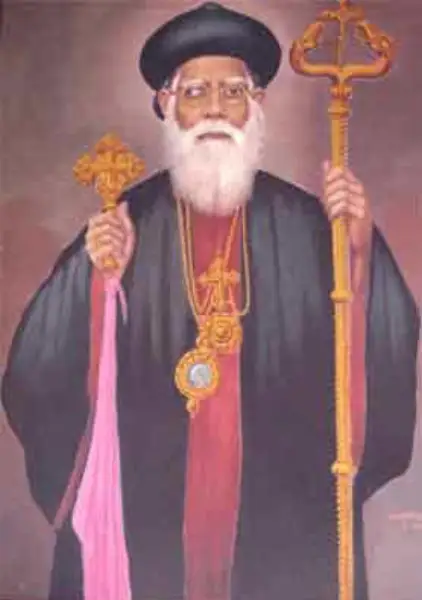
Overview
Geevarghese Dionysius of Vattasseril, often called Dionysius VI or simply Vattasseril Thirumeni, served the Malankara Church as its fifteenth Malankara Metropolitan from 1909 until his death in 1934. Born into a devout family of Mallappally in Kerala, he rose from sub-deacon to priest and scholar under the tutelage of St. Gregorios of Parumala, becoming a renowned authority on the Syriac language, canon law, patristics and doctrine. As a teacher he trained generations of clergy at the Old Seminary in Kottayam, translated the liturgy into Malayalam, and wrote Doctrines of the Church, still a standard exposition of Orthodox teaching. Consecrated bishop in Jerusalem in 1908, he led his Church through a painful division between the Metropolitan and Patriarch factions, defended its independence, and helped elevate its primate to the rank of Catholicos of the East. In his final year he prepared the draft from which the Church Constitution of 1934 was formed. Anchored in prayer, fasting and constant reading of Scripture, he was honored by his Church with the title 'The Great Luminary of Malankara'. He died in Kottayam on 23 February 1934 and was canonized in 2003, the second saint the Malankara Orthodox Syrian Church has raised from India.
The Complete Life
Early Life
Geevarghese was born on 31 October 1858 into the Vattasseril family of Mallappally, in what is now Kerala, India. He was the fifth child of Joseph Vattasseril and Aleyamma of the Kolathu Kalathil house of Kurichy, and grew up in a household already marked by clerical service, since his brother Ouseph Punnoose would also become a priest. His schooling began at the C. M. S. Middle School in Mallappally, and he completed his secondary education at the C. M. S. High School in Kottayam, institutions of the Anglican mission that nonetheless shaped many young men of the Malankara Church. While he was still a high school student, his gifts were recognized by the highest authority of his Church: on 12 October 1876, Patriarch Ignatius Peter III of Antioch ordained the boy a sub-deacon at Puthuppally St. George Church. From those beginnings in a riverside village of central Travancore came the man who would one day govern the whole Malankara Church, though nothing in his outward circumstances suggested so wide a horizon. What his early years did establish were habits of disciplined study and patient obedience, the quiet foundations on which his later scholarship and leadership would rest.
§ Early life and education
Vocation and Formation
After school, Geevarghese spent four years studying at the Orthodox Theological Seminary in Kottayam, the institution later generations would call the Old Seminary. He served as secretary to Gregorios Geevarghese of Parumala, and under that saint's careful instruction at Parumala Seminary he became a distinguished scholar of Syriac. He deepened his theological and linguistic formation further with Metropolitan Baselios Paulose I at the Monastery of Saint Thomas in Vettikkal. The sequence of his ordinations followed quickly: made a full deacon on 16 October 1879, he was raised to the priesthood on 18 January 1880 by St. Gregorios himself, and according to the tradition of the time he was ordained for service at Parumala Seminary, where for a period he oversaw the theological education of the students. His mastery soon extended across Syriac, the canons of the Church, church history, faith and doctrine, the Fathers, patristics and theology, and in recognition of it he received the designation Malankara Malpaan, doctor and teacher of the Church. In 1887 he was appointed Syriac teacher at the Old Seminary, working alongside the eminent scholar Fr. Mathen Malpan of Konat, and in 1895 he accompanied his mentor Gregorios on pilgrimage to the Holy Land.
§ Life in the Church
Teacher, Scholar and Bishop
The middle decades of his life joined scholarship to administration. In his free hours he read, studied and wrote: he edited and published the order of Church worship so that the laity could take part intelligently in the services, produced a textbook called Syriac - Chapter I for students of the language, and composed Doctrines of the Church, a work that endures as one of the most authoritative and popular accounts of Orthodox dogma and ecclesiastical tradition, explained thoroughly from Scripture. In 1903, with the blessing of the Church authorities, he rendered the Holy Service book from Syriac into Malayalam and saw it through the press, opening the liturgy more fully to Malayalam-speaking worshippers. In 1896 the Managing Committee of the Church named him Principal of M. D. Seminary School in Kottayam, a post he held for eight years while continuing to teach at the Old Seminary. Leadership of a different kind followed: the Malankara Association at Parumala nominated him for the episcopate in December 1902, he was blessed a Ramban in November 1903, and in 1908, after an arduous two-week journey to Jerusalem during the Great Lent, Patriarch Ignatius Abded Aloho II consecrated him a metropolitan at Sehion House, the traditional site of the Last Supper, with representatives of the Coptic and Greek Orthodox Churches present. The next year he became Malankara Metropolitan.
§ Bishopric
Spirituality
Those who knew Dionysius testified that his public achievement grew out of hidden discipline. He was an outstanding orator who understood the vitality and persuasive power of the Bible when he preached to the faithful, but the eloquence of the pulpit was fed by hours of private prayer. Alongside the liturgical hours of the Church he kept long seasons of silent meditation behind closed doors, and however crowded his calendar became with administration and controversy he always found time for three to four lessons from Holy Scripture each day. Prayer and fasting, his biographers note, were the twin pillars of his spiritual life. Yet his sanctity was never withdrawn: he combined these ascetic habits with a strong, at times commanding, charisma and a distinctly progressive mind, so that contemporaries experienced him both as a man of contemplation and as a decisive leader. The Malankara Orthodox Church came to regard him as a living saint of his own generation, and it was this union of scholarship, courage and hidden holiness that his colleagues remembered when, laying him to rest, Baselios Geevarghese II compared him to Mar Aprem, the great doctor of the East, and called him a confessor who had suffered for the Church.
§ Legacy
Final Years
As Metropolitan, Dionysius guided the Malankara Church through the gravest institutional crisis in its modern history. From the early 1910s the Church split into two parties: the Metropolitan faction, loyal to Dionysius and later known as the Malankara Orthodox Church, and a rival faction loyal to the Patriarch of Antioch, which chose Coorilos Paulose of Panampady as its own metropolitan. With the help of Patriarch Ignatius Abdul Masih II and his own profound command of the canons, Dionysius drafted a constitution for the Church, and he and his fellow clergy played a central part in raising the primate of Malankara to the title of Catholicos of the East, thereby securing the sovereignty and independence of India's St. Thomas Christians. The quarrel with the Jacobite faction was never healed in his lifetime, but he pressed on. In February 1934 his strength failed: he fell ill on the 13th, suffered paralysis on the 16th, and received the anointing of the sick from Baselios Geevarghese II on the 21st. He died on 23 February 1934, aged seventy-five, and was buried the next day in the Chapel of the Old Seminary at Kottayam, beside the tombs of his predecessors, his final encyclical having commended the Catholicate to the care of his people.
§ Death
Canonization
The Church exalted Dionysius as a saint and confessor of the faith. On 24 February 2003, the sixty-ninth feast day observance of his death, the Episcopal Synod of the Malankara Orthodox Church, headed by Baselios Mar Thoma Mathews II, Catholicos of the East and Malankara Metropolitan, formally canonized him. The honor had been anticipated decades earlier: Baselios Geevarghese II, who buried him, had ordered the words 'The time will not dim his glory' to be engraved on his tomb, and history bore the judgment out. His feast is kept on 23 February, the anniversary of his death. With his canonization he became the second Indian saint raised by the Malankara Orthodox Syrian Church, following St. Gregorios of Parumala, his own teacher and mentor in the faith. His principal shrine is the Old Seminary at Kottayam, where his tomb lies in the chapel among his predecessors, and pilgrims continue to seek his intercession there, honoring the bishop whom the Church styles Malankara Sabha Bhasuran, the Great Luminary of Malankara.
§ Canonization
Legacy
Dionysius left his Church institutions, writings and an enduring memory. The constitution he drafted, completed after his death as the Church Constitution of 1934, still frames the governance of the Malankara Orthodox Syrian Church, and the Catholicate he defended remains the symbol of its autonomy. His Doctrines of the Church continues to teach Orthodox dogma to new generations, and his liturgical translations remain part of his gift to Malayalam-speaking worshippers. His memory has spread far beyond Kerala: churches honor him at Perukavu in Trivandrum, in Al Ain in the United Arab Emirates, in Dammam in Saudi Arabia's Eastern Province under the Thrissur diocese, in Auckland, New Zealand, at Dasarahalli in Bangalore, and in a chapel at Aravali near Gurugram, while the Dionysius Senior Secondary School in Mallappally keeps his name among the children of his home village. The M. G. D. Ashram founded at Panayampala in 1980 took him as its patron and has cared for an orphanage, the Balabhavan, since 2000. Biographies in Malayalam and English, from V. C. Samuel's Truth Triumphs to later Malankara studies, preserve the story of the metropolitan whom his Church remembers as a living saint.
§ Churches, monasteries and orphanages
Timeline
- 31 Oct 1858
Born Geevarghese, fifth child of Joseph Vattasseril and Aleyamma, at Mallappally, Kerala
§ Early life and education
- 12 Oct 1876
Ordained sub-deacon by Patriarch Ignatius Peter III at Puthuppally St. George Church while still a schoolboy
§ Early life and education
- 16 Oct 1879
Ordained full deacon after four years of study at the Orthodox Theological Seminary, Kottayam
§ Life in the Church
- 18 Jan 1880
Ordained priest by St. Gregorios of Parumala and placed in charge of theological education at Parumala Seminary
§ Life in the Church
- 1887
Appointed Syriac teacher at the Old Seminary, having been designated Malankara Malpaan
§ Malankara Malpan
- 1895
Accompanies St. Gregorios on pilgrimage to the Holy Land with Paulose Ramban
§ Life in the Church
- 1896
Named Principal of M. D. Seminary School, Kottayam, serving for eight years
§ Principal of M. D. Seminary School
- 2 Dec 1902
Nominated to the office of Metropolitan Bishop by the Malankara Association meeting at Parumala Seminary
§ Bishopric
- 1903
Publishes his Malayalam translation of the Holy Service book from Syriac
§ Malankara Malpan
- 2 Nov 1903
Professed as a Ramban at Parumala on the feast of St. Gregorios, blessed by Dionysius V.
§ Bishopric
- 14 Feb 1908
Formally elected by the Malankara Association, with Kochuparampil Paulose Ramban, for consecration as Metropolitan
§ Bishopric
- 31 May 1908
Consecrated metropolitan by Patriarch Ignatius Abded Aloho II at Sehion House in Jerusalem, after a Lenten journey there
§ Bishopric
- 1909
Becomes Malankara Metropolitan after nearly a year as assistant to Dionysius V
§ Bishopric
- 26 Nov 1911
Elected by the Malankara Association at the Old Seminary as successor to Malankara Metropolitan Dionysius V
§ Malankara Metropolitan
- 1912
Assumes full office as Malankara Metropolitan following the death of Dionysius V
§ Malankara Metropolitan
- 23 Feb 1934
Dies at Kottayam after paralysis; his draft shapes the Church Constitution of 1934
§ Death
- 24 Feb 2003
Canonized by the Episcopal Synod of the Malankara Orthodox Church headed by Baselios Mar Thoma Mathews II
§ Canonization
In Their Own Words
And I commit in each of you the responsibility to upkeep that institution which most of you along with myself truly believe to be indispensable for the survival, prosperity and progress of our Church, and which has been till now painstakingly guarded by all of us, namely the Catholicate.
The Record
- Major works
- Doctrines of the Church (Mathopadeshasarangal)·Syriac - Chapter I·Malayalam translation of the Holy Service book (1903)·First draft of the Church Constitution of the Malankara Orthodox Syrian Church
- Patron of
- The Malankara Orthodox Syrian Church·M. G. D. Ashram, Panayampala, Kerala
- Symbols
- Bishop's staff and cross·Books of doctrine and Syriac liturgy·Portrait titled 'The Great Luminary of Malankara Church'
- Canonization
- Canonized 24 February 2003 by the Episcopal Synod of the Malankara Orthodox Church, headed by Baselios Mar Thoma Mathews II
Prayer
Bibliography
Show 5 sources
- Samuel, Rev. Dr. V. C. (1986). Truth Triumphs: Life and Achievements of Metropolitan Mar Dionysius VI. M. O. C. Publishers, Kottayam, India.
- Cheeran, Rev. Dr. Joseph; Kottackal, K. V. Mammen; Pulikkottil, Adv. P. C. Mathew (February 2002) [2001]. Vattasseril Thirumeni: The Fortress of Malankara Church (Biography) (in Malayalam) (3rd ed.). Kottackal Publishers, Manganam, Kerala.
- Kochukoshy I. A. S., C. K. (February 2011) [1994]. The Saint with Exemplary Courage (in Malayalam) (2nd ed.). St. Dionysius Foundation, Kottayam, Kerala.
- Paret, Z. M. (1965). Mar Dionyisus Vattasseril. Malankara Nasraani (in Malayalam). J. M. Chemmarappally, Kottayam.
- Varghese, Alexander P. (2008). India: History, Religion, Vision and Contribution to the World. Atlantic Publishers & Dist. pp. 364-368. ISBN 978-81-269-0903-2.
Profile text adapted from the Wikipedia article, licensed CC BY-SA 4.0.
Pray with this saint every day
Save St. Dionysius Vattasseril to your favorites, read the full profile, and get feast-day reminders in the Saints app.
Get the Saints AppFree on the App Store for iPhone and iPad