
1350 – 1389·Feast May 19
St. Dmitry Donskoy
Right-Believing Prince and Victor of Kulikovo
Overview
Dmitry Ivanovich Donskoy, born in Moscow on 12 October 1350, reigned as Prince of Moscow from 1359 and as Grand Prince of Vladimir from 1362, holding both thrones until 1389. Orphaned of his father Ivan II at the age of nine, he grew to manhood under the guidance of Metropolitan Alexius, who made the fortunes of the Russian Orthodox Church and of Moscow one cause and effectively governed during his minority. Dmitry was the first prince of Moscow to challenge Mongol authority openly. After decades spent securing his position against the claims of Suzdal and Tver and rebuilding the Moscow Kremlin in stone, he refused tribute to the Horde's strongman Mamai from 1374. His army destroyed a Mongol force at the Vozha River in 1378, and on the Kulikovo field in 1380, after receiving the blessing of Sergius of Radonezh, he won the first great Russian victory over the Tatars, a triumph on the Don River that gave him the name Donskoy. Tokhtamysh sacked Moscow in 1382 and reasserted Mongol overlordship, yet Moscow's prestige among the Russian principalities had been permanently raised. By his death on 19 May 1389 Dmitry had welded the thrones of Moscow and of Vladimir into one and was the first grand prince to pass his titles to his son Vasily I without seeking the Khan's consent. Russian historiography honors him as a national hero, and the Russian Orthodox Church canonized him in 1988.
The Complete Life
An Orphan Prince in a Turbulent Age
Dmitry Ivanovich came into the world at Moscow on 12 October 1350, firstborn son of Ivan II of Moscow by his second wife Alexandra Velyaminova, daughter of the city's tysyatsky or military commander. His childhood ended early. Ivan died on 13 November 1359, and Dmitry succeeded to the principality at nine years old. During his minority real power lay with his father's advisers, led by the boy's own grandfather Vasily Velyaminov, while Metropolitan Alexius supervised both his upbringing and education and wielded decisive influence in the government. It was Alexius above all who taught the young prince to see the fortunes of Moscow and of the Russian Orthodox Church as one cause. The wider world offered the boy no security. The assassination of Khan Berdi Beg in 1359 had pitched the Golden Horde into civil turmoil, and in 1360 the Grand Principality of Vladimir, heretofore held by Dmitry's predecessors, was handed by the khan Nawruz Beg to Dmitry Konstantinovich of Suzdal, while Novgorod invited the same rival to reign in their city. Out of these unpromising beginnings — a child on the throne of Moscow, a divided Horde, and a rival at Vladimir — the future victor of Kulikovo learned the statecraft that would let him turn each of these dangers to Moscow's advantage within a decade.
§ Early life
Securing the Grand Principality
Dmitry's first task was to recover what turmoil had lost. In 1362 he secured from one of the rival khans, Murad, the patent to the throne, and, joined by the Moscow boyars and his cousin Vladimir Andreyevich of Serpukhov drove Dmitry Konstantinovich out of Vladimir. Pressing on toward Suzdal, he forced his rival to abandon his claim, then turned rival into ally: from 1363 to 1365 he helped restore Dmitry Konstantinovich to the throne of Nizhny Novgorod against his brother Boris, and in January 1366 married the man's daughter Eudoxia, a union that secured a lasting peace between the houses. From the second half of the decade Dmitry pursued an increasingly independent policy. In 1367 Moscow's Kremlin rose anew in stone, its first rebuilding so, a decision that soon proved providential. When Mikhail Aleksandrovich of Tver, backed by Lithuanian power, mounted a direct challenge to Moscow's primacy, Lithuanian armies came to his aid but could not take the new stone walls. Dmitry invaded Tver in 1370 while the Lithuanians were engaged elsewhere; when Grand Duke Algirdas himself approached Moscow, Dmitry stood so well prepared that Algirdas proposed a truce and withdrew. Metropolitan Alexius negotiated peace with Lithuania, and by the treaty then concluded Algirdas acknowledged the grand principality to be Dmitry's patrimony, declining to recognize Mikhail's claim outright.
§ Struggle against Suzdal
The Challenge to the Horde and Kulikovo
Under Dmitry's thirty-year rule the Mongol dominion over Rus' began to fall apart. Torn by civil war, the Golden Horde and dynastic rivalry, had fallen under the power of Mamai, a general who established his own entity in its western half. After 1374 Dmitry refused to pay Mamai tribute, and when Mikhail of Tver obtained the khan's patent in 1375 Dmitry kept the loyalty of the other princes, defeated Mikhail's army, and by the treaty of 1 September 1375 bound him to aid against the Tatars. Dmitry judged a clash with Mamai inevitable, and it came. In 1378 the army Mamai sent to punish him was destroyed at the Battle of the Vozha River, the opening Russian triumph of arms against the Mongols. Two years later Mamai marched in person. Sergius of Radonezh blessed Dmitry for the campaign of Kulikovo — but only after satisfying himself that every peaceful means of resolution had been exhausted — and sent the warrior monks Alexander Peresvet and Oslyabya to fight alongside the Russian host. The battle opened with single combat: Peresvet and the Horde champion Temir-Murza killed each other in the first run, and Dmitry then defeated the Horde on the field by the Don. In gratitude he founded a monastery of the Dormition beside the Dubenka and built on the battlefield a church of the Nativity of the Holy Theotokos above the graves of the slain.
§ Struggle against the Golden Horde
Pious Prince of the Russian Church
Dmitry's reign cannot be separated from the Russian Orthodox Church, whose interests Metropolitan Alexius had deliberately bound to those of Moscow. Educated under Alexius's eye, Dmitry learned to treat the Church not merely as an ally but as the spiritual spine of his rule. The most famous episode of his religious life came on the eve of Kulikovo, when he sought out Sergius of Radonezh, the greatest spiritual father of the age. Sergius would bless the expedition only once assured that all peaceful means had been pursued, and then blessed it, dispatching the monks Peresvet and Oslyabya to bear arms beside the soldiers. The story, preserved in the frescoes of the Trinity-Sergius Lavra, made the victory a matter of blessing rather than mere arms. Dmitry's thanksgiving likewise took ecclesial form: he set up the Dormition monastery beside the Dubenka and reared a church honoring the Nativity of the Holy Theotokos above the graves of the warriors who fell there on the Kulikovo field, turning the battlefield's grief into intercession. At his death he was buried in the Cathedral of the Archangel in the Moscow Kremlin, the necropolis of Moscow's princes, where a fresco of the saint was later painted in the seventeenth century. This union of sword and sanctuary is why the Church numbers him among the right-believing princes.
§ Struggle against the Golden Horde
Tokhtamysh, Restoration, and Death
Kulikovo did not end the Mongol yoke in a day. Mamai, defeated, was presently dethroned by the rival general Tokhtamysh, who reasserted Mongol rule over Rus' and in 1382 overran Moscow in punishment for Dmitry's resistance to Mamai. The sack of the city was the price of the victory on the Don, yet it did not undo what Kulikovo had accomplished: Moscow's prestige among the Russian principalities had risen beyond recall. Dmitry, recognizing the balance of force, swore loyalty to Tokhtamysh and the Horde and was restored to his place as the Mongols' chief tax collector and as grand prince of Vladimir. His final years were spent not in new wars but in consolidating what he had won, strengthening his authority among the Russian princes until the thrones of Moscow and Vladimir were permanently united. In his family he was likewise a founder: by Eudoxia Dmitriyevna he had at least twelve children, among them his successor Vasily I, Yury of Zvenigorod, and Konstantin of Uglich and Pskov, several of whom carried his line through the princely houses of Russia. When he died in Moscow on 19 May 1389, aged thirty-eight, he did what no grand prince had done before: he bequeathed his titles to his son Vasily without consulting the Khan, leaving his heir a patrimony no horde could again divide.
§ Struggle against the Golden Horde
Canonization in the Age of the Millennium
Six centuries after his death, the Russian Orthodox Church raised Dmitry Donskoy to the calendar of saints. The canonization took place on 6 June 1988 at the Trinity Lavra of St. Sergius — the monastery of the saint whose blessing had once sealed his greatest victory — during the Local Council of the Russian Church gathered in 1988 under Patriarch Pimen of Moscow. That council, convened in the year of the thousandth anniversary of the Baptism of Rus', restored to veneration a company of holy princes and elders of whom Dmitry, styled Right-Believing Prince Demetrius Ioannovich Donskoy, was among the most emblematic. The Church honors him under the title of right-believing prince, the rank given to rulers whose governance of their lands was itself an act of Orthodox faith, following the pattern of figures such as Alexander Nevsky. His principal shrine is the Cathedral of the Archangel in the Moscow Kremlin, where his tomb lies among the princes of the old dynasty, and his iconographic attributes are the sword and helmet of the warrior sovereign who fought under a saint's blessing. His cult thus binds together the memory of Kulikovo, the monastery of Radonezh, and the revival of Russian Orthodox self-consciousness at the close of the twentieth century.
§ Veneration
National Hero of Medieval Russia
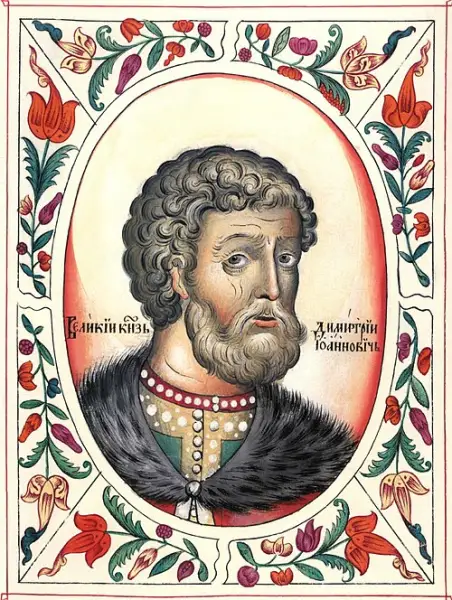
In Russian historiography Dmitry Donskoy stands in the historiography as a national hero, a commanding figure of the medieval age. His nickname, alluding to the Don, fixed in the language the memory of the victory that began the long unbinding of the Mongol yoke, and his reign is treated as the hinge on which the history of Muscovy turned: the child prince who inherited a contested throne left behind a united grand principality that passed intact to his heirs without the Khan's sanction. The artistic memory of his life is unusually rich. He appears in the seventeenth-century Tsarsky titulyarnik, in Adolphe Yvon's painting of the Battle of Kulikovo, in a First World War patriotic poster by Konstantin Korovin, on the Millennium of Russia monument in Veliky Novgorod, and in the Rublev-artel fresco of his blessing by Sergius of Radonezh at the Trinity-Sergius Lavra. Anton Rubinstein made him the subject of an opera in 1852. In the Church his memory is kept on 19 May, again with the Radonezh Synaxis on 6 July and with the Tula Synaxis on 22 September, while the Military Police of Russia have taken him as patron. Historians from Fennell to Crummey and Kuchkin continue to weigh his reign as the formative chapter in the formation of Muscovy.
§ Veneration
Timeline
- 12 Oct 1350
Dmitry Ivanovich came into the world at Moscow on 12 October, firstborn son of Ivan II and Alexandra Velyaminova.
§ Early life
- 13 Nov 1359
On 13 November Ivan II died, and Dmitry became Prince of Moscow at the age of nine, under Metropolitan Alexius's supervision.
§ Early life
- 1360
Amid turmoil in the Golden Horde, the Grand Principality of Vladimir was transferred to Dmitry Konstantinovich of Suzdal.
§ Struggle against Suzdal
- 1362
Dmitry received a patent from the khan Murad and drove Dmitry of Suzdal from Vladimir, becoming Grand Prince of Vladimir.
§ Struggle against Suzdal
- Jan 1366
In January Dmitry married Eudoxia, daughter of Dmitry of Suzdal, sealing a lasting peace between the two houses.
§ Struggle against Suzdal
- 1367
Moscow's Kremlin was rebuilt in stone, the first such rebuilding, as Dmitry pursued an independent policy.
§ Struggle against Suzdal
- 14 Dec 1371
On 14 December Muscovite forces defeated the army of Ryazan at the Battle of Skornishchevo.
§ Struggle against Tver
- 1374
Dmitry refused further tribute to Mamai, beginning a six-year stand-off with the Horde.
§ Struggle against Tver
- 1 Sep 1375
By the treaty of 1 September, Mikhail of Tver made peace and acknowledged Dmitry as his feudal superior.
§ Struggle against Tver
- 1378
Dmitry's forces destroyed the Mongol army sent by Mamai at the Battle of the Vozha River.
§ Struggle against the Golden Horde
- 1380
Blessed by Sergius of Radonezh, Dmitry defeated Mamai on the Kulikovo field beside the Don River.
§ Struggle against the Golden Horde
- 1382
Tokhtamysh overran Moscow in punishment for Dmitry's resistance; Dmitry pledged loyalty and was reinstated.
§ Struggle against the Golden Horde
- 19 May 1389
Dmitry died in Moscow on 19 May, first grand prince to hand his titles on to his son Vasily I without asking the Khan.
§ Struggle against the Golden Horde
- 6 Jun 1988
The Russian Orthodox Church canonized Dmitry as Right-Believing Prince on 6 June at the Trinity Lavra of St. Sergius.
§ Veneration
The Record
- Major works
- Reunification of the thrones of Moscow and Vladimir·Rebuilding of the Moscow Kremlin in stone (1367)·Founding of the Dormition monastery on the Dubenka River·Church of the Nativity of the Holy Theotokos over the fallen of Kulikovo
- Patron of
- Military Police of Russia·soldiers and defenders of Russia
- Symbols
- sword and helmet
- Canonization
- Canonized 6 June 1988 by the 1988 Local Council of the Russian Orthodox Church at the Trinity Lavra of St. Sergius, under Patriarch Pimen I of Moscow.
Prayer
Bibliography
Show 6 sources
- Crummey, Robert O. (2014) [1987]. The Formation of Muscovy 1300–1613. Routledge. ISBN 978-1-317-87200-9.
- Fennell, John L. I. (2014) [1995]. A History of the Russian Church to 1488. Routledge. ISBN 978-1-317-89720-0.
- Kuchkin, V. A. (2007). "Дмитрий Иванович Донской". Большая российская энциклопедия. Том 9. pp. 129–130. ISBN 978-5-85270-339-2.
- Kvlividze, N. V. (2007). "Димитрий Иоаннович". Православная энциклопедия. Т. XV. pp. 116–132. ISBN 978-5-89572-026-4.
- "Prince Dmitry Donskoy - Victor of the Battle of Kulikovo, who was the first to bring glory to Rus' and unite it". Presidential Library.
- Timofeychev, A. (2017-07-19). "The Battle of Kulikovo - When the Russian nation was born". Russia Beyond the Headlines. Retrieved 2020-01-29.
Profile text adapted from the Wikipedia article, licensed CC BY-SA 4.0.
Pray with this saint every day
Save St. Dmitry Donskoy to your favorites, read the full profile, and get feast-day reminders in the Saints app.
Get the Saints AppFree on the App Store for iPhone and iPad