
1582 – 1591·Feast May 15
St. Dmitry of Uglich
Slain Tsarevich and Wonderworker of Russia
Overview
Dmitry Ivanovich, born 29 October 1582 in Moscow, was the youngest son of Tsar Ivan the Terrible by his last wife Maria Nagaya, and through the nearly seven years of his half-brother Feodor's reign he stood as the tsarevich, the heir apparent of Russia. When Ivan died in 1584, the sickly Feodor I took the throne under a regency council that Boris Godunov came to head from 1586, and in that same year Dmitry, his mother, and her brothers were sent into internal exile at Uglich, the boy's appanage. There, on 15 May 1591, the eight-year-old tsarevich died under circumstances that have never been settled. The official inquiry under Vasily Shuisky concluded that he had cut his own throat in an epileptic fit while playing with a knife; popular opinion, stirred by his mother's family, blamed Boris Godunov, and a riot in Uglich lynched fifteen supposed assassins. When Feodor died childless in 1598 the Rurikid dynasty ended, and Godunov claimed the throne amid lingering suspicion. During the Time of Troubles, pretenders calling themselves the rescued Dmitry — False Dmitry foremost among them, sponsored by Polish nobles — destabilized the whole realm. In changed political circumstances Shuisky reversed his finding, declaring the boy murdered on Godunov's orders. Dmitry's remains were translated to Moscow on 3 June 1606, his cult flourished, and the Orthodox Church venerates him as a pious crown prince and wonderworker.
The Complete Life
The Last Son of Ivan the Terrible
Dmitry was born in Moscow on 29 October 1582, the youngest son of Ivan IV of Russia and the only child of that tsar's last marriage with Maria Nagaya. His birth placed him in a perilous position from the start: under Russian Orthodox canon law, which permits a maximum of three marriages, Ivan's union with Maria was of doubtful validity, so that Dmitry's legitimacy as an heir of the Rurikid line could be contested by the Church itself. Nonetheless, when Ivan the Terrible died in 1584 and was succeeded by his sickly and weak elder son Feodor I, the infant Dmitry stood as the only other male Rurikid and was regarded as tsarevich, the heir apparent, throughout Feodor's reign. Actual power rested with a regency council, with Boris Godunov, Feodor's brother-in-law and Malyuta Skuratov's son-in-law, at its head from 1586. That same year Godunov removed the potential rival from the capital: Dmitry, together with his mother and her brothers, was sent into internal exile at Uglich, the appanage town that gave the tsarevich the name by which history knows him. There the boy grew up under his mother's Nagaya kin, at a court that watched Moscow's politics with suspicion and where the child's very existence kept alive an alternative to Godunov's rising power.
§ Life
Death at Uglich and the Three Theories
On 15 May 1591 the eight-year-old tsarevich died at Uglich, and every account of his death has been contested ever since. The first theory, upheld by nineteenth-century historians such as Nikolai Karamzin, Sergei Soloviev, and Vasily Klyuchevsky, holds that Dmitry was killed by assassins sent on Boris Godunov's orders, the murder being staged as an accident; critics answer that Dmitry, as the son of Ivan's fourth marriage, was illegitimate under canon law and thus no real obstacle to Godunov, and modern scholars are inclined to acquit Boris of any part in the deed. The second theory, favored by Mikhail Pogodin, Sergei Platonov, Vladimir Klein, and Ruslan Skrynnikov, is that the boy had opened his own throat in an epileptic fit while toying with a knife; the official investigation of the time asserted that the seizure came while he played a svaika game or with a knife held by the blade, turned toward himself, which makes the self-inflicted wound while falling forward appear more likely — though detractors note that the open palms of an epileptic fit make such a wound unlikely. A third, older school — Konstantin Bestuzhev-Ryumin and Ivan Belyaev — suggested Godunov's men killed another child and Dmitry escaped, explaining the later impostors; most modern historians dismiss this, since the boy's face was surely known and many Polish nobles who backed False Dmitry I disbelieved their own candidate.
§ Death theories
Cult, Translation, and Veneration
The death of the tsarevich at once roused a violent riot in Uglich. Maria Nagaya and her brother Mikhail proclaimed aloud that Dmitry had been murdered, and enraged citizens lynched fifteen supposed assassins, among them the local representative of the Moscow government and one of Dmitry's playmates. The official inquiry, led by Vasily Shuisky, concluded after a thorough examination of witnesses that the boy had died of a self-inflicted wound, and Maria was made a nun by force and banished to a distant convent. Years later, when political circumstances had changed, Shuisky retracted that finding and asserted that Dmitry had been murdered on Boris Godunov's orders. On 3 June 1606 the tsarevich's remains were brought up from Uglich to Moscow, and devotion to him soon grew; he came to be venerated in the calendar of the Russian Orthodox Church as a Saint Pious Tsarevitch, remembered under the titles of Wonderworker, Slain Crown Prince, and Pious Crown Prince. His feast days are 19 October, 15 May, and 3 June, the last marking the translation of his relics. In Uglich the Church of St. Demetrius on Blood was raised on the site of his death, and in the twentieth century some Russian and Soviet historians returned greater credit to the conclusions of Shuisky's first investigation, which ruled the death an accident.
§ Aftermath
The Shadow over the Time of Troubles
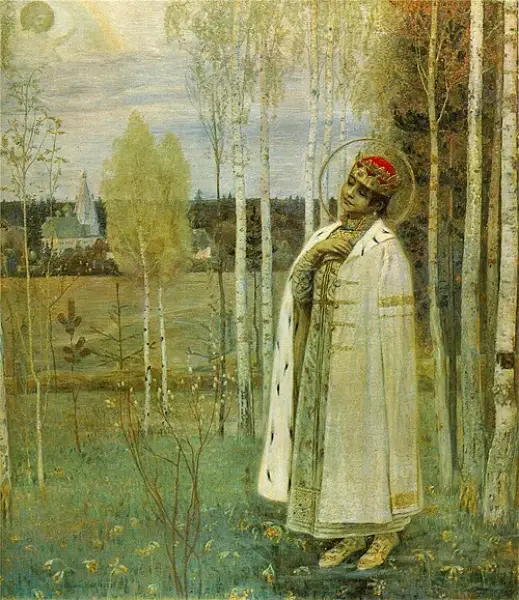
Dmitry's death proved a seed of catastrophe for Russia. Because the tsarevich died and Feodor remained childless, the ancient Rurikid dynasty ended with Feodor's death in 1598, and Boris Godunov claimed the throne under the permanent suspicion — widely believed at the time — that he had cleared his path by murder. From that suspicion flowed the most destabilizing phenomenon of the Time of Troubles: the impostors. Since a portion of the population was ready to believe that the rightful tsarevich had escaped his assassins, a series of pretenders arose claiming to be Dmitry, the first and most dangerous of them, False Dmitry I, sponsored by the Polish nobility and backed by forces that reached Moscow itself. The theory that the boy had survived found support among earlier historians precisely because it explained the pretenders, though most modern scholars consider survival improbable. The murder story entered Russian art at its highest level: Aleksandr Pushkin presumed it in his play Boris Godunov, which Modest Mussorgsky made into an opera that remains a monument of the national repertoire. Painters such as Pavel Pleshanov and Mikhail Nesterov depicted the tsarevich's death and figure, and the Church of St. Demetrius on Blood still stands at Uglich over the memory of 15 May 1591, keeping alive one of Russia's most haunting mysteries.
§ Cultural references
Timeline
- 29 Oct 1582
Dmitry was born in Moscow on 29 October, the only child of Ivan the Terrible and his last wife Maria Nagaya.
§ Life
- 1584
Ivan the Terrible died and Feodor I succeeded; Dmitry, his mother, and her brothers were exiled to Uglich.
§ Life
- 1586
Boris Godunov, Feodor's brother-in-law, became head of the regency council governing Russia.
§ Life
- 15 May 1591
On 15 May Dmitry died at Uglich under mysterious circumstances, aged eight; a riot followed his mother's murder claims.
§ Death theories
- 1598
Feodor I died childless; with Dmitry also dead, Boris Godunov claimed the throne.
§ Life
- 3 Jun 1606
On 3 June Dmitry's remains were carried up from Uglich to Moscow; his cult soon flowered.
§ Aftermath
The Record
- Patron of
- victims of political violence·the city of Uglich
- Symbols
- knife·the Church of St. Demetrius on Blood at Uglich
- Canonization
- Venerated by the Russian Orthodox Church as Saint Pious Tsarevitch; his cult developed after the translation of his remains to Moscow on 3 June 1606.
Prayer
Bibliography
Show 6 sources
- Ray, Michael. "Dmitry Ivanovich". Encyclopedia Britannica.
- Hahn, Gordon M. (2021). The Russian dilemma: security, vigilance and relations with the West from Ivan III to Putin. Jefferson. ISBN 978-1-4766-4434-9. OCLC 1289513805.
- Vernadsky, George (1954). The death of the Tsarevich Dimitry. Oxford University Press. ASIN B0007JWDNG.
- "RUSSIA...Dmitry on the Blood | Travel Blog". travelblog.org. Retrieved 15 October 2020.
- Sergey Platonov. Очерки по истории смуты в Московском государстве XVI-XVII вв. Moscow, 1937.
- Ruslan Skrynnikov. Лихолетье. Москва в XVI-XVII веках. Moscow, 1988.
Profile text adapted from the Wikipedia article, licensed CC BY-SA 4.0.
Pray with this saint every day
Save St. Dmitry of Uglich to your favorites, read the full profile, and get feast-day reminders in the Saints app.
Get the Saints AppFree on the App Store for iPhone and iPad