
5th century Wales·Feast July 13
St. Dogfan
Fifth-Century Welsh Martyr, Son of King Brychan
Overview
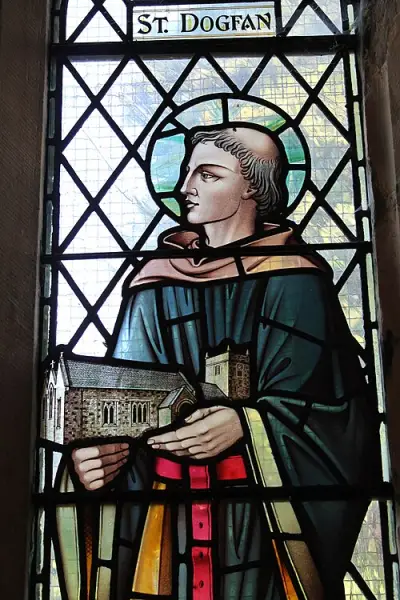
Dogfan, Doewan in another spelling, was a martyr-saint of fifth-century Wales, remembered among the many children of King Brychan, the great dynast whose numerous sons and daughters peopled the early church of Wales with saints. The town of Llanrhaeadr-ym-Mochnant honors him as its patron, and it may have been where his mother was born, binding the saint's family to that place in Powys. His life ended not in old age but in blood: the old records tell that he was slain by heathen Anglo-Saxon raiders in Pembrokeshire, in the far southwest of Wales, where a church rose in his memory. Nothing more of his acts or words has survived, but the pattern of his death — a native Christian of the old British church slain by pagan raiders — belongs to the age in which British Christianity held its ground against the incoming English peoples. His memory has endured across denominational boundaries: he is venerated on 13 July in the Roman Catholic Church, the Eastern Orthodox Church, the True Orthodox Church, and the Anglican Church, and the church of St Dogfan still stands at Llanrhaeadr-ym-Mochnant, keeping his name alive in the landscape of Wales.
The Complete Life
A Son of King Brychan
Dogfan belonged to the most prolific saint-producing family of early Wales. He was one of the sons of King Brychan, the fifth-century ruler of Brycheiniog whose enormous posterity was remembered by medieval Welsh tradition as a generation of saints, their lives scattered across the churches of Wales, Cornwall, and Brittany. Of Dogfan's mother less is recorded, but tradition preserves a single connecting thread: the town of Llanrhaeadr-ym-Mochnant, of which he is patron, may have been her birthplace. That association suggests how the saint's cult took root in the community — through family memory, in a landscape where the kin of Brychan's children planted churches and endowed wells. He is also known by the variant name Doewan, the form in which his cult traveled in some traditions. The sources say nothing of his education or ordination, but as the son of a Christian king in the British church of the fifth century he would have been formed in the faith carried to Wales in the Roman era and preserved there after the legions withdrew. His identity was fixed early in the memory of the Welsh church as both prince and saint, a combination the age regarded not as paradox but as a family calling.
§ Family
Martyrdom in Pembrokeshire
Dogfan's sanctity was sealed not by a long life of foundations but by the manner of his death. The old records tell that he was slain by heathen Anglo-Saxon raiders in Pembrokeshire, the southwestern peninsula of Wales, far from his father's court in the east. His presence there belongs to the turbulent fifth and sixth centuries, when British Christian communities pushed westward and southward before the advance of the pagan English peoples, and when raiders and settlers reached even the remotest coastal cantrefs of Dyfed. That he died at the invaders' hands rather than under his father's protection suggests a life spent at the moving frontier of the old British church, where to preach and pastor was to stand in the path of violence. The early church of Wales, like the church of the age of the martyrs, counted those who fell to pagan hostility among its saints from the moment of their death, needing no process to confirm what their blood had declared. At the place of his death a church was built to his memory, the customary monument of a Welsh martyr, and it was this foundation that carried his name forward through the centuries of Welsh Christian history that followed.
§ Martyrdom
Cult and Commemoration
Dogfan's memory settled where his martyrdom had been honored: at Llanrhaeadr-ym-Mochnant, of which he is the patron saint, where the Church of St Dogfan still bears his name in the valley of the Mochnant. His feast fell on 13 July, the day on which the old calendars of the Welsh church kept his memory. Unusually for a figure of whom so little is recorded, his veneration crossed every division of later Christianity: he is honored on that day in the Roman Catholic Church, in the Eastern Orthodox Church and the True Orthodox Church, and in the Anglican Church, a convergence reflecting the shared inheritance of the pre-Saxon British saints whom all the churches of Wales claim. His cult was preserved in the standard compilations of the hagiology of the British Isles, including the Monks of Ramsgate's Book of Saints, from which the principal modern accounts derive. As one of the sons of Brychan, he belongs to that extensive family cycle of Welsh saints — sons and daughters of one king, scattered across dedications from the Brecon Beacons to the sea — which remains one of the distinctive features of Wales's Christian memory, and his story keeps alive the witness of the native British church in the age of its persecution.
§ Family
The Record
- Patron of
- Llanrhaeadr-ym-Mochnant in Wales
- Symbols
- martyr's palm·the sword of the pagan raiders
- Canonization
- Pre-congregation — a martyr of the age before formal processes, venerated in the Roman Catholic, Eastern Orthodox, True Orthodox, and Anglican Churches.
Prayer
Bibliography
Show 4 sources
Profile text adapted from the Wikipedia article, licensed CC BY-SA 4.0.
Pray with this saint every day
Save St. Dogfan to your favorites, read the full profile, and get feast-day reminders in the Saints app.
Get the Saints AppFree on the App Store for iPhone and iPad