
5th/6th century Wales·Feast June 14
St. Dogmael
Sixth-Century Welsh Monk and Preacher of Pembrokeshire
Overview
Saint Dogmael — his name appears in the sources as Docmael, Dogfael, Dogmeel, Dogwel, and, in Brittany, Toel — was a sixth-century Welsh monk and preacher whose working life was spent among the churches of Pembrokeshire. He belonged to the royal house of Cunedda, the dynasty from which the kings of Wales descended: he was the son of Ithel ap Ceredig ab Cunedda Wledig, and his grandmother was Saint Meleri, daughter of Saint Brychan, so that the blood of two great saint-producing houses ran in his veins. He was said to be a cousin of Saint David, patron of Wales, who shared the same grandfather Ceredig. Renouncing the prospects of his lineage, Dogmael became a monk and gave his energy to preaching, concentrating his labors in Pembrokeshire, where a remarkable number of churches came to bear his name. The geography of those dedications shows his cult took root south of the Teifi, among the Dyfed communities of Cemais and Pebidiog. He died in the sixth century and was buried at the site where, in 1120, Robert fitz Martin and his wife Maud Peveril founded St Dogmael's Abbey, which stands ruined today above the Teifi and still holds the traditional place of his grave. Alban Butler records his virtue of prayer and penance, and Brittany honors him at Pomerit-Jaudy as St. Toël.
The Complete Life
Born of the House of Cunedda
Dogmael came into the world as a prince of the founding dynasty of Gwynedd. The genealogies make him the son of Ithel ap Ceredig ab Cunedda Wledig — Cunedda Wledig being the legendary chieftain from whom the kings of Wales traced their descent — and place him within the third generation of that great house. Sanctity flowed through both sides of his family: his grandmother was Saint Meleri, one of the many saintly daughters of Saint Brychan of Brycheiniog, whose enormous offspring populated the churches of Wales and beyond. Through his grandfather Ceredig he shared blood with the most famous of all Welsh saints, for tradition says he was the cousin of Saint David, who was likewise a grandson of Ceredig. A Welsh awdl in honor of Dewi Sant preserves the kinship of the two men in verse. To be born into such a family in the Wales of the late fifth and early sixth centuries was to be born into a Christian aristocracy in which royal birth and religious vocation were expected to meet: the grandchildren of Cunedda and of Brychan became monks, abbots, abbesses, and patrons of churches in extraordinary numbers. Dogmael's names — Docmael, Dogfael, Dogmeel, Dogwel — reflect the many communities that later claimed him, and in Brittany he would be remembered under the further form of Toel.
§ Life
The Monk of the Teifi Country
Dogmael's vocation led him out of the halls of his lineage and into the monastic life of the early Welsh church. The sources are reticent about where he was formed as a monk, but the tradition is unanimous that he embraced the habit and the discipline of the monastery rather than the ambitions of his house. Of the practice of that vocation, Alban Butler supplies the character: by his fervor in all the virtues, especially prayer and penance, he gave witness to the crucified life, in Butler's words a living instance of St. Bernard's teaching that a soul mindful of what it owes to the Crucified finds even the cross's humiliations sweet. This is the portrait the old calendars preserve — not a warrior prince or a bishop administering a great see, but a penitential monk whose holiness of prayer made him a figure of the age. The sixth-century Welsh church was built around just such monastic centers, communities whose discipline radiated outward into the countryside through preaching and the founding of chapels. Dogmael's life followed that pattern, and his choice of the monastic state — while his cousin David rose to lead the church of Wales — placed him among the silent penitents whose names the parishes remembered even when their writings did not survive.
§ Butler's account
Preaching in Pembrokeshire
The field of Dogmael's apostolate was Pembrokeshire, the far southwestern peninsula of Wales, where he seems to have concentrated his preaching. There a striking number of churches came to be dedicated to him, and the pattern of those dedications maps his mission with unusual precision: his cult had its center south of the Teifi, among the Dyfed communities of Cemais and Pebidiog. The village of St Dogmaels, called in Welsh Llandudoch, stands on the south bank of the Teifi facing Cardigan, at the heart of that territory. Around it the saint's name survives in the church dedications of the whole region: Capel Degwel lies nearby, St Dogwell's stands near Fishguard, and the Church of St Dogfael serves Meline, each name a variant form of the one man — Dogmael, Dogfael, Dogwel. His cult even crossed the sea of Menai, for Llanddogwel in Anglesey is also dedicated to him, evidence that his reputation as a preacher and holy man reached far beyond the parishes where he actually labored. In this network of churches the historian reads the footprint of a sixth-century mission: a monk moving among the townships of north Pembrokeshire, planting or blessing places of worship, whose memory the settlers fixed into the very names of their villages.
§ Legacy
Prayer and Penance
The oldest extended portrait of Dogmael's sanctity comes from Alban Butler's Lives of the Primitive Fathers, Martyrs, and Other Principal Saints, in the entry set under 14 June. Butler found the English and British calendars unanimous that the saint flourished in Pembrokeshire in the sixth century, and he framed the man's holiness in terms of two virtues above all: prayer and penance. By his fervor in the practice of these, Butler wrote, Dogmael was a living instance of what St. Bernard taught: that a soul conscious of what she owes to the One who was crucified out of love for her finds the cross's humiliations sweet. From that sentence Butler drew his own exhortation, that no bounds should be set to the endeavor to love Christ more each day, seeing that we can never love him either as much as he deserves or as much as he loves us. Whether or not Butler knew more of Dogmael than the calendars preserve, the portrait fits the sixth-century Welsh church exactly: a monastic spirituality of the cross, disciplined by fasting and vigil, in which love of the Crucified was tested and proved in daily penance. It is as such a penitent, rather than as a prince or prelate, that the tradition of Dogfael has come down.
§ Butler's account
Death and the Place of His Grave
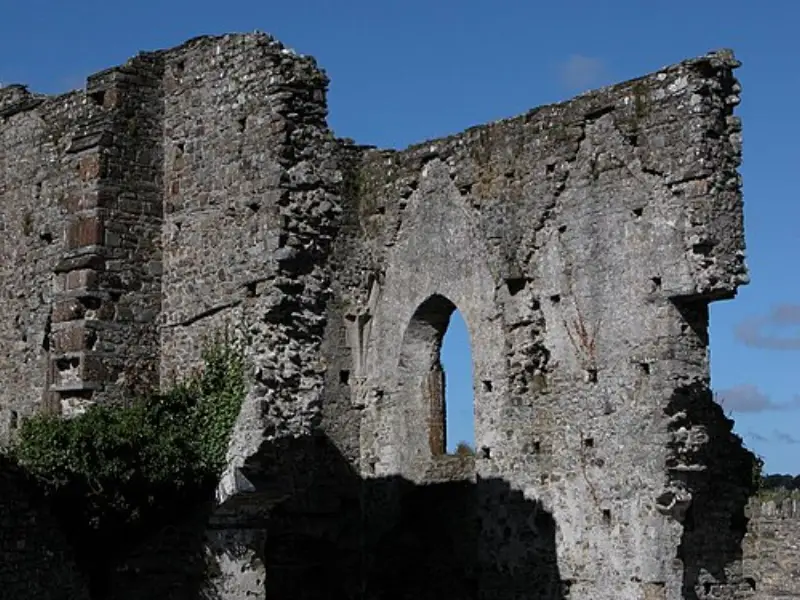
Dogmael died in the sixth century, and the church of Pembrokeshire buried him in its own soil. The precise year of his death is not recorded, but the traditional site of his grave was never lost: it lies where St Dogmael's Abbey now stands, on a hillside above the River Teifi looking over the water toward Cardigan. The sanctity of that spot outlived the age of the Welsh saints. In 1120, in the generation after the Norman settlement of the region, Robert fitz Martin and his wife Maud Peveril founded an abbey on the hillside, gathering the saint's grave into a monastic church that became one of the great religious houses of west Wales. That a Norman lord and his wife chose the grave of a sixth-century Welsh monk as the seed of their foundation shows how living the cult remained: the new monasticism of the twelfth century sought out and enshrined the holy men of the old British church. The abbey flourished for centuries, and though it now stands in ruins above the Teifi, it still contains the traditional site of St Dogmael's grave, and the village of St Dogmaels at its foot keeps his name in both English and Welsh — Llandudoch — as it has for a thousand years.
§ Legacy
A Saint of the Undivided Devotion
Dogmael belongs to the saints of the pre-congregation age, honored by the church from the time when the calendars of Wales, England, and Brittany recorded the feasts of the native saints without any formal process. His feast is kept on 14 June, the date under which Alban Butler collected his life and under which the older English and British calendars remembered him. Butler notes that Dom Lombineau, in his lives of the Saints of Brittany, found himself unable to discover who this St. Docmael might be — evidence both of how far the saint's cult had traveled and how easily its threads frayed — yet the Breton connection is firm: Dogmael is the titular patron of Pomerit-Jaudy's church in the diocese of Tréguier, in Brittany, where he is honored under the name of St. Toël, a dedication Butler attests on the authority of Chatelain. His cult thus spans three countries: the churches of north Pembrokeshire and Anglesey that bear his name, the Norman abbey built over his grave, and a Breton parish that took him for its patron. The survival of his feast in the modern calendars of the Church, and the attention of scholars from Emanuel to Charles-Edwards in the Dictionary of Welsh Biography and the Oxford Dictionary of National Biography, keep this quiet sixth-century preacher among the documented saints of Wales.
§ Butler's account
Churches, Village, and Abbey
Dogmael's name is written more deeply into the landscape of west Wales than almost any document could manage. The village of St Dogmaels on the Teifi's southern bank, looking across at Cardigan, is called Llandudoch in Welsh and remains the living center of his cult. Around it stand Capel Degwel nearby, St Dogwell's near Fishguard, and the Church of St Dogfael at Meline — each a distinct community that took a different form of the saint's name, Dogmael, Dogwel, Dogfael, as its own. Across the island of Anglesey, far from his Pembrokeshire mission field, the church of Llanddogwel, also called Llanddygfael, is dedicated to him, showing the reach of his reputation among the churches of the Welsh. Overlooking all of these stands St Dogmael's Abbey, raised in 1120 at the hands of Robert fitz Martin and Maud Peveril upon the hillside above the Teifi and now a celebrated ruin, still sheltering the traditional grave of the saint. Scholars have traced his cult through the Dictionary of Welsh Biography, where Hywel David Emanuel treated him in 1959, and the Oxford Dictionary of National Biography, where T. M. Charles-Edwards assessed the evidence under Dogfael in 2004. Six centuries of obscurity, one Norman abbey, and a scatter of parish names: that is the monument a sixth-century preacher left, and it has proven durable.
§ Legacy
Timeline
- 1120
Robert fitz Martin and his wife Maud Peveril found St Dogmael's Abbey on the hillside above the Teifi, at the saint's traditional grave.
§ Legacy
- 1799
Alban Butler's Lives of the Primitive Fathers records his cult and his patronage of Pomerit-Jaudy in Brittany.
§ Butler's account
In Their Own Words
The humiliations of the cross are sweet to a soul which is sensible of what she owes to him who was crucified for the love of her.
The Record
- Major works
- Preaching mission in Pembrokeshire·Churches dedicated to him across north Pembrokeshire and Anglesey
- Patron of
- church of Pomerit-Jaudy in the diocese of Tréguier, Brittany·communities of Cemais and Pebidiog in Dyfed
- Symbols
- monk's habit·the ruined abbey above the Teifi
- Canonization
- Pre-congregation — venerated as a saint from the age of the early Welsh church, with his feast kept on 14 June.
Prayer
Bibliography
Show 6 sources
- Butler, Alban (1799), The Lives of the Primitive Fathers, Martyrs, and Other Principal Saints: Compiled from Original Monuments and Other Authentic Records, J. Moir.
- Charles-Edwards, T. M. (23 September 2004). "Dogfael [St Dogfael, Dogwel, Dygfael, Dogmael]". Oxford Dictionary of National Biography (online ed.). Oxford University Press. doi:10.1093/ref:odnb/7769.
- Emanuel, Hywel David (1959), "Dogmael", Dictionary of Welsh Biography, National Library of Wales.
- Ross, David, "St Dogmael's Abbey", Britain Express, retrieved 1 August 2021.
- St. Augustine's Abbey, Ramsgate (1921), The Book of saints: a dictionary of servants of God canonized by the Catholic Church, London: A. & C. Black, ltd., p. 82.
- Starr, Brian Daniel (2008), The Life of Saint Brychan: King of Brycheiniog and Family, Brian Daniel Starr. ISBN 978-1-4392-0361-3.
Profile text adapted from the Wikipedia article, licensed CC BY-SA 4.0.
Pray with this saint every day
Save St. Dogmael to your favorites, read the full profile, and get feast-day reminders in the Saints app.
Get the Saints AppFree on the App Store for iPhone and iPad