
died 363·Feast August 7
St. Dometius of Persia
Persian martyr stoned to death under Julian the Apostate
Overview
Dometius, sometimes recorded under the variant spelling Domitius, is honored as a Christian martyr who died at Nisibis in Mesopotamia in the year 363. Tradition holds that he was put to death by stoning during the persecution launched under the emperor Julian the Apostate, and that he suffered alongside two companions, who are remembered with him in the act of martyrdom. His cult is comparatively obscure: the name Domitius actually appears three separate times in the Roman Martyrology, assigned to the feasts of August 7, March 23, and July 5, and scholars caution that it is by no means certain these commemorations refer to the same man. The Persian Dometius is kept on August 7, the date under which he is invoked especially against sciatica. Interest in him endured far from Mesopotamia: an eighth-century fresco in the Roman church of Santa Maria Antiqua portrays him, a survival that also suggests the presence of Greek-speaking monks in that community, since the same paintings show saints of the Christian East such as Barachisius, Euthymius, and Sabas of Palestine.
The Complete Life
Martyrdom at Nisibis
The historical memory of Dometius closes with the year 363, when he was killed at Nisibis, a frontier city of Mesopotamia that stood on the contested border between the Roman and Persian worlds. His death came in the final year of the reign of Julian the Apostate, the emperor who had rejected the Christianity of his upbringing and sought to restore the old cults of the empire. Tradition preserves the manner of his execution: he was condemned to die by lapidation, killed by a shower of stones rather than by the sword or the arena. Two companions were joined to him in this fate and are remembered with him as fellow martyrs. The choice of stoning, a punishment with deep biblical resonance, gave his witness a particular character, and later devotion connected his intercession with those who suffer afflictions of the body, especially sciatica. Beyond these bare facts the ancient sources are silent, leaving his last days clothed in the simplicity of the earliest martyr acts. No ancient writer records his origins, his age, or the events that carried him to the frontier city; the tradition has kept only the place, the year, the manner of his death, and the two who died at his side.
§ Dometius of Persia
An Ancient and Confused Commemoration
Dometius belongs to the company of martyrs venerated before any formal process of canonization existed; his cult rests on the continuous memory of the Church rather than on a decree. Yet even that memory is tangled. The name Domitius appears in the Roman Martyrology on three distinct feast days: August 7, March 23, and July 5. Commentators have long noted that it is uncertain whether these commemorations describe one saint or several men who happened to bear the same name. The Persian martyr honored on August 7 is the one remembered as Dometius of Nisibis, put to death under Julian. His feast entered the universal calendars of the West, and the very confusion surrounding his name testifies to how widely it traveled: a martyr of the Persian frontier was being read about and sung to in Rome centuries after his death. He stands, therefore, in the long line of early witnesses whose sanctity the Church acknowledged simply by keeping their memory alive year after year. Whatever the truth of the threefold listing, the Church has never withdrawn the August 7 commemoration, and the Persian martyr's name remains in the Roman Martyrology to this day.
§ Dometius of Persia
A Persian Saint on the Walls of Rome
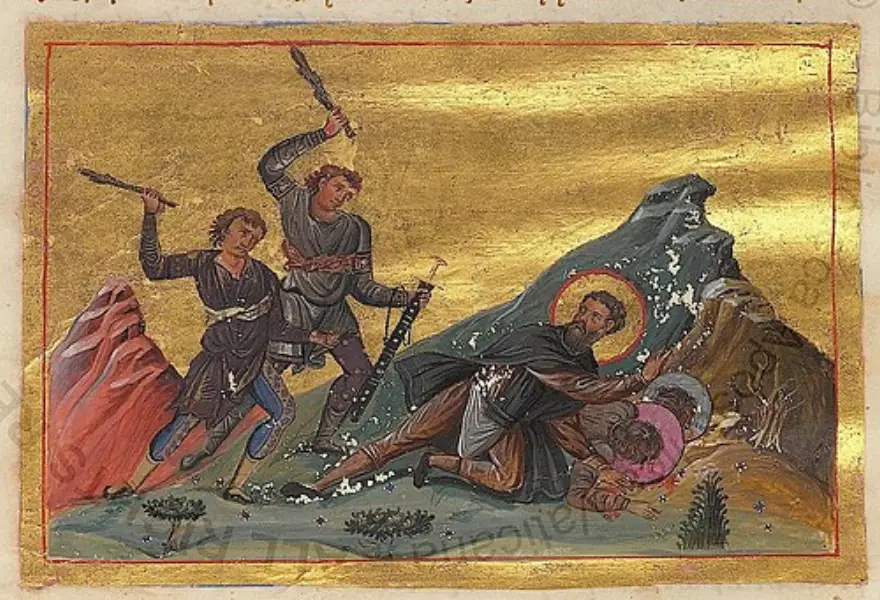
The most striking survival of Dometius's cult is pictorial. In the eighth century, an artist working in the Roman church of Santa Maria Antiqua painted his image on its walls, centuries after his death in distant Mesopotamia. The fresco is more than a devotional artifact: scholars have seen in it evidence that Greek-speaking monks lived and prayed at Santa Maria Antiqua, since the same cycle of paintings honors Eastern figures such as Barachisius, Euthymius, and Sabas of Palestine. In the company of these monks of the Christian East, the Persian martyr found a home in the heart of Rome. His image was also preserved in the Menologion of Basil II, the richly illuminated Byzantine menology, where his martyrdom is shown with his two disciples. For a saint about whom almost nothing is recorded, this artistic afterlife is remarkable: it shows that devotion to Dometius crossed languages and empires, carried from the Persian frontier into Byzantine and Roman worship, and that his witness continued to instruct the faithful long after the city of his death had passed into other hands. For a man whose earthly story occupies barely a paragraph of the sources, this endurance in paint and manuscript is his true monument.
§ Dometius of Persia
Timeline
- 363
Suffered martyrdom by stoning at Nisibis in Mesopotamia, with two companions, during the persecution under Emperor Julian the Apostate.
§ Introduction
- 700
An eighth-century fresco depicting Dometius was painted in the church of Santa Maria Antiqua in Rome, alongside Eastern saints.
§ Introduction
The Record
- Patron of
- invoked against sciatica
- Symbols
- shown stoned together with his two disciples in the Menologion of Basil II
- Canonization
- Pre-congregation martyr, venerated from earliest tradition and entered in the Roman Martyrology
Prayer
Bibliography
Show 3 sources
- Sean Kelly, Rosemary Rogers, Saints preserve us!: Everything you need to know about every saint you'll ever need (Random House, Inc., 1993), 78.
- "St. Patrick Catholic Church Saint of the Day: August 7". St. Patrick Catholic Church. 2010. Archived from the original on December 21, 2016. Retrieved January 29, 2010.
- Éamonn Ó Carragáin, Carol L. Neuman de Vegvar, Roma felix: formation and reflections of medieval Rome: Church, faith and culture in the medieval West (Ashgate Publishing, Ltd., 2007), 148 and 148n.
Profile text adapted from the Wikipedia article, licensed CC BY-SA 4.0.
Pray with this saint every day
Save St. Dometius of Persia to your favorites, read the full profile, and get feast-day reminders in the Saints app.
Get the Saints AppFree on the App Store for iPhone and iPad