
c. 1589 – 1633·Feast September 28
St. Domingo Ibáñez de Erquicia
Dominican missionary martyred in the Nagasaki persecution
Overview
Domingo Ibáñez de Erquicia was a Spanish Dominican priest whose missionary life carried him from the Basque country to the Philippines and finally to martyrdom in Japan. Born around 1589 at Régil in Guipúzcoa, he received the habit at the San Telmo friary of the Dominicans in San Sebastián, making his profession there in 1605. He sailed from his homeland in 1610 for mission service in the Philippines, traveling across Mexico en route, and landed at Manila in 1611, receiving priestly ordination there in 1612. He labored first in Pangasinan and then at Binondo, a settlement of converted Chinese immigrants, before taking up a chair of theology at the Colegio de Santo Tomás. In 1623, answering appeals from a mission depleted by the Tokugawa persecution, he sailed for Japan disguised as a merchant. For roughly ten years he served the persecuted Catholic community in secret, moving constantly, working mainly at night, comforting believers and reconciling those who had lapsed. Denounced by an apostate in 1633, he was imprisoned, taken to Nagasaki, and killed by the torture of the gallows and pit. He died on August 14, 1633, together with his Japanese collaborator Francis Shoyemon.
The Complete Life
From Guipúzcoa to the Convent
Domingo Ibáñez de Erquicia was born around 1589 in Régil, a town in the Basque province of Guipúzcoa in northern Spain. The region had a strong Dominican tradition, and as a young man he entered the Order of Preachers at the convent of San Telmo in the nearby port city of San Sebastián. There he took the habit and made his religious profession in 1605, committing himself to the life of study, prayer, and preaching that characterized the Order. He pursued theological studies to their completion, acquiring the learning that would later support both his teaching and his missionary work. The Spain of his youth was a nation at the height of its missionary expansion, and the Dominican province of the Philippines drew men eager to carry the faith across the Pacific. In 1610, having finished his formation, he left his homeland for the missions, taking the long route by way of Mexico to the Far East. He never returned to the land of his birth, giving his whole life instead to the peoples of Asia. It was a formation typical of the Spanish Dominicans of his generation, men whose province looked across the Atlantic and the Pacific for its work.
§ Life
Priest and Professor in Manila
Ibáñez reached Manila in 1611 and was ordained a priest the following year. His first assignments took him into the missionary field of Luzon: he served the people of Pangasinan in the north of the island, and then worked at Binondo, a settlement established for Chinese immigrants who had embraced the Catholic faith. This double experience of ministry to Filipinos and to Chinese converts shaped him as a missionary prepared for culturally demanding work. His abilities did not go unnoticed, and he was eventually appointed a professor of theology at the Colegio de Santo Tomás, the institution of the Dominicans in Manila that would later grow into the University of Santo Tomás. The move from mission station to lecture hall was not a retirement but a widening of his service: he was forming the next generation of missionaries even as the Church in Japan was entering its cruelest trial. By 1622 the Tokugawa persecution had thinned the Dominican ranks in Japan to a handful, and appeals went out for men willing to reinforce the dying mission. Ibáñez answered. The chair at Santo Tomás was a mark of the esteem his order had for him, and it made his offer for Japan the more striking.
§ Life
Ten Hidden Years in Japan
In 1623 Father Domingo sailed for Japan disguised as a merchant, one of the few ways a foreign priest could still reach the hidden Christians. Shortly after his arrival the shogunate issued a decree expelling Spaniards from residence in the country, sealing the isolation of the Church he had come to serve. For roughly ten years he lived and worked incognito among the Catholic communities, moving constantly so that the authorities could never fix his whereabouts. His ministry was conducted mainly at night: he comforted believers living in fear, reconciled apostates who wished to return to the sacraments, and administered the rites of the Church in circumstances of great hardship. In 1625 he was appointed provincial vicar of the mission and spent two years in the north of the country, where the pressure of persecution drove many Christians to take refuge in the mountains. Throughout those years he was aided by Francis Shoyemon, a Japanese layman who served as catechist and interpreter and who would later join the Dominican Order himself as a cooperator brother, becoming his companion in mission and in death.
§ Life
Faith Under Ground
The spirituality that emerges from Ibáñez's Japanese years is one of perseverance, discretion, and mercy. He chose to remain in a land where discovery meant torture, and he renewed that choice day after day for a decade, never staying long in one place and performing most of his ministry under cover of darkness. His care for apostates is especially telling: rather than condemning those who had broken under threat, he worked to reconcile them with God and restore them to the community of believers, believing that no one was beyond recovery. As provincial vicar he bore responsibility for an entire mission under sentence of extinction, staying with his flock even as they fled to the mountains. His fidelity was sealed by the sacramental generosity for which he risked his life, bringing the comforts of religion to people who could practice their faith only in hiding. When at last he was caught, his refusal to renounce his faith completed a life that had been, in effect, a continuous act of self-offering. The gallows and pit that killed him were the final expression of a priestly life already wholly given away.
§ Life
Betrayal, Prison, and the Pit
The end came in the summer of 1633. In July of that year a Christian apostate denounced Ibáñez to the government officials who had hunted him for a decade, and he was interned in the prison of Nagoya. His Japanese collaborator Francis Shoyemon was imprisoned with him, and in a final act of pastoral care Ibáñez received him into the Order of Preachers as a cooperator brother while they waited together in captivity. From Nagoya the prisoner was taken to Nagasaki, the city that had become the proving ground of the persecution. Asked to renounce his faith, he refused. On August 13, 1633, he was subjected to tsurushi, the execution method in which the victim was hung from a gallows over a pit, a slow torture designed to break the will without shedding blood. He died the following day, August 14, 1633, and Shoyemon was put to death with him. Afterward his body was burned and his ashes scattered, so that no relics could be gathered by the faithful. His official cause of death is recorded simply as tsurushi, the torment he endured rather than deny Christ.
§ Life
From Cause to Canonization
The road to the altars for Ibáñez and his companion martyrs was prepared by careful scholarship. The Positio Super Introductione Causae, the document that formally introduced the cause of beatification, was written by the historian Fidel Villarroel of the Dominican Order. The reward came during the pontificate of John Paul II, whose reign saw an unprecedented number of martyr elevations. On February 18, 1981, the Pope beatified Domingo Ibáñez de Erquicia in Manila, during his pastoral visit to the Philippines, the country whose Church the martyr had served as a young priest. That ceremony held particular historical weight: it was the first beatification celebrated outside the Vatican in the modern era, reviving a practice from the Middle Ages when beatifications had been delegated to papal legates. Six years later the cause reached its conclusion. On October 18, 1987, in St. Peter's Basilica in Vatican City, the same Pope inscribed him among the saints, joining him to the great company of martyrs of Japan recognized in that ceremony. In raising him to the altars, the Church confirmed a missionary career that had spanned three countries and ended on a scaffold in Nagasaki.
§ Veneration
Memory in Manila and Nagasaki
Domingo Ibáñez de Erquicia is remembered today on two shores of the Pacific. In the Philippines, where he spent his early priesthood, his memory is attached to the Minor Basilica of the National Shrine of Saint Lorenzo Ruiz in Binondo, Manila, which serves as his major shrine; there he is honored alongside Lorenzo Ruiz, the protomartyr of the Philippines with whom he shares the calendar of Filipino saints. His feast is kept on September 28, the common celebration of the martyrs with whom he was raised to the altars. In Japan his witness belongs to the long saga of the hidden Christians, whose endurance he sustained for a decade and whose descendants kept the faith through centuries of persecution. Scholars and Dominican writers continue to study his life; the research of Fidel Villarroel, whose Positio grounded the cause, stands behind much of what is known, and commemorations such as those of the Irish Dominicans have carried his story to a wider public. For missionaries working where the faith is proscribed, his ten secret years remain a model of quiet, stubborn fidelity.
§ Veneration
Timeline
- 1589
Born at Régil in Guipúzcoa, Spain, around this year.
§ Life
- 1605
Made religious profession in the Dominican Order at the convent of San Telmo in San Sebastián.
§ Life
- 1610
Left Spain for the Philippine mission, traveling by way of Mexico.
§ Life
- 1611
Arrived in Manila to begin missionary work in the Philippines.
§ Life
- 1612
Ordained a priest, then served in Pangasinan and Binondo and later taught theology at the Colegio de Santo Tomás.
§ Life
- 1623
Departed for Japan disguised as a merchant to reinforce the Dominican mission weakened by persecution; a decree soon banned Spaniards from the country.
§ Life
- 1625
Appointed provincial vicar and spent two years ministering in the north of Japan as persecution intensified.
§ Life
- Jul 1633
Denounced to the authorities by a Christian apostate and interned in the prison of Nagoya.
§ Life
- 14 Aug 1633
Tortured the previous day on the gallows and in the pit at Nagasaki, he died there alongside Francis Shoyemon, and his remains were burnt.
§ Life
- 18 Feb 1981
Beatified by Pope John Paul II in Manila, the first modern-era beatification ceremony held outside the Vatican.
§ Veneration
- 18 Oct 1987
Canonized by Pope John Paul II at St. Peter's Basilica in Vatican City.
§ Veneration
The Record
- Major works
- missionary service in Pangasinan and Binondo·theological teaching at the Colegio de Santo Tomás·clandestine ministry to the persecuted Church in Japan
- Patron of
- patron of missionaries·patron of the persecuted Church
- Symbols
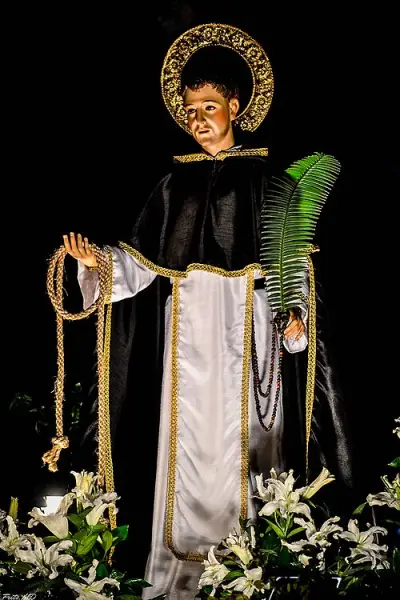
- Dominican habit·palm of martyrdom
- Canonization
- Canonized by Pope John Paul II on 18 October 1987 at St. Peter's Basilica, Vatican City
Prayer
Bibliography
Show 7 sources
- "Beatifications of Pope John Paul II", Vatican News Service
- Jansen OP, Luuk Dominiek. "Saint Dominic Ibanez de Erquicia and companions", Irish Dominicans, September 18, 2010
- "Santo Domingo Ibáñez", Real Academia de la Historia
- "Domingo Ibáñez de Erquicia", Vatican News Service
- "2-volume UST history charts evolution of higher education in the Philippines | Inquirer Lifestyle". Lifestyle.inquirer.net. 2012-01-22. Retrieved 2012-10-21.
- "UST historian named Master of Theology". The Varsitarian. Retrieved 2012-10-21.
- Lorenzo de Manila, The Proto-Martyr of The Philippines and his Companions - Fr. Fidel Villarroel, O.P., 1988
Profile text adapted from the Wikipedia article, licensed CC BY-SA 4.0.
Pray with this saint every day
Save St. Domingo Ibáñez de Erquicia to your favorites, read the full profile, and get feast-day reminders in the Saints app.
Get the Saints AppFree on the App Store for iPhone and iPad