
1170-1221·Feast August 8
St. Dominic
Priest, Founder of the Order of Preachers
Overview
Dominic de Guzmán was born around 1170 at Caleruega, halfway between Osma and Aranda de Duero in Old Castile, and named for the abbot Dominic of Silos whose shrine lay nearby. His mother, Joan of Aza, was herself beatified, as was his brother Manés. Schooled with the Premonstratensians at La Vid and then at Palencia, where he spent six years on the arts and four more on theology, early on he showed how much he valued people over things: in the famine year of 1191 he sold even his precious manuscripts to buy food, asking whether one should study dead skins while men were starving. Ordained at twenty-four, he joined the cathedral chapter of Osma and became its subprior. A diplomatic journey through the south of France around 1203 changed his life: seeing Cistercian preachers fail against the Cathars through pomp, he and Bishop Diego of Osma embraced poverty itinerant preaching instead. From the house of nuns he gathered at Prouille in 1206 to the band of six brethren housed by Peter Seila at Toulouse in 1215, a new kind of order took shape, combining study with mobility and mendicancy. Pope Honorius III confirmed the Order of Preachers in December 1216. Dominic, thin, red-bearded, cheerful and austere, died at Bologna on 6 August 1221, aged fifty-one, urging his friars to charity, humility, and poverty.
The Complete Life
Early Life
Dominic was born at Caleruega, midway between Osma and Aranda de Duero — Old Castile, on 8 August 1170, and named after the abbot Dominic of Silos, whose Benedictine house lay a few miles north of his village. The earliest narrative, by Jordan of Saxony, does not name his parents — Jordan was writing a history of the order's first years, not a biography — but a thirteenth-century source gives them as Juana and Felix, and later writers make his father a man of the de Guzmán family and his mother of the Aza; Rodrigo de Cerrato, writing nearly a century on, calls his father honoured and wealthy in the village. Around the birth grew a famous legend: his barren mother, so the story runs, dreamt that a dog sprang from her womb bearing a flaming torch and set the earth alight — a tale that flourished once the order's Latin name, Dominicanus, could be read as Domini canis, the Lord's dog. His mother, Joan of Aza, was beatified in 1829; his brother Manés in 1834.
Conversion and Vocation
At fourteen Dominic was sent to the Premonstratensian house of Santa María de La Vid, and moved afterwards to the schools of Palencia, where he gave six years to the arts course and four to theology. Two episodes of those years were remembered. In the famine of 1191 he handed out his money and sold his clothes, his furniture and even his precious manuscripts to feed the hungry, telling astonished fellow students that he would not study off dead skins while men were dying of hunger. Ordained priest at twenty-four, he joined the cathedral canonry of Osma, and in 1198 the reformed chapter's bishop made him subprior. His true vocation began in 1203 or 1204, when he accompanied Bishop Diego de Acebo on a diplomatic journey north for King Alfonso VIII — a bride-seeking embassy for the crown prince — and on the return met the Cistercians sent by Innocent III to preach against the Cathars of southern France. Dominic and Diego judged the mission's failure to lie in the preachers' pomp against the Cathars' austerity, and determined to answer asceticism with asceticism.
Mission and Ministry
From late 1206 Dominic's work centred on Prouille, near Fanjeaux, where Diego's little group established itself at a church placed at their disposal by Bishop Foulques of Toulouse. The house served two purposes: a refuge for women who had lived in Cathar religious houses, and the first fixed base for the preaching mission. Dominic gave the first community the Rule of Saint Augustine, and formal Catholic–Cathar debates took place at Verfeil, Pamiers and Montréal. When Diego was recalled and died at Osma in December 1207, Dominic was left to carry the mission alone. In 1215, with six followers, he accepted a house in Toulouse given by Peter Seila, and the shape of a new kind of order emerged: an organisation combining systematic education with organisational flexibility beyond anything the monastic orders or the secular clergy offered, dedicated to preaching for the growing cities. Bishop Foulques gave written authority to preach; in 1215 Dominic went to Rome for approval, and in December 1216 Honorius III granted it — the Ordo Praedicatorum, the Order of Preachers.
Spirituality and Teaching
The spiritual tradition Dominic left is embodied in the order's constitutions and in the practices his first friars recorded. He bound himself and his companions to monastic patterns of prayer and penance while freeing them from stability of place, so that study and preaching could go anywhere; the constitutions legislated for dispersal and representative chapters, government by elected superiors and by brothers in council. Dominican tradition also attaches to him, at Prouille in 1208, a vision of the Blessed Virgin Mary giving him a rosary — beads already known to the age, but thereafter carried through the world largely by Dominicans, so that Pius XI could call the rosary the order's principle and foundation for perfecting the lives of the friars and working the salvation of others. His personal austerity became proverbial: he abstained from meat, kept stated fasts and silences, chose the worst lodging and the meanest clothes, never allowed himself a bed, travelled often barefoot, and met rain and discomfort with nothing but praise. Cecilia Cesarini, whom he received into the order, remembered him thin and of middle height, fair and reddish-bearded, with beautiful eyes, long fine hands and a pleasingly resonant voice.
Trial and Final Years
Dominic's last years were spent in constant travel over the network of convents spreading through Europe, with headquarters in Rome. Honorius III invited the friars to the ancient basilica of Santa Sabina, which they occupied by early 1220, and gave them San Sisto Vecchio around 1218 for the reform of Rome's nuns; the studium founded at Santa Sabina in 1222 was the ancestor of the Angelicum. Dominic reached Bologna on 21 December 1218, settled at San Nicolò of the Vineyards, and held the order's first two General Chapters there — Bologna remaining the place of his heart. Guiraud's account, drawing on the earliest witnesses, has him die at fifty-one on 6 August 1221, exhausted by the austerities and the journeys of his last decade; the order he left behind was already international, its friars teaching in the universities and preaching in the towns of a dozen provinces scattered across Europe.
Canonization
The canonisation of Dominic was rapid even by thirteenth-century standards. Gregory IX, who as Cardinal Ugolino had known him intimately — the two had lodged under one roof in the winter of 1216 — opened the process at Bologna, and on 3 July 1234, not thirteen years after his death, enrolled Dominic among the saints. The same pope transferred his relics to a shrine at Bologna, where they remain the object of the order's pilgrimage. The canonisation confirmed a cult already widespread among the friars and the people of the city, from whom the first testimonies had been gathered. His cult spread with the order itself, and his feast on 8 August is kept throughout the Roman rite. Devotion to him as patron of astronomers and natural scientists grew from the legend of the star on his brow; the tradition of the rosary keeps his name permanently attached to the Church's most popular devotion.
Legacy
Dominic's legacy is one of the largest in the history of religious life. The Order of Preachers permanently changed the Church's conception of what a religious order could be: an itinerant, educated, centrally governed body whose purpose was teaching and preaching rather than monastic stability, and whose constitutions pioneered representative government centuries before the secular world attempted it. From the order came Thomas Aquinas and Albert the Great, Catherine of Siena, Meister Eckhart and Bartolomé de las Casas, and the universities' theological faculties across Europe. The spread of the rosary, whatever its precise origins, belongs to the Dominican story and through it to the daily prayer of millions. Dominic himself remains, by the evidence of his first biographers, one of the most attractive of the founders: a man of no recorded miracle-working vanity, whose stated ambition was to weep for sinners and whose austerities were the private face of a very public intelligence.
Timeline
- 8 Aug 1170
Born at Caleruega in Old Castile and named after Dominic of Silos, whose abbey lay nearby.
§ Introduction
- 1191
During the famine devastating Spain, he sold his books, clothes, and furniture so that hungry people could be fed.
§ Education and early career
- 1198
Bishop Martin de Bazan, having reformed the chapter, appointed him subprior of the Cathedral of Osma.
§ Education and early career
- 1203
Set out with Bishop Diego de Acebo on a diplomatic journey to Denmark for King Alfonso VIII of Castile, in 1203 or 1204.
§ Education and early career
- 1206
In late 1206 the group settled at the Monastery of Our Lady of Prouille, the first base of the preaching mission.
§ Prouille
- Dec 1207
Diego de Acebo died at Osma, obeying the pope's order to return to his diocese, leaving Dominic alone in the mission.
§ Prouille
- 1208
Experienced a vision of the Blessed Virgin in the church at Prouille, in which she gave him the rosary.
§ The vision of Mary and the rosary
- 1215
Moved with six followers into a Toulouse house given by Peter Seila, receiving written authority from Bishop Foulques to preach.
§ Foundation of the Dominicans
- Dec 1216
Pope Honorius III granted written authority for founding the Ordo Praedicatorum, the Order of Preachers.
§ Foundation of the Dominicans
- 21 Dec 1218
Arrived in Bologna, where a convent was soon established at the Mascarella church by Reginald of Orleans.
§ Later life
- 1219
Summoned by Honorius III, Dominic and his friars made the ancient Roman basilica of Santa Sabina their headquarters.
§ Later life
- 1220
The friars moved into Santa Sabina by early this year, having earlier occupied the convent of San Sisto Vecchio.
§ Later life
- 6 Aug 1221
Died at noon at the convent of St Nicholas in Bologna, worn out by the austerities and labors of his career.
§ Later life
- 24 May 1233
His remains were laid in a plain sarcophagus at Bologna, the earliest removal of his relics.
§ Later life
- 3 Jul 1234
Canonized by Pope Gregory IX at Rieti Cathedral.
§ Introduction
- 5 Jun 1267
Relics placed in the elaborate monument that Nicola Pisano's workshop had crafted for San Domenico in Bologna.
§ Later life
- 15 Feb 1383
Commemoration of the translation of his skull, kept by Catholics on this date.
§ Veneration
- 11 Nov 1411
Commemoration of the third translation of his relics, observed on this date.
§ Veneration
In Their Own Words
Would you have me study off these dead skins when men are dying of hunger?
have charity, to guard their humility, and to make their treasure out of poverty
I am well aware that we are reaping these material goods, but we are not sowing spiritual goods in them; we are kneeling and asking God to help us understand them and to be able to speak to them so that we can proclaim the Word of God to them.
The Record
- Patron of
- Astronomers·Natural scientists
- Symbols
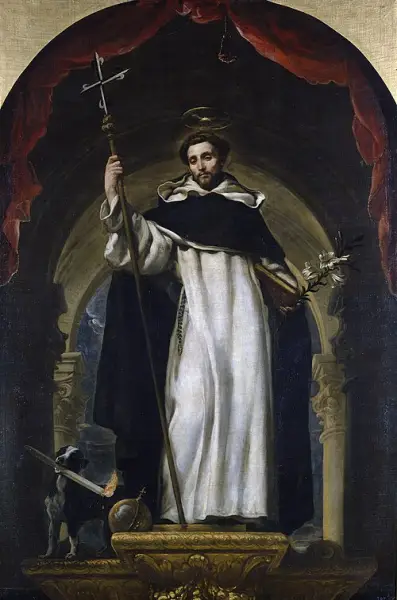
- Dog with a flaming torch (the Domini canis emblem)·Rosary received from the Virgin in the tradition of Prouille·Lily and book (traditional iconography)
- Canonization
- Canonized by Pope Gregory IX in 1234
Prayer
Bibliography
Show 12 sources
- ↑ "Saint Dominic" . Catholic Church Times. 3 May 2026 . Retrieved 8 August 2026 .
- ↑ Jong, Jonathan (14 November 2018). "St Albert the Great: Patron Saint of Scientists" . St Mary Magdalen School of Theology . Retrieved 8 August 2026 .
- ↑ McAfee, Shaun (22 January 2025). "Where Did the Rosary Come From? Here's the Case for St. Dominic" . National Catholic Register . Retrieved 8 August 2026 .
- ↑ "Saint Dominic", Franciscan Media
- ↑ Walsh, Michael J., "Jane of Aza", A New Dictionary of Saints , Liturgical Press, 2007 ISBN 9780814631867
- ↑ Libellus de principiis , 4.
- ↑ Pedro Ferrando, "Legenda Sancti Dominici, 4."
- ↑ Cerrato, Rodrigo de Vita S. Dominico . He also said Dominic had the divine gift of speaking in tongues . Quote: "I am well aware that we are reaping these material goods, but we are not sowing spiritual goods in them; we are kneeling and
- ↑ Pero Tafur, Andanças e viajes (tr. Malcolm Letts, p. 31). Tafur's book is dedicated to a member of the de Guzmán family.
- 1 2 Hook, Walter Farquhar (1848). An ecclesiastical biography, containing the lives of ancient fathers and modern divines, interspersed with notices of heretics and schismatics, forming a brief history of the church in every age . Vol. 4. L
- 1 2 Guiraud 1913 , p. 7.
- ↑ Thomsett, Michael C., The Inquisition: A History ,(McFarland, 2010), p. 54
Profile text adapted from the Wikipedia article, licensed CC BY-SA 4.0.
Pray with this saint every day
Save St. Dominic to your favorites, read the full profile, and get feast-day reminders in the Saints app.
Get the Saints AppFree on the App Store for iPhone and iPad