
1019 – 1109·Feast May 12
St. Dominic de la Calzada
Builder of causeways and bridges for pilgrims
Overview
Dominic de la Calzada (1019 – 12 May 1109), born Domingo García, was a Spanish shepherd's son who became a hermit, a priest, and one of the great builders of the Way of St. James. Born at Viloria de Rioja to the peasant Ximeno García and his wife Orodulce, he knocked at the gates of the Benedictine houses of Valvanera and of San Millán de la Cogolla and was refused by each in turn. He withdrew to the forests near Ayuela as a hermit until 1039, when he joined Gregory, bishop of Ostia, a papal envoy sent to combat a plague of locusts in Navarre and La Rioja. Gregory ordained him a priest, and together they raised a wooden bridge over the Oja River for pilgrims walking to Santiago de Compostela. After Gregory's death in 1044, Dominic returned to Ayuela, cleared forest, tilled the land, and cut a paved causeway that soon carried the main traffic between Nájera and Redecilla del Camino. With his companion Juan de Ortega he replaced the wooden bridge with stone and built a hospice for travelers. A town grew around his hermitage, took his name, and received a church consecrated in 1106. He died in 1109 and was buried in what became the Cathedral of Santo Domingo de la Calzada.
The Complete Life
A Shepherd Twice Refused
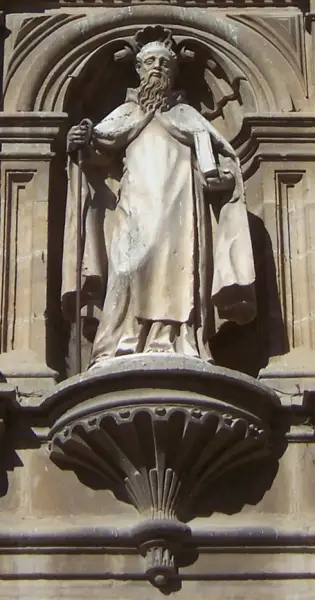
The boy born Domingo García in 1019 at Viloria de Rioja, in the Burgos countryside close to La Rioja, came from the soil he would later break open for roads. His father Ximeno García was a peasant and his mother was named Orodulce, and their son's first occupation was the keeping of sheep, an apprenticeship in solitude and watchfulness that shaped the rest of his life. Feeling called to the religious life, he sought entry into the Benedictine Order, trying Valvanera first and San Millán de la Cogolla afterward; each house refused him, a double rejection that might have ended a lesser vocation. Instead Dominic withdrew into the woods around Ayuela, in the district of the modern town of Santo Domingo de la Calzada, and remained there as a hermit until 1039. Those years in the woods formed the man whom pilgrims would later remember with the emblems of the monastic habit, the prayer beads, and the shepherd's crook: a figure who never stopped being a solitary at heart, even when his roads and bridges made him one of the most publicly useful men of his age.
§ Life
The Envoy from Ostia and the First Bridge
Dominic's hermit life ended in 1039, when Gregory, bishop of Ostia, arrived in the region. Rome had dispatched Gregory to Calahorra as its legate to fight a plague of locusts then ravaging Navarre and La Rioja, and in his service Dominic found the direction his vocation would take: care for a suffering people rather than flight from the world. The bishop ordained him a priest, giving the former hermit a ministry to exercise. The first great work of their partnership was practical and pastoral at once: a wooden bridge over the Oja River, built to help the growing stream of pilgrims who crossed it on the Way of St. James, the great road of faith running from the interior of Europe to the shrine of Santiago de Compostela. When Gregory died in 1044, Dominic returned to Ayuela, but he did not go back to being a mere solitary. The priest of the pilgrim road had discovered his life's work, and everything he built afterward, causeways, bridges, hospices, and churches, would serve the same communion of travelers that he and the bishop from Ostia had first served with timber.
§ Life
The Causeway and the Town That Grew Around It
Back at Ayuela, Dominic set about reshaping the country he had settled. He felled woodland, broke new ground for cultivation, and threw himself into the enterprise that would rename him: a paved road, the calzada, offering an alternative to the old Roman highway linking Logroño and Burgos. Travelers soon made his road the main artery between Nájera and Redecilla del Camino, and the pilgrim traffic of the Way of St. James began to flow across ground he had opened. He was joined in these labors by Juan de Ortega, a companion whose collaboration endured for decades. To better the condition of the pilgrims using the new road, Dominic replaced his and Gregory's wooden bridge with one of stone, and on the site of an old fort he raised a building to serve as a hospice for travelers, a structure that survives today as the Casa del Santo, still used as a hostel by modern pilgrims. A settlement of a few houses formed around his hermitage during his lifetime. In 1076 Alfonso VI of Castile annexed La Rioja and, seeing that Dominic's works aided the Castilianization of the region, resolved to support them; after a royal visit in 1090, Dominic began, with Juan de Ortega at his side, the church in honor of Christ and his Virgin Mother, which received its consecration from the bishop of Calahorra in 1106.
§ Life
Prayer Poured into Stone and Road
Dominic's spirituality joined the solitude of the desert to the service of the road. He began as a hermit in the forests of Ayuela, and even after ordination and decades of public building he remained essentially that figure, remembered in art with prayer beads in hand and the shepherd's crook at his side. His love of God expressed itself in what his hands made: a causeway cut so that pilgrims would not lose their way, a bridge of stone so that they would not drown at the crossing, a hospice so that they would not lie exposed at night. In him the eremitical instinct for withdrawal was not abandoned but redirected; the man twice refused by monasteries built, in effect, a monastery of roads, where every traveler was a guest of God. His care extended to the practical conditions of the body as much as the soul, since he replaced his own timber bridge with masonry precisely to better the pilgrims' situation. When the king came to him in 1090, the hermit-builder gave his answer in the only language he had mastered: another church, dedicated to Christ and his Mother, rising from the wealth his roads had drawn to the region.
§ Life
Consecration and Burial
The closing years of Dominic's long life crowned his work. The church he had undertaken after King Alfonso VI's visit in 1090, raised in honor of Christ and his Mother, stood finished and was given its consecration at the hands of Calahorra's bishop in 1106, three years before his death. Dominic died on 12 May 1109, at about ninety years of age, in the town that had formed around his hermitage and already borne his name. He was buried in the church he had built, and his tomb became the center of a cult that outgrew the building itself: in the 1230s, the church was elevated to the rank of cathedral when it came under the jurisdiction of the Diocese of Calahorra, and it remains the Cathedral of Santo Domingo de la Calzada, his major shrine. The hermit who had been turned away from two monasteries now lies beneath a cathedral of his own founding, and the pilgrims he served in life still pass his tomb on their way to Compostela, pausing at the ornate coop where, in memory of his most famous miracle, a white rooster and hen are kept alive throughout the year.
§ Life
A Cult Born at the Tomb
Dominic de la Calzada never underwent any formal process of canonization; he belongs to the long ranks of saints whose recognition rested on the devotion of the people who prayed at their graves. Miracles were reported at his sepulcher from early on: a French knight possessed by the devil was freed of his affliction after visiting the tomb; a German pilgrim named Bernard, afflicted in his eyes, was cured there in the fifteenth century; and a blind Norman regained his sight when he came to the cathedral. The most famous story attached to his intercession, the miracle of the hanged pilgrim and the singing roasted birds, set in the fourteenth century, spread his fame across Europe and fixed his emblem, the rooster and hen, in his iconography. His feast was fixed on May 12, the day of his death, and the town of Santo Domingo de la Calzada, which grew from a handful of houses around his hermitage, enshrined his memory in its very name. The Church's acknowledgment of his sanctity has always rested on this continuous, centuries-deep veneration at the tomb of the road-builder of La Rioja.
§ Miracles
The Rooster, the Road, and the Engineers
Dominic's most enduring legacy is a legend. A German pilgrim of Xanten named Hugonell, falsely accused of theft by a spurned hostess, was hanged at the town; his parents, finding him alive on the gallows, hurried to the magistrate, who was eating dinner and remarked that the boy was as alive as the rooster and chicken on his plate, whereupon the two birds leaped up singing and crowing. The tale of the rescued hanged pilgrim circulates widely in medieval miracle collections, appearing in Gonzalo de Berceo's Milagros de Nuestra Señora, in the Cantigas de Santa María of Alfonso X, and in the Codex Calixtinus, and is told of other saints and other towns, but the dancing roasted birds are unique to Santo Domingo de la Calzada. In memory of the miracle, a white rooster and hen are kept alive year-round at the cathedral, replaced monthly and housed in the coop maintained by the Confraternity of Santo Domingo; medieval pilgrims wore the birds' feathers in their hats, and chicken-shaped pastries called milagros del santo are sold in the town today. More concretely, his centuries of road and bridge building made him the patron saint of Spanish civil engineers, whose profession he practiced, in effect, as a form of charity.
§ Legend
Timeline
- 1019
Born at Viloria de Rioja near La Rioja, son of the peasant Ximeno García, and raised as a shepherd.
§ Life
- 1039
Left his hermitage at Ayuela to work with Gregory of Ostia, papal envoy combating a locust plague in Navarre and La Rioja, and was ordained a priest.
§ Life
- 1044
After Gregory's death, returned to Ayuela, cleared trees, cultivated the land, and began building the paved causeway that gave him his name.
§ Life
- 1076
Alfonso VI of Castile annexed La Rioja and, valuing Dominic's role in the region's Castilianization, decided to support his projects.
§ Life
- 1090
King Alfonso VI visited Dominic, who then, with Juan de Ortega's help, laid the first stones of a church in honor of Christ and his Mother.
§ Life
- 1106
The new church was consecrated by the bishop of Calahorra.
§ Life
- 12 May 1109
Died on 12 May, aged about ninety, and was buried in his church, which later became the Cathedral of Santo Domingo de la Calzada.
§ Life
- 1230
In the 1230s his burial church was elevated to the rank of cathedral under the jurisdiction of the Diocese of Calahorra.
§ Life
- 1445
A wayside shrine was built at the cathedral holding a piece of wood from the gallows in the legend of the hanged pilgrim Hugonell.
§ Veneration
In Their Own Words
Santo Domingo de la Calzada / Donde cantó la gallina después de asada
The Record
- Major works
- paved causeway that became the principal route between Nájera and Redecilla del Camino·stone bridge over the Oja River·hospice for pilgrims, today the Casa del Santo hostel·church dedicated to Christ and the Virgin Mary, now the Cathedral of Santo Domingo de la Calzada
- Patron of
- patron saint of Spanish civil engineers
- Symbols
- hen and rooster·monastic habit·prayer beads·shepherd's crook
- Canonization
- Pre-congregation saint, venerated at his tomb since his death; feast kept on May 12
Prayer
Bibliography
Show 8 sources
- Stracke, Richard (2015-10-20). "Dominic de la Calzada". Christian Iconography.
- "History of the City", Santo Domingo de la Calzada. Archived from the original on 2021-04-18. Retrieved 2016-01-24.
- "Santo Domingo de la Calzada: Historia de la ciudad". Archived 2007-07-01 at the Wayback Machine.
- "Santo Domingo de la Calzada", Pilgrim Pathways. Archived August 3, 2014, at the Wayback Machine.
- "el milagro del gallo y la gallina".
- "El milagro del peregrino ahoracado". Archived from the original on 2014-03-07. Retrieved 2014-03-07.
- Sharp, Cecil J. (1911). "King Herod and the Cock". English Folk-Carols. Novello & Co. – via Wikisource.
- "Dreaming of Cockaigne". Retrieved 2014-03-07.
Profile text adapted from the Wikipedia article, licensed CC BY-SA 4.0.
Pray with this saint every day
Save St. Dominic de la Calzada to your favorites, read the full profile, and get feast-day reminders in the Saints app.
Get the Saints AppFree on the App Store for iPhone and iPad