
995 – 1060·Feast October 14
St. Dominic Loricatus
Hermit of the iron cuirass and penitential ascetic
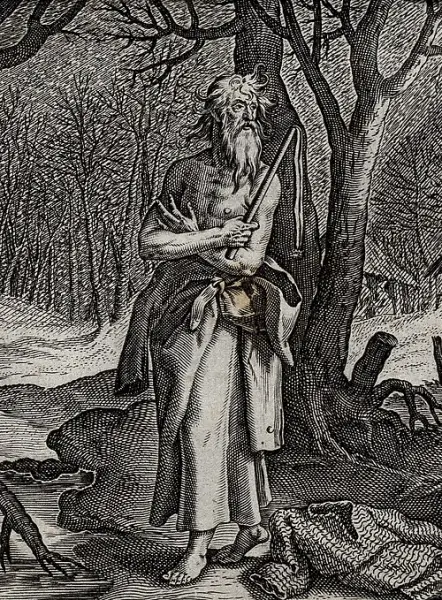
Overview
Dominic Loricatus (995–1060) was an Italian monk of the Camaldolese tradition whose name became a byword for the harshest penitential discipline of his age. Born at Luceolis in the Duchy of Spoleto, he was marked out for Holy Orders by parents who purchased his ordination from a bishop before the age the canons required. Struck by contrition over this act of simony, he abandoned secular priestly life and became a monk, probably at the hermitage of Luceoli, taking John of Monte Feltro as his spiritual director. Around 1044, seeking still greater austerity, he moved to Fonte-Avellana to become a disciple of St. Peter Damian. There he practiced extraordinary mortifications: he wore iron rings and chains on his limbs and a mail shirt, the lorica that gave him his name, and he scourged himself while reciting the psalms, assigning a fixed arithmetic of lashes to years of sin. He is said to have completed the penance of a hundred years, three hundred thousand strokes, in a single Lent. Appointed prior of the Hermitage of San Vicino by Peter Damian in 1059, he died there in 1060, where his remains are still venerated.
The Complete Life
An Ordination Bought with Money
Dominic was born around 995 at Luceolis in the Duchy of Spoleto, in the hill country of central Italy. His path seemed settled early: his parents intended him for the priesthood, and to secure that future they resorted to bribery, paying a bishop to ordain their son before he had reached the age the church's canons required. The arrangement succeeded in making him a priest, and for a few years he lived as a secular clergyman. But the irregular ordination weighed on him. In the reforming climate of eleventh-century Italy, when simony, the buying and selling of sacred offices, was the great scandal that reformers like Peter Damian preached against, Dominic came to regard his own ordination as a share in that sin. The conviction did not destroy him; it converted him. His response was to withdraw from the world entirely and to dedicate himself to a life of penance so severe that it became famous in its own time, the record of a conscience that refused to let a youthful wrong be forgotten until it had been paid for many times over.
§ Biography
The Monk of Luceoli
Stricken with contrition for his part in the simoniacal ordination, Dominic left secular priestly life and became a monk. The likely place of his conversion was the hermitage of Luceoli, where he put himself under the spiritual direction of John of Monte Feltro and remained for roughly two decades, until about 1044. Those years formed him in the eremitical tradition of central Italy, in which solitary monks joined rigorous personal asceticism to the common round of prayer. But Dominic's hunger for penance outran even the discipline of Luceoli. Desiring to intensify his mortifications, he transferred to Fonte-Avellana, the hermitage in the Apennines led by Peter Damian, himself the foremost apostle of penitential self-mortification in the Latin Church. The relationship between the two men was close and in some ways paradoxical: Damian admired Dominic deeply, yet some scholars describe Dominic as Damian's disciple, while Damian called himself Dominic's teacher and lord. Under Damian the older monk found the arena his conscience demanded, and Fonte-Avellana became the stage on which his extraordinary penitential reputation was made. Whatever the exact terms of their bond, the two men agreed in practice on the central place of penance in the Christian life.
§ Biography
The Arithmetic of Lashes
Dominic's asceticism was systematic, almost mathematical. He wore a mail shirt, the lorica from which he took his name Loricatus, as a kind of hairshirt against his skin, in addition to iron rings and chains bound round his limbs. Loaded with this weight he prostrated himself a thousand times each day, or recited entire psalters while holding his arms wide in the shape of a cross. Two scourges lacerated his body day and night, a third whip, perhaps of birch, never left his side, and he applied it each night before sleep. He tied the discipline to the recitation of the psalms: one hundred lashes for each psalm. By the penitential arithmetic of the age, thirty psalms, three thousand strokes, made satisfaction for one year of sin; a full psalter redeemed five years; and twenty psalters, three hundred thousand strokes, redeemed a hundred years. Dominic undertook that hundred-year penance during Lent, and the historian Edward Gibbon marveled that he could discharge an entire century of sin in six days. Peter Damian drew the theological conclusion: the wounds Dominic inflicted on himself were, in his friend's eyes, the stigmata of Christ, and his whole life a Good Friday crucifixion.
§ Biography
Prior of San Vicino
Dominic's austerity did not end in obscure solitude. In 1059, one year before his death, Peter Damian appointed him prior of the Hermitage of San Vicino, near San Severino Marche in the Marche of Camerino, placing the great penitent in command of a community. The appointment acknowledged both his holiness and his experience of the eremitical life; the disciple of Fonte-Avellana was entrusted to lead others along the same path. He did not hold the office long. In 1060 he died at San Vicino, the hermitage he had governed, and there his body remained: his remains are still venerated at the place of his death. The Camaldolese Order, to which the hermitage tradition belonged, fixed his commemoration on October 14. Already within his lifetime or shortly after it, his story had been thought worthy of permanent record: Peter Damian wrote his Life at the request of Pope Alexander II, securing for the man with the iron cuirass a literary monument that outlasted the century of penance he whipped out of himself in a single Lent. The place of his death has remained the place of his veneration, as it has been for nearly a thousand years.
§ Biography
A Saint of the Reforming Church
Dominic Loricatus never passed through any formal process of canonization; he belongs to the age when the recognition of saints rested on local cult, episcopal approval, and the written testimony of credible witnesses. His credentials were of the strongest kind. His Life was composed by Peter Damian, a cardinal bishop and Doctor of the Church, at the express request of Pope Alexander II, which placed the papacy itself behind the testimony to his sanctity. Damian, who promoted penitential self-mortification throughout his writings, presented his friend as an exemplar of the penitential life and did not hesitate to compare his scars to the stigmata of Christ. The church of his region received him as a saint, and his feast passed into the calendar of the Camaldolese Order, kept on October 14. In art he is identified by the emblem of his asceticism: a mail hauberk lying on the ground beside him, or the same hauberk handed to a beggar, images that capture both the armor he wore on his flesh and the poverty he embraced. No decree was needed; the testimony of Damian, the interest of the Pope, and the devotions of the region were proof enough for his age.
§ Attributes and afterlife
Relic, Manuscript, and Gibbon's Verdict
Dominic's afterlife ran through manuscripts and metalwork as much as through hagiography. An Italian sacramentary made for the use of Sant'Apollinare in Classe in Ravenna, originally a rather plain book, was believed to have been used by both Peter Damian and Dominic himself; after Dominic's death it was treasured as a relic. In the twelfth century it received sumptuous silver covers, the work of smiths from southern Italy strongly influenced by Byzantium, setting older ivory plaques taken from an early eleventh-century casket modeled on Byzantine examples. The book later stood for years in the church of Santa Anna of Frontale, then disappeared and passed at one point through the Rütschi collection in Zurich; it is now held in the Glazier Collection of the Morgan Library & Museum in New York. Centuries later his memory surfaced in unlikely company: Edward Gibbon, writing in the Decline and Fall of the Roman Empire, summoned Dominic of the iron Cuirass as the supreme specimen of what he called the fantastic arithmetic of penance, noting that penitents of both sexes imitated the famous hermit and that sturdy disciplinarians might even expiate the sins of their benefactors on their own backs.
§ Attributes and afterlife
Timeline
- 995
Born at Luceolis in the Duchy of Spoleto.
§ Introduction
- 1044
Left the hermitage of Luceoli, where he had lived as a monk under John of Monte Feltro, to join St. Peter Damian at Fonte-Avellana.
§ Biography
- 1059
Appointed prior of the Hermitage of San Vicino near San Severino Marche by Peter Damian.
§ Biography
- 1060
Died at the Hermitage of San Vicino, where his remains are still venerated.
§ Biography
In Their Own Words
Our Dominic, however, bore in body the stigmata of Jesus, and fixed the sign of the cross not only on his forehead, but printed it on every part of his body ... His whole life was for him a Good Friday crucifixion.
By a fantastic arithmetic, a year of penance was taxed at three thousand lashes; and such was the skill and patience of a famous hermit, Saint Dominic of the iron Cuirass, that in six days he could discharge an entire century, by a whipping of three hundred thousand stripes.
The Record
- Major works
- subject of the Vita Sancti Dominici Loricati written by St. Peter Damian
- Patron of
- patron of penitents
- Symbols
- coat of mail lying on the ground·giving a coat of mail to a beggar
- Canonization
- Pre-congregation saint of the Camaldolese tradition; his Life was written by St. Peter Damian at the request of Pope Alexander II
Prayer
Bibliography
Show 10 sources
- Husenbeth, Frederick Charles (1860). Emblems of Saints, by Which They Are Distinguished in Works of Art (2 ed.). London: Longman, Green, Longman, and Roberts. pp. 48, 200.
- Toke, Leslie (1913). "Fonte-Avellana". In Herbermann, Charles (ed.). Catholic Encyclopedia. New York: Robert Appleton Company. Retrieved 10 August 2026.
- Jasper, Kathryn (2024). Land and Reform at the Hermitage of Fonte Avellana, Ca. 1035-1072. Cornell UP. pp. 60, 156. ISBN 9781501777615.
- Cushing, Kathleen G. (2008). "Pueri, Iuvenes, and Viri: Age and Utility in the Gregorian Reform". The Catholic Historical Review. 94 (3): 435–449.
- Smith, Katherine Allen (2008). "Saints in Shining Armor: Martial Asceticism and Masculine Models of Sanctity, ca. 1050-1250". Speculum. 83 (3): 572–602.
- Cooper, William M. (1869). Flagellation and the Flagellants: A History of the Rod in All Countries from the Earliest Period to the Present Time. John Camden Hotten. pp. 49, 477.
- Muessig, Carolyn (2013). "Signs of Salvation: The Evolution of Stigmatic Spirituality Before Francis of Assisi". Church History. 82 (1): 40–68.
- Plummer, John (1959). "The Glazier Collection of Manuscripts". The Burlington Magazine. 101 (674): 193–195.
- Gibbon, Edward. The History of the Decline and Fall of the Roman Empire. Vol. V. Grand Rapids, MI: Christian Classics Ethereal Library. pp. 2476–77.
- Peter Damian, Vita Sancti Dominici Loricati (Life of St. Dominic Loricatus), in Jacques Paul Migne, Patrologia Latina, CXLIV
Profile text adapted from the Wikipedia article, licensed CC BY-SA 4.0.
Pray with this saint every day
Save St. Dominic Loricatus to your favorites, read the full profile, and get feast-day reminders in the Saints app.
Get the Saints AppFree on the App Store for iPhone and iPad