
1000 – 1073·Feast December 20
St. Dominic of Silos
Abbot who rebuilt a decaying abbey into a light of Spain
Overview
Dominic of Silos (1000 – 20 December 1073) was a Spanish Benedictine monk and abbot after whom the Abbey of Santo Domingo de Silos is named. A peasant's child from Cañas in the Kingdom of Najera, he spent his boyhood with the flocks before taking the Benedictine habit at the monasteries of San Millán de la Cogolla, where he was ordained a priest and rose to master of novices and prior. When he and two fellow monks opposed King García Sánchez III of Navarre's plan to annex the monastery's lands, they were driven out. Under the protection of King Ferdinand I of León, they found refuge in 1041 at Silos, at the decaying Abbey of St. Sebastian, then home to only six monks, and Dominic was appointed abbot. Inspired by the reforms of Cluny, he rebuilt the monastery spiritually and physically, raising the great Romanesque cloisters, founding a scriptorium that made the abbey a center of book design and scholarship, and funding charity from a gold and silver workshop. He became known for works of healing and raised money to ransom Christians captured by the Moors. When he died on 20 December 1073 the community numbered forty monks, and both the abbey and the town were afterward renamed for him.
The Complete Life
A Peasant's Son from La Rioja
Dominic was born in the year 1000 at Cañas, in the Kingdom of Najera, in what is today La Rioja in northern Spain. His family were peasants, and his first work was the humble one that would follow him into his iconography and his patronage: he kept sheep. The boy who guarded flocks on the hillsides of La Rioja passed, in the natural course of a religious age, into the monastery, becoming a Benedictine at the celebrated monasteries of San Millán de la Cogolla. There his gifts quickly showed themselves. He was ordained a priest, and within the community he was entrusted first with the formation of newcomers as master of novices and then advanced to prior, the second office of the house. His rise through the ranks of one of Spain's greatest abbeys might have carried him to a comfortable and honored old age had not providence, in the form of an ambitious king, interrupted it. The shepherd from Cañas was about to learn that fidelity to the Church's property and freedom could cost a monk his home, and that what seemed an expulsion was in fact a sending.
§ Life
Expulsion and Refuge
Trouble came to San Millán through King García Sánchez III of Navarre, who intended to annex the monastery's lands for himself. Dominic opposed the plan, standing with the monastery's rights against royal appetite, and for his resistance he was driven out together with two of his fellow monks. The expulsion proved to be the hinge of his life. The three exiles found protection with another king, Ferdinand I of León, and in 1041 they took refuge in the town of Silos, on Castilian soil, at the Abbey of St. Sebastian. The house they reached was itself in decay, occupied by only six monks, a shell of a monastery barely holding on. Dominic was appointed abbot of this struggling remnant, and the monk who had lost his post for defending a great monastery was given a dying one to save. He set about the work under the inspiration of the reforms of Cluny, the Benedictine renewal that was then transforming monastic life across Europe, and the small community at Silos became the theater of one of the most remarkable monastic restorations of eleventh-century Spain.
§ Life
Rebuilding Silos in Body and Soul
As abbot, Dominic rebuilt his monastery in both senses, spiritually and physically. Physically he raised the cloisters in the Romanesque style, the double-tiered arcade for which Silos remains famous; spiritually he reformed the community until the abbey flourished again. He established a scriptorium that turned Silos into a center of book design and scholarship, and the house ranked among the great strongholds of the Mozarabic liturgy while keeping alive the Visigothic script of ancient Spain, so that the abbey he rescued became a treasury of Spain's Christian past. The community's material needs were supported by the proceeds of a gold and silver workshop, and its wealth flowed outward in significant charity. Dominic became known for works of healing, and his most characteristic labor of mercy was ransoming: he raised funds to free Christians who had been taken prisoner by the Moors, a work that made him a natural patron of captives. Wealthy patrons endowed the monastery as its reputation grew. By the time of his death the six monks he had found at Silos had become forty, and the abbey that bore another saint's name when he arrived would soon bear his own.
§ Life
The Cluniac Abbot and Healer
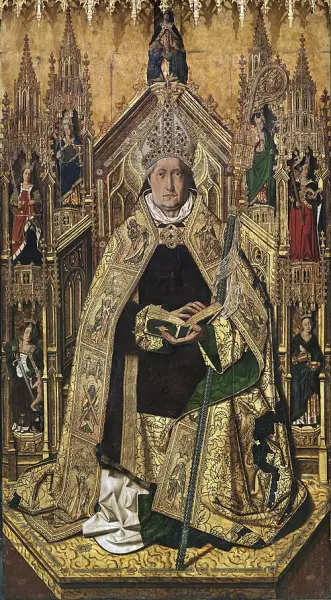
Dominic's spirituality was formed in the Benedictine tradition renewed by Cluny: solemn liturgy, disciplined community life, and generous care for the poor and captive. The abbey he shaped preserved the Mozarabic liturgy and the Visigothic script, suggesting an abbot who reverenced inheritance as much as innovation, guarding the ancient worship and writing of Spain even as he built in the current Romanesque manner. His charity was practical and large-hearted, funded by the abbey's workshops and aimed at the most vulnerable, above all the Christian captives in Moorish hands, whose freedom he purchased with money he raised himself. Contemporaries and later tradition attached a different kind of fame to him as well: he became known for works of healing, and his intercession was credited with cures that continued after his death. This reputation for healing shaped the devotional geography of Spain, since the sick and the anxious came to his shrine as to a source of relief. The veiled crozier of the abbot, the book in his enthroned hands, and the Seven Virtues gathered around him in later paintings express the ideal he embodied: learning, liturgy, and mercy rooted in a life of monastic prayer.
§ Life
Forty Monks and a Name Changed
Dominic governed Silos for more than three decades, long enough to see his work complete. He died on 20 December 1073, aged seventy-two or seventy-three, at the abbey he had raised from near extinction. The measure of his abbacy was simple and telling: the community that had numbered six monks at his arrival counted forty at his death, a sevenfold increase that testifies to the attractiveness of the life he had built there. The gratitude of the place outlasted him in its very name, for monastery and town alike took his name after his death, forming the Abbey of Santo Domingo de Silos and the settlement that grew beside it, the only abbey in Spain dedicated to one of its own abbots. His remains were carried in translation to the abbey church on 5 January 1076, barely two years after his death, an early and eloquent sign of the veneration gathering at his tomb. The abbot who had been driven out of one great monastery had, by the end, given Spain a greater one, and he rested in its church as its patron and possession.
§ Veneration
An Early and Flourishing Cult
Dominic of Silos was never the subject of a formal canonization process as later centuries would understand one; he belongs to the era when sanctity was affirmed by the swift growth of a cult at a saint's tomb. The signs came quickly. On 5 January 1076 his remains were moved to the abbey church, and by 1085, hardly a dozen years after his death, churches and monasteries were already being dedicated to him across the region. His annual feast was fixed on 20 December, the day of his death, and he entered the calendar of the universal Church as a confessor. His fame was carried through the thirteenth century by Gonzalo de Berceo, the noted priest and poet who wrote an account of his life, giving the cult a literary monument to match its liturgical one. Later art fixed his image: Bartolomé Bermejo's fifteenth-century painting shows him enthroned as mitred abbot with a book and the veiled crozier proper to his office, and surrounded by the Seven Virtues. The Church's continuous recognition, from translated relics to painted altarpieces, has never been interrupted at Silos.
§ Veneration
The Crozier of Queens and the Founder's Namesake
The most famous chapter of Dominic's legacy concerns another Dominic. Tradition tells that Blessed Joan of Aza, mother of the future St. Dominic de Guzmán, prayed at his tomb and conceived the son to whom she gave his name; that son would go on to found the Dominican Order. From this story flows the saint's special connection with pregnancy: down to the founding of the Second Spanish Republic in 1931, queens of Spain received the blessing of his crozier, and the staff stood beside their beds through their hours of labor. He is honored as patron of prisoners, pregnant women, and shepherds, and invoked against rabies, rabid dogs, and insects. His abbey had a second life as well: in the nineteenth century Silos became a monastery of the Benedictine Congregation of Solesmes, and it is now celebrated for its fine double Romanesque cloisters, its extensive library, and its recordings of Gregorian chant, which carried the abbey's song to listeners around the world. The shepherd's son from Cañas thus remains audible and visible in the Church, in the chant of his monks, in the stones of his cloister, and in the name of the great order his shrine helped bring to birth.
§ Patronage
Timeline
- 1000
Born at Cañas in the Kingdom of Najera, modern La Rioja, to peasant parents, and worked as a shepherd before entering monastic life.
§ Life
- 1041
Driven out of San Millán de la Cogolla for opposing King García Sánchez III's land annexation, found refuge at the decaying Abbey of St. Sebastian at Silos and was appointed abbot.
§ Life
- 20 Dec 1073
Died at Silos, leaving a community of forty monks in the abbey he had rebuilt in the spirit of Cluny.
§ Life
- 5 Jan 1076
His relics were translated to the monastery church, which afterward took his name together with the town.
§ Veneration
- 1085
Churches and monasteries were being dedicated to him by this early date, a sign of his spreading cult.
§ Veneration
The Record
- Major works
- rebuilding of the Abbey of Santo Domingo de Silos, including its Romanesque cloisters·scriptorium that made Silos a center of book design and scholarship·ransom of Christians held prisoner by the Moors
- Patron of
- against rabies·against rabid dogs·against insects·captives·prisoners·pregnant women·shepherds
- Symbols
- abbot surrounded by the Seven Virtues·mitred abbot enthroned with a book·veil tied to his crozier
- Canonization
- Pre-congregation saint; his relics were translated in 1076 and churches were dedicated to him as early as 1085
Prayer
Bibliography
Show 6 sources
- "Saint Dominic of Silos". Franciscan Media. 2015-12-20. Retrieved 2020-09-28.
- "St. Dominic of Silos". Catholic News Agency. Archived from the original on October 8, 2020. Retrieved 2020-09-28.
- Stevens, Clifford. The One Year Book of Saints. Our Sunday Visitor Publishing Division, Our Sunday Visitor, Inc., Huntington, Indiana.
- "Dominic of Silos". Oxford Reference. Retrieved 2020-09-28.
- "Saint Who? Saint Dominic of Silos". Magnificat. 18 (3). Magnificat USA: 324. May 2016.
- "St. Dominic of Silos". faith.nd.edu. Retrieved 2020-09-28.
Profile text adapted from the Wikipedia article, licensed CC BY-SA 4.0.
Pray with this saint every day
Save St. Dominic of Silos to your favorites, read the full profile, and get feast-day reminders in the Saints app.
Get the Saints AppFree on the App Store for iPhone and iPad