
1842 – 1857·Feast May 6
St. Dominic Savio
The schoolboy saint of Don Bosco's Oratory
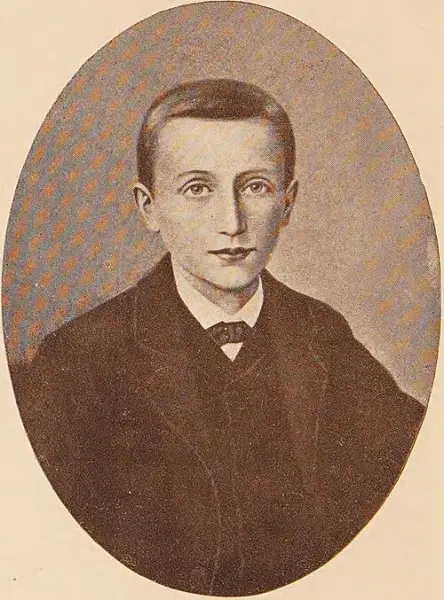
Overview
Dominic Savio was an Italian teenager, a student of St. John Bosco, who became one of the youngest canonized saints in the history of the Catholic Church. Born on 2 April 1842 near Chieri in Piedmont to a poor, hardworking blacksmith and a seamstress, he showed unusual piety from early childhood: he prayed by himself at four, served Mass at five, and was allowed an early First Communion at seven, a day he called the happiest of his life. Sent to school at Castelnuovo and then, after meeting John Bosco on 2 October 1854, to the Oratory of St. Francis de Sales in Turin, he resolved to become a saint. Bosco steered his zeal away from extreme penances toward cheerful fidelity in ordinary duties. Dominic founded the Sodality of Mary Immaculate, stood between quarreling schoolmates with a crucifix, and encouraged his companions in prayer and the sacraments. His health failed, and he was sent home to Mondonio, where he died on 9 March 1857, aged fourteen, probably of pleurisy hastened by bloodletting. Bosco's biography of him, The Life of Dominic Savio, became the foundation of his cause, and Pius XII canonized him in 1954.
The Complete Life
The Blacksmith's Son from Piedmont
The birth of Domenico Savio took place on 2 April 1842 at San Giovanni, a hamlet belonging to Riva presso Chieri in Piedmont, two miles from the town of Chieri. His baptismal name means "of the Lord" and his surname means "wise". His father Carlo was a blacksmith, his mother Brigitta a seamstress, and they would have ten children in a household described as poor, hardworking, and pious. When Dominic was two the family returned to their hometown of Murialdo, on the outskirts of Castelnuovo d'Asti. There his Christian upbringing showed early fruit: by four he could pray alone and was sometimes found in solitude at prayer; he helped his mother, welcomed his father home, and said grace at meals unfailingly. The chaplain of Murialdo recalled seeing the boy kneel outside the locked church to pray, even in mud or snow. At the village school he advanced through diligence as much as cleverness, and refused to join classmates in anything he judged morally wrong. At five he learned to serve Mass, attended daily when he could, and went regularly to confession. His early First Communion at seven, exceptional in an age when children usually waited until twelve, became the touchstone of his spiritual life.
§ Early life
Meeting Don Bosco and the Resolve for Sainthood
For secondary schooling Dominic walked daily to the County School at Castelnuovo, where his conduct won the praise of the school's head, Fr. Allora, who said he was wise, as his name, not only in name but in fact. His teacher Fr. Giuseppe Cugliero gave the boy so warm a character reference that John Bosco sought him out around the Feast of the Rosary; their meeting came on 2 October 1854, Dominic arriving in his father's company, who tested the boy by handing him a Catholic apologetics pamphlet to memorize; hardly ten minutes had gone by before the boy was at his elbow, reciting the page and expounding it to his satisfaction. Bosco took him to Turin to study at the Oratory of St. Francis de Sales, where Dominic wished to prepare for the priesthood. About six months later he heard a talk on sainthood whose three points seized him: that God wills everyone to be a saint, that it is easy, and that a great reward awaits those who try. Anxious about how to begin, he grew quiet until Bosco counselled him to keep his cheerfulness, his studies, his devotions, and his games with the other boys. Learning that his name meant "belonging to God" only deepened his resolve.
§ Under John Bosco's mentorship
Apostle Among His Schoolmates
Dominic's mission field was the playground and the classroom. When two older, stronger schoolmates prepared to settle a quarrel with a rock fight, he could not restrain them by force; instead he walked with them to the site, placed himself between them, held up his crucifix, and asked them to throw their first stones at him, since whatever they did to him they did to Christ. Shame accomplished what argument could not: the duel collapsed, and Dominic then led both boys to confession. When a visitor spread a magazine of bad pictures among fascinated boys, he snatched it, tore it up, and told them one look was enough to stain the soul. He spent time with his friends encouraging their devotions, discouraged swearing, taught catechism at Sunday school, and urged frequent confession and Communion, even offering spiritual advice in the middle of games. When the dogma of the Immaculate Conception was defined in 1854, Dominic resolved to fix the event in his school's memory and, with his friends, founded the Sodality of Mary Immaculate, whose aims were to honor Mary and draw others to honor her, and to encourage frequent Communion; the twenty-one articles they composed were proclaimed together at Mary's altar in the Oratory and, after the rector's careful review, won his approval under certain conditions. A member later founded the Sodality of the Blessed Sacrament, which spread through Catholic schools.
§ Notable incidents in the life of Dominic Savio
The Heroism of the Ordinary
Dominic's spirituality rested on the sacraments, on Mary, and on the sanctification of everyday duty. A homily on the sacraments moved him to fix on one priest as his permanent confessor, and by the close of his first Oratory year, on advice, he was Communicating daily, assigning a particular intention to the Eucharist for every day of the week. He eagerly accompanied priests carrying the Viaticum to the dying and knelt in the street when the Eucharist passed by. In his zeal for sainthood he attempted severe bodily penances: stones and splinters of wood laid in his bed, scanty clothes in the cold, a hair shirt, bread-and-water fasts, deliberately slow marches through the frost, even pricks from a pen nib. His superiors forbade all such mortification as a danger to his health, and Bosco told him that for a schoolboy the best penance was to perform his duties with perfection and humility, obedience being the greatest sacrifice. Dominic accepted this direction, forming the motto that he could not do big things but wanted everything done for God's glory. He stopped complaining about food or weather, bore suffering cheerfully, and practiced custody of his eyes and tongue. John Bosco's mother observed that none of the many good boys could match the heart and soul of Dominic Savio.
§ Attempts to do penances
A Radiant Death at Fourteen
Signs of mortality gathered in Dominic's last year. He confided that he felt he had not long to live, threw himself into the monthly Exercise of a Happy Death, and predicted he would be the first of his group to die. In May 1856 he told Bosco to let him do what he could that year, promising to reveal his plans if he lasted another. His strength waned even as he spent his time encouraging troubled companions and helping in the school infirmary. When a severe cough developed, Bosco followed the doctors' advice and fixed 1 March 1857 as the day he must go home; Dominic accepted the decision, spent his last evening in spiritual conversation with Bosco, asked to be enrolled among those sharing the Pope's plenary indulgence, and took an affectionate farewell of his friends. At home in Mondonio his cough worsened; the doctor bled his arm ten times in four days, a treatment now thought to have hastened his death. Calm throughout, he made his confession, received Viaticum and the anointing of the sick, and on the evening of 9 March 1857, once the prayers of the Exercise of a Happy Death had been read over him, he spoke of the wonderful things he saw and died. His father wrote to Bosco comparing his son to a white lily, like Aloysius Gonzaga.
§ Death
Too Young? The Case of the Boy Saint
The path to the altars began almost immediately, for John Bosco wrote his pupil's life soon after his death, and that biography, together with the testimony of family and friends, became the backbone of the cause. Objections were raised that no child of fourteen could yet have earned the altars, but Pius X refused the argument and set the process in motion, reasoning that what mattered was the display of heroic virtue in everyday life, not length of years. Dominic was raised to the rank of Venerable in 1933 by Pius XI, who paired his small stature with a spirit of towering size. Pius XII beatified him on 5 March 1950 in Rome and canonized him on 12 June 1954, making him the youngest non-martyr saint in the Catholic Church, a distinction he held until the canonization in 2017 of Francisco and Jacinta Marto, the child visionaries of Fatima, aged ten and nine. His canonization established once for all that sanctity has no minimum age, and that a schoolboy's fidelity in small things can weigh as much in the Church's judgment as the achievements of the old and great.
§ Veneration
A Book, a Tomb, and a Patron of the Young
Dominic Savio's chief monument is literary: John Bosco's The Life of Dominic Savio, written soon after the boy's death, which was so highly regarded in its day that, with Bosco's History of Italy and Ecclesiastical History, it served as course material for Italian language classes in public schools. The book preserved the incidents, resolutions, and sayings that carried his cause, and it remains a classic of Salesian spirituality. His body rests in the Basilica of Our Lady Help of Christians in Turin, where an altar holds his relic. He is honored on 6 May, having formerly been celebrated on 9 March, the day of his death. He is invoked as patron of choirboys, of falsely accused people, in memory of his silent endurance of an unjust accusation at Mondonio, of juvenile delinquents, and of altar servers. Parishes under his patronage exist as far afield as Slavonski Brod in Croatia. In the long line of youthful saints he remains the model of the ordinary sanctified, cited alongside Carlo Acutis, the Italian teenager canonized in 2025, as proof that holiness can ripen in a childhood cut short.
§ The Life of Dominic Savio
Timeline
- 2 Apr 1842
Born at San Giovanni, a frazione of Riva presso Chieri in Piedmont, son of the blacksmith Carlo and the seamstress Brigitta Savio.
§ Early life
- 1849
At seven, permitted to make his First Communion early and wrote his famous resolutions in a little book, ending with "Death rather than sin".
§ First Communion
- 2 Oct 1854
Met John Bosco at Murialdo, impressing him with a recitation test, and was soon taken to Turin to study at the Oratory.
§ Meeting with John Bosco
- 12 Sep 1856
Asked leave to go home to his ailing mother, whose recovery and delivery of his sister Catherine followed his visit.
§ His mother's pregnancy
- 1 Mar 1857
Left the Oratory for home on doctors' orders as his cough and failing health worsened.
§ Failing health
- 9 Mar 1857
Died at Mondonio, aged fourteen, after receiving the last sacraments and the papal blessing.
§ Death
- 1858
John Bosco reported to Pope Pius IX Dominic's vision of the Catholic faith lighting up England.
§ The vision of England
- 1933
Declared Venerable by Pope Pius XI, who had earlier contrasted the boy’s small frame with the giant scale of his spirit.
§ Veneration
- 5 Mar 1950
Beatified in Rome by Pope Pius XII.
§ Veneration
- 12 Jun 1954
Canonized by Pope Pius XII, becoming the youngest non-martyr saint in the Catholic Church at that time.
§ Veneration
In Their Own Words
First I will confess very often and I will receive Communion whenever the confessor gives me permission. Second: I wish to sanctify feastdays. Third: my friends will be Jesus and Mary. Fourth: death but not sins.
That was the happiest and most wonderful day of my life.
Nothing seems tiresome or painful when you are working for a master who pays well.
I can't do big things but I want everything to be for the glory of God.
Goodbye, Dad, goodbye ... what was it the parish priest suggested to me ... I don't seem to remember ... Oh, what wonderful things I see ...
The Record
- Major works
- The Sodality of Mary Immaculate, founded with his friends at the Oratory
- Patron of
- choirboys·falsely accused people·juvenile delinquents·altar servers
- Symbols
- crucifix
- Canonization
- Canonized by Pope Pius XII on 12 June 1954 in Rome
Prayer
Bibliography
Show 10 sources
- Arduino, Fabio. "Domenico Savio", Santi e Beati. Retrieved on 24 November 2006.
- "Saint of the Day, March 9", Saint Patrick Catholic Church, Washington, D.C. Retrieved 2 March 2012.
- Bosco, John. Memoirs of the Oratory of Saint Francis de Sales. Daniel Lyons, trans. New Rochelle, New York: Don Bosco Publications, 1989.
- McNamara, Robert. "St. Dominic Savio", Saints Alive, 24 November 2006.
- Stevens, Clifford. "St. Dominic Savio", The One Year Book of Saints, OSV Publishing.
- Avella, Steven M; Zalar, Jeffrey (Fall 1997), "Sanctity in the Era of Catholic Action: The Case of St. Pius X", Catholic Historian, 15 (4), pp. 57–80.
- Newland, Mary Reed. The Saints and Our Children, Chapter 3, Tan Books.
- Index ac status causarum beatificationis servorum dei et canonizationis beatorum (in Latin). Typis polyglottis vaticanis. January 1953. p. 59.
- Media, Franciscan (10 March 2016). "Saint Dominic Savio". Retrieved 14 September 2023.
- "Župa sv. Dominika Savija slavi nebeskog zaštitnika" [St. Dominic Savio Parish celebrates its celestial patron]. ika.hkm.hr (in Croatian). Informativna katolička agencija (IKA). 6 May 2026.
Profile text adapted from the Wikipedia article, licensed CC BY-SA 4.0.
Pray with this saint every day
Save St. Dominic Savio to your favorites, read the full profile, and get feast-day reminders in the Saints app.
Get the Saints AppFree on the App Store for iPhone and iPad