
died 560·Feast May 7
St. Domitian of Huy
Bishop of Tongeren and apostle of the Meuse Valley
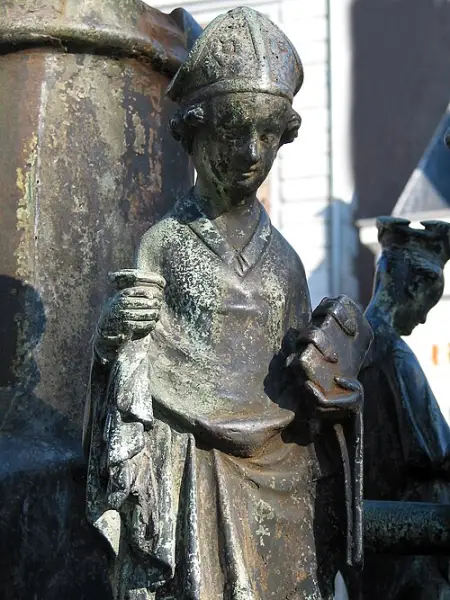
Overview
Domitian of Huy (Latin: Domitianus), also remembered as Domitian of Maastricht, was a sixth-century bishop in the Frankish kingdom whose episcopate joined learned resistance to heresy with concrete works of mercy. Chosen for the see of Tongeren, he afterwards transferred his seat to Maastricht, and he represented his church at the Council of Clermont in 535 and at the Fifth Council of Orléans in 549, where his arguments against heretical teachers were judged especially convincing. He fostered the writing of polemic against heresy in the early Frankish church and laboured to evangelize the Meuse Valley, an effort that earned him the title Apostle of the Meuse Valley. He built churches and hospices so that his people could be cared for in soul and body alike, and his talent for raising money once relieved a famine in his bishopric. He died on 7 May 560. His relics are venerated at the Church of Notre-Dame in Huy, of which he is patron, and he is invoked against fever.
The Complete Life
A Frankish Bishop of Obscure Origins
The surviving record tells remarkably little about Domitian's beginnings. He was born somewhere within the Kingdom of the Franks during the sixth century, and no source names his parents, his hometown, or the circumstances that first set him on the path to church service. Later writers sometimes attach him to Maastricht, and the doubled dedication — Domitian of Huy, Domitian of Maastricht — reflects the movement of his episcopal seat rather than any known change in his life story. What the earliest notices preserve instead is the shape of his public career: a Gaulish bishop of the sixth century noted for generosity and for writing against heresy. The quietness of his origins is itself a reminder of how the Frankish church took root, through men whose names survive not because of distinguished birth but because of the sees they held, the councils they attended, and the valleys they evangelized. For the faithful of Huy, that obscurity has never dimmed his memory; it has only made the local devotion that grew around his tomb the more remarkable.
§ Introduction
Shepherd of Tongeren and Maastricht
Domitian's ministry unfolded among the sees of the Meuse, where the Frankish church was still consolidating its structure. He was chosen bishop of Tongeren, an ancient see, and later moved his seat to Maastricht, a transfer that placed him at the centre of the church's work in the region. His standing among his colleagues is measured by the councils he attended: he was present at the Council of Clermont in 535, and fourteen years later he took part in the Fifth Council of Orléans in 549, where the assembled bishops confronted the heretical movements still troubling Gaul. There Domitian spoke out against the heretics with such effect that his intervention was remembered long afterwards. Contemporaries valued him not only as a debater but as an encourager of others, for he promoted the development of written polemic against heresy throughout the early church in the Frankish lands. In an age when episcopal authority carried both spiritual and civic weight, he used that authority chiefly to clarify doctrine and to protect his people from teaching he judged false.
§ Life
Apostle of the Meuse Valley
Domitian's ambition extended beyond the council chamber to the villages and river towns of his vast territory. He worked to evangelize the Meuse Valley, preaching where Christian roots were still shallow, and his success there was such that he is occasionally called the Apostle of the Meuse Valley. Evangelization for him was never a matter of words alone. He constructed churches and hospices so that the communities he planted could worship and find care for the body as well as the soul, an early example of the paired spiritual and corporal works of mercy. His generosity became proverbial, and with it went a practical gift that sounds almost modern: he was remarkably adept at procuring money through fund-raising, a talent that on one occasion helped ease a famine in his bishopric. Bread gathered by a bishop's pleading kept his people alive. This union of doctrine, building, and almsgiving is why his memory endured along the river he served, long after the political map of the Frankish kingdom had been redrawn many times over.
§ Life
Patron of Huy and Deliverer from the Dragon
Domitian died on 7 May 560, and his cult took root at Huy, where his relics are kept and venerated in the Church of Notre-Dame. The city that received his bones made him its patron saint, and each year his memory is kept in a procession to a local spring, a rite that preserves the memory of his care for the valley's waters. Popular tradition holds that he rid the district of a dragon whose venom had spoiled the waters, and for that reason art shows him with the conquered beast lying at his feet — the conquered evil subdued at the saint's prayer. Alongside the legend stands a continuing practice of intercession: he is invoked against fevers, the affliction his people associated with tainted water. His feast is kept on 7 May, the anniversary of his death, in both the Eastern Orthodox and Roman Catholic Churches. Few bishops of the sixth century left so distinct a local imprint, and at Huy the saint of the Meuse Valley is still honoured in stone, procession, and prayer.
§ Veneration
Timeline
- 535
Chosen bishop of Tongeren and present at the Council of Clermont; he later moved his episcopal seat to Maastricht.
§ Life
- 549
Spoke out convincingly against heretics at the Fifth Council of Orléans.
§ Life
- 7 May 560
Died on 7 May; his relics are now venerated at the Church of Notre-Dame in Huy.
§ Introduction
The Record
- Major works
- Polemical writings against heresy·Churches and hospices across the Meuse Valley
- Patron of
- Huy, Belgium·against fever
- Symbols
- A dragon at his feet
- Canonization
- Pre-congregation; venerated as a saint by the Eastern Orthodox and Roman Catholic Churches
Prayer
Bibliography
Show 5 sources
- Jones, David Rice. "Domitianus, St.", A Dictionary of Christian Biography, (William Smith, ed.), J. Murray, 1877
- "St. Domitian of Huy", Catholic Review, Archdiocese of Baltimore
- "Domitian of Maastricht", Catholic News Service, May 7, 2017
- Baring-Gould, Sabine. Lives of the Saints, J.C. Nimmo, 1898, p. 108
- Rabenstein, Katherine (August 1999). "Domitian of Huy". Saint of the Day, May 7: Domitian of Huy
Profile text adapted from the Wikipedia article, licensed CC BY-SA 4.0.
Pray with this saint every day
Save St. Domitian of Huy to your favorites, read the full profile, and get feast-day reminders in the Saints app.
Get the Saints AppFree on the App Store for iPhone and iPad