
c. 550 – 602·Feast January 10
St. Domitian of Melitene
Archbishop, imperial diplomat, and kinsman of Maurice
Overview
Domitian (Greek: Dōmitianos, c. 550 – 602) was archbishop of Melitene in Roman Armenia from about 580 until his death, and the nephew of the emperor Maurice. The sources portray him first as a courtier-bishop: he became one of Maurice's most trusted counsellors in the Persian and Balkan wars, received foreign envoys such as King Childebert II of Austrasia, and was named guardian of the imperial children in the emperor's testament. His chief diplomatic hour came in 590–591, when he joined the mission that restored the exiled Persian king Khosrow II to his throne; the bishops involved evidently hoped to convert Khosrow, and Domitian corresponded about the effort with his old friend Gregory the Great. He took the surrender of Martyropolis, marched with the Roman army as far as Mardin, and helped negotiate a treaty of friendship with Persia, using money Khosrow gave him to build churches and hospitals. As the de facto head of religious affairs under Maurice he enforced Chalcedonian orthodoxy, and in 598–599 he directed a persecution of the monophysites that monophysite chronicles remember as brutal, blaming him for the killing of 400 resisting monks at Edessa. His death came on 12 January 602, and the Church of the Holy Apostles in Constantinople received his body.
The Complete Life
A Nephew of the Emperor
Domitian was born around 550, and almost everything the sources say about his origins passes through later and uneven witnesses. His life is sketched in the Synaxarion of Constantinople and, probably drawing on it, in the Menologion of Basil II of the eleventh century — texts written centuries after his death, whose reliability is acknowledged to be uncertain, though their notice that he was thirty at his consecration is thought to preserve a genuine fact. On the identity of his father the sources divide: the Chronicle of 1234 and Michael the Syrian make him the son of Peter, the emperor Maurice's brother, and this is generally accepted; John of Nikiu contradicts himself between that account and another that would make him a cousin, while Evagrius Scholasticus, Theophylact Simocatta, and Nicephorus Callistus call him simply a relative. The Synaxarion alone names a Theodore and his mother Ecdicia, but no brother Theodore of Maurice is otherwise known. What is consistent is that Domitian was given both a secular and a biblical education, that as a young man he befriended the future Pope Gregory the Great when Gregory served in Constantinople between 579 and 585, and that the two studied Scripture together. Married briefly, he was widowed young, renounced the world, and became known for uniting sagacity with ascetic discipline.
§ Early life
Bishop and Archbishop of Melitene
Domitian's elevation came through his family's rising fortunes. While Maurice was still commander of the eastern armies and perhaps two years before his accession — around 580, then — he arranged Domitian's election to the see of Melitene, the metropolitan church of the province in Roman Armenia. The Synaxarion's note that the new bishop was thirty years old fixes the outlines of a career begun young, and the sources agree that he was strikingly youthful for such a charge. He repaid the family's confidence by lending his see new dignity: though Melitene's bishops were metropolitans of their province, Domitian was the first to bear the title archbishop, and Maurice in his honour raised the province itself from Armenia Tertia to Armenia Prima, transferring his kinsman's city from the administrative shadow of Cappadocia into a province of its own. John of Ephesus records that after Maurice became emperor, Domitian soon removed to Constantinople, where for long stretches of the reign — 582 to 585, and again 591 to 598 — he resided at court. His episcopate was thus spent less in his cathedral city than in the palace, a bishop whose diocese in practice was the empire's eastern policy.
§ Maurice's advisor
Diplomat Between Two Empires
Domitian's public career unfolded on the stage where Roman and Persian power met. At court he stood close to Maurice in the direction of the fighting against Persia and against the Avars and Slavs, and the emperor entrusted him with missions to various pagan tribes. His standing abroad is witnessed by a letter King Childebert II of Austrasia addressed to him in 587 or 588 seeking a peace treaty with the Romans — evidence that a Frankish court considered an Armenian archbishop the right channel for diplomacy, and a rare survival of his correspondence in the Epistulae Austrasicae. His great assignment came in 590, during a Persian civil war, when he and Bishop Gregory of Antioch were sent to Constantina to meet the exiled king Khosrow II; the choice of two churchmen pointed to the hope of converting him. Domitian received the capitulation of Martyropolis's Persian garrison — his speech on that occasion was recorded by Theophylact Simocatta — accompanied the king and Narses' army as far as Mardin in 591, and at Ammodium addressed the troops once more before returning to Roman territory, declining to press on to the Persian capital. When Khosrow offended the people of Dara, Domitian withdrew the army until the king yielded obeisance. He helped conclude a treaty of friendship with Persia, and in August 593 he reported these efforts to Gregory the Great, who praised him for preaching the faith to the Persian king.
§ Persian mission
Ascetic at the Centre of Power
The combination that struck his contemporaries was piety joined to political weight. The Synaxarion says he renounced the world after his young wife's death and became celebrated for joining sagacity with asceticism — a court bishop who lived like a monk. John of Ephesus, no admirer of his later career, testifies that in religion he was thoroughly imbued with the teaching of the Council of Chalcedon and of Leo's Tome, the twin standards of imperial orthodoxy, and the same writer records the touchstone of his personal conduct: he gave away to the poor the gifts he received from the emperor. His theological standing was recognized by others of his rank. Eulogius of Alexandria dedicated to him his treatise on Leo's Tome, and Photios preserves an exchange in which Domitian took exception to Eulogius's use of Cyril's miaphysite formula about the one nature of God the Word — a protest Eulogius could only answer apologetically, which shows who carried the greater authority. With the patriarchal see of Constantinople he was close enough to take part in the consecration of Cyriacus II in 596, an occasion on which Gregory the Great chided the bishops for a misuse of scripture. To the men of his generation he functioned, for all practical purposes, as the foremost spiritual figure of the empire during Maurice's reign.
§ Maurice's advisor
The Persecution of the Monophysites
Between 598 and 599 the emperor granted Domitian license to move against the monophysites around Melitene, and the campaign spread through Mesopotamia and northern Syria, where monophysite writers accuse him of seizing all their churches. Who drove the policy the sources dispute: Michael the Syrian says it was provoked by Domitian, gnawed by jealousy at monophysite conversions in his own city, while the Chronicle of 1234 holds that Maurice summoned his archbishop and authorized him to act against the followers of Severus of Antioch. Modern historians have judged the persecution's scale very differently, some calling it the most brutal of its age, others insisting it cannot have reached significant proportions. What is certain is the account of Edessa: the Chronicle of 1234 and Michael the Syrian, both drawing on the lost Dionysios of Tel Maḥre, relate that four hundred monks of the monastery of the Orientals who refused communion from him were put to death outside the Bēth Shemesh gate, the Chronicle laying the order on Domitian himself and Michael the Syrian excusing him and blaming the commander. He deposed Thomas of Harqel from Mabbug and Paul from Constantia, exiling them to the monastery of the Antonini. Only Khosrow's capture of Edessa in 609 reversed what he had done.
§ Persecution of monophysites
Death and Burial
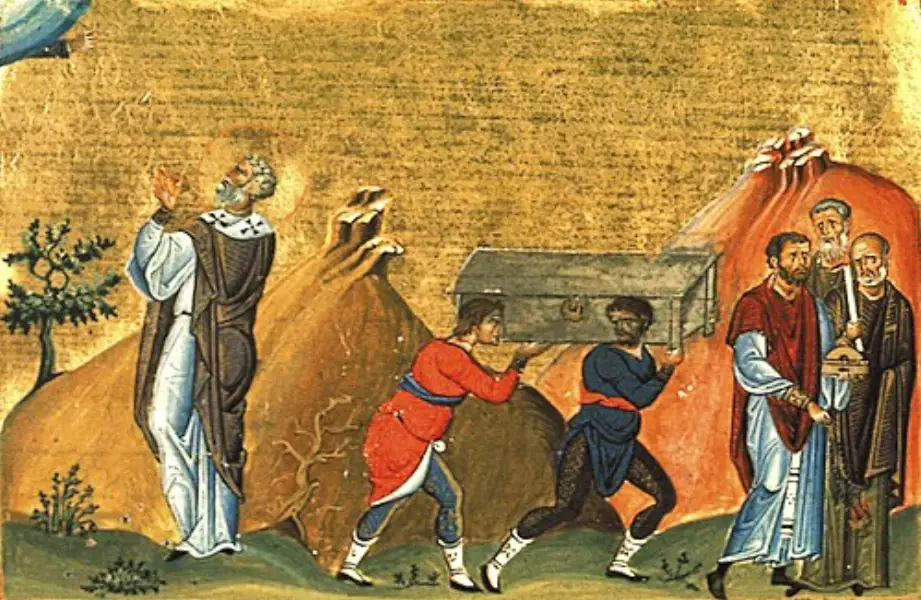
Domitian did not live to see the fall of the dynasty he served. According to Theophanes the Confessor he died on 12 January 602, some ten months before Maurice himself was overthrown and executed by Phocas. He was buried in the Church of the Holy Apostles in Constantinople, the mausoleum-church of the imperial house, and the whole Senate followed his bier — a final measure of how completely the bishop of a distant Armenian see had belonged to the capital's ruling world. The Synaxarion adds that his body was afterwards transferred to Melitene, his own see; if that is right, the translation must have occurred in the reign of Heraclius, when Armenia was again within the empire's grasp. His liturgical memory settled on January 10, the date some sources give for his death, and the Chalcedonian churches keep his memory on this date, honouring him among their saints. The revised Roman Martyrology of 2004 includes him, though he has never been assigned a place in the General Roman Calendar. He is thus honoured in the registers of the universal church while remaining, in practice, a saint of the Byzantine and Eastern Catholic tradition.
§ Death and veneration
A Saint Divided Between the Churches
Few bishops of late antiquity left so double a memory. In the Chalcedonian tradition Domitian is the sainted archbishop who enforced orthodoxy in the empire's northeast, the kinsman of a sainted emperor, honoured on January 10 and named in the Roman Martyrology. In the monophysite tradition he is remembered for brutality: the Syriac writers of the seventh century and after — Michael the Syrian and Bar Hebraeus, the Chronicle of 724 and the Chronicle of 1234 — speak of him without a kind word, and the Narratio de rebus Armeniae confirms the severity of the crackdown he led. The same tradition preserves the counter-evidence of his earlier reputation, for John of Ephesus, who died before the persecution began, thought him wise. His standing in learned circles is measured by Eulogius's dedication and by his correspondence with Gregory the Great, who wrote him at least three letters between 593 and 598, the last chiefly about Sicilian church affairs. He also stood behind one of the age's spiritual classics: he met the holy woman Golinduch at the Persian court's orbit, and Eustratius of Melitene drew on him for her biography. Historians still debate whether the persecutor of the Syriac chronicles and the almsgiving diplomat of the Greek sources can be reconciled; both portraits hang, unresolved, on the same man.
§ Persecution of monophysites
Timeline
- 550
Born around 550; the Synaxarion of Constantinople records that he was thirty years old at his consecration
§ Early life
- 580
Elected bishop of Melitene through Maurice's arrangement, becoming the first holder of that see with the rank of archbishop
§ Maurice's advisor
- 582
Took up residence in Constantinople (582–585) as one of Emperor Maurice's closest advisors
§ Maurice's advisor
- 587
Received a letter from King Childebert II of Austrasia seeking a peace treaty with the Romans, preserved in the Epistulae Austrasicae
§ Maurice's advisor
- 590
Sent with Bishop Gregory of Antioch to Constantina to meet the exiled Persian king Khosrow II and work for his conversion
§ Persian mission
- 591
Accepted the surrender of the Persian garrison at Martyropolis, accompanied Khosrow and Narses' army to Mardin, and negotiated a treaty of friendship with Persia
§ Persian mission
- Aug 593
Sent Pope Gregory the Great a letter reporting his work toward converting Khosrow II; the pope replied, praising his preaching of the faith.
§ Persian mission
- 596
Named guardian of Emperor Maurice's children in the testament the emperor had drawn up, discovered only under Heraclius.
§ Maurice's advisor
- 596
Joined the bishops consecrating Patriarch Cyriacus II of Constantinople; that October Gregory the Great rebuked them for misusing a psalm verse
§ Spiritual authority
- 598
Authorized by Maurice to persecute the monophysites around Melitene, a campaign that widened into Mesopotamia and Syria
§ Persecution of monophysites
- 12 Jan 602
Died 12 January; the entire Senate followed his bier and the Church of the Holy Apostles received his body, while his feast is kept on January 10
§ Death and veneration
In Their Own Words
He summoned the monks from the Abbey of the Orientals and did his utmost to deflect them from Orthodoxy by playing on their emotions, but they would have nothing of it. He tried threats instead, but they were impervious to fear. So then he ordered the commander of the troops whom the King had sent with him, whose name was Sakellarios, to take them out to the ditch outside the southern gate, which was called the Bēth Shemesh [House of the Sun] Gate and he slaughtered them all in a single pool of blood. In number they were four hundred men.
preached the Christian faith
The Record
- Major works
- Churches and hospitals at Melitene, funded by gifts from Khosrow II·First-hand account for Eustratius of Melitene's Life of Golinduch
- Canonization
- Pre-congregation; regarded as a saint by the Chalcedonian churches and listed in the revised Roman Martyrology (2004)
Prayer
Bibliography
Show 14 sources
- Allen, Pauline (1980). "Neo-Chalcedonism and the Patriarchs of the Late Sixth Century". Byzantion. 50 (1): 5–17. JSTOR 44170608
- Booth, Phil (2019). "The Ghost of Maurice at the Court of Heraclius". Byzantinische Zeitschrift. 112 (3): 781–826. doi:10.1515/bz-2019-0032
- Dal Santo, Matthew (2011). "Imperial Power and Its Subversion in Eustratius of Constantinople's Life and Martyrdom of Golinduch (c. 602)". Byzantion. 81: 138–176. JSTOR 44173231
- Greatrex, Geoffrey (2018). "Domitianus". In Nicholson, Oliver (ed.). The Oxford Dictionary of Late Antiquity, Volume 1: A–I. Oxford: Oxford University Press. p. 498. ISBN 978-0-19-881624-9
- Greatrex, Geoffrey; Lieu, Samuel N. C., eds. (2002). The Roman Eastern Frontier and the Persian Wars: A Narrative Sourcebook. Vol. Part II, AD 363–630. Routledge
- Hatch, William H. P. (1937). "The Subscription in the Chester Beatty Manuscript of the Harclean Gospels". Harvard Theological Review. 30 (3): 141–155. doi:10.1017/S0017816000022203. JSTOR 1507949
- Honigmann, Ernest (1953). "Two Metropolitans, Relatives of the Emperor Maurice: Dometianus of Melitene (about 580 – January 12, 602) and Athenogenes of Petra". Patristic Studies. Vatican City: Biblioteca Apostolica Vaticana. pp. 217–225
- Kaegi, Walter Emil; Kazhdan, Alexander (1991). "Domitianos". In Kazhdan, Alexander (ed.). The Oxford Dictionary of Byzantium. Oxford and New York: Oxford University Press. p. 648. ISBN 0-19-504652-8
- Lee, Doug (2007). "Episcopal Power and Perils in the Late Sixth Century: The Case of Gregory of Antioch". Bulletin of the Institute of Classical Studies. 50 (Supplement 91): 99–106. doi:10.1111/j.2041-5370.2007.tb02380.x
- Martindale, John R., ed. (1992). The Prosopography of the Later Roman Empire: Volume III, AD 527–641. Cambridge: Cambridge University Press. ISBN 0-521-20160-8
- Palmer, Andrew (1993). The Seventh Century in the West-Syrian Chronicles. Liverpool University Press
- Paret, Roger (1957). "Dometianus de Mélitène et la politique religieuse de l'empereur Maurice". Revue des études byzantines. 15: 42–72. doi:10.3406/rebyz.1957.1148
- Watkins, Basil (2016). The Book of Saints: A Comprehensive Biographical Dictionary (8th rev. ed.). Bloomsbury
- Whitby, Michael (1988). The Emperor Maurice and His Historian: Theophylact Simocatta on Persian and Balkan Warfare. Clarendon Press
Profile text adapted from the Wikipedia article, licensed CC BY-SA 4.0.
Pray with this saint every day
Save St. Domitian of Melitene to your favorites, read the full profile, and get feast-day reminders in the Saints app.
Get the Saints AppFree on the App Store for iPhone and iPad