
fl. 8th century·Feast October 23
St. Domitius
Hermit of Saint-Acheul and Guide of Saint Ulphia
Overview
Domitius, known in French as Domice, is a saint of the eighth century honored above all in the diocese of Amiens, where his memory is woven into the fabric of the cathedral city. He began his adult life as a canon of the cathedral chapter of Notre-Dame of Amiens, a position of security and standing in the church of the Picardy capital, and renounced it, surrendering his prebend, to embrace a solitary life. The hagiographer Laurentius Surius, drawing on the readings of the saint's own liturgical office, makes clear that he never received priestly orders, serving instead as a deacon of the Amiens church, and that in that order he withdrew to a hermit's cell at Saint-Acheul, beside the waters of the Avre. There, in the quiet between the cathedral and the water meadows, he became known above all as a spiritual director: it was to Domitius that the young Saint Ulphia came for guidance, and under his direction she grew into one of the beloved saints of the Amienois. His figure was carved on the portal of the great cathedral and painted beside his disciple within it, and his commemoration is kept on 23 October.
The Complete Life
From the Chapter to the Riverbank
Domitius came to holiness by way of renunciation. He had been a canon of Notre-Dame of Amiens, a member of the cathedral chapter whose prebend assured him support and standing within one of the great churches of the Frankish north. Against all worldly calculation he gave that prebend up, choosing a solitary life above the security of the chapter, a break with comfort that made his vocation unmistakable to those who recorded it. The hagiographer Laurentius Surius, working from the readings assigned to the saint's own office, supplies the exact form his retreat took: Domitius never received priestly orders; he served the church of Amiens as a deacon, and in that lower rank of clergy he embraced the eremitical life at Saint-Acheul, beside the running water of the Avre. The place itself carried meaning. Saint-Acheul, on the southern edge of Amiens, was a site of ancient Christian memory, and the Avre wound quietly through the meadows below the city, a fitting boundary between the ecclesiastical world he had left and the solitude he sought. A hermit who remained a deacon, Domitius embodied a vocation of humility in office as in dwelling: he never sought the altar's presidency, content to serve the church of his city in the order to which God had first called him.
§ Legend
Director of a Saint
The work for which Domitius is remembered was not writing, preaching, or foundation, but the direction of souls. Among those who sought him out at Saint-Acheul was the young woman whom the church of Amiens would come to honor as Saint Ulphia, and it is in relation to her that his sanctity is chiefly recorded. The sources name his service precisely: he provided spiritual guidance to Ulphia, and under that guidance the young ascetic matured into a saint whose own cult endured at Amiens for centuries. Such a relationship belonged to the oldest traditions of the desert, where the elders of the hermitages formed the young in prayer and discernment, and the hermitage on the Avre kept that pattern alive in eighth-century Picardy. No writing of Domitius survives, no sermon or rule; his mission was carried out in conversation, counsel, and example, the invisible labor by which one holiness calls forth another. The church's judgment on that labor is written in the art of Amiens Cathedral, where the two appear together: the deacon-hermit and the virgin he formed, painted side by side for the instruction of later generations. A spiritual father is measured by his children, and in Ulphia the quiet deacon of Saint-Acheul left the church of Amiens a daughter worthy of his patience.
§ Legend
Stone and Paint at Amiens
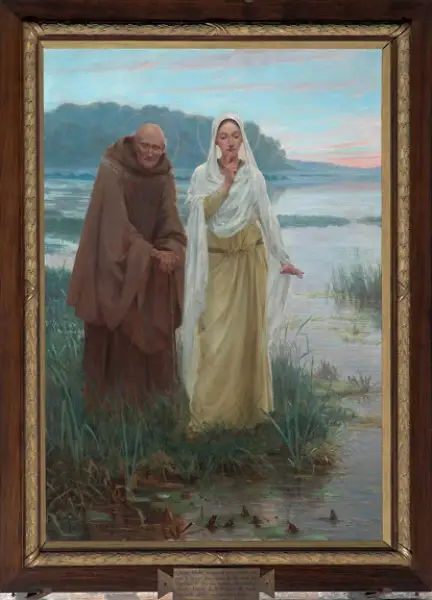
The memory of Domitius found its permanent home in the cathedral of his city. Among the carved figures on the cathedral's portal, one has been recognized as a likeness of the hermit of Saint-Acheul, so that worshippers and visitors passing beneath the great west front have looked up for centuries at his carved figure among the company of the saints. Within the cathedral hangs a painting of Domitius with Saint Ulphia, the director and the disciple together, the work attributed to the nineteenth-century painter Jean de Franqueville, a sign that devotion to the pair remained alive into the modern era. His liturgical commemoration is kept on 23 October, a date preserved by the local calendar of the diocese where he was especially venerated. His absence from the revised Roman Martyrology of 2004 marks the humbler register of his cult: Domitius belongs to the company of local saints whose memory lives in the stone, the paint, and the devotional practice of a single church, rather than in the universal catalogues of the Roman see. For the diocese of Amiens he remains what the sources declare him, a saint of the eighth century, the canon who became a deacon, the deacon who became a hermit, and the hermit who made a saint.
§ Legend
The Record
- Canonization
- Pre-congregation canonization; venerated especially in the diocese of Amiens, though not listed in the 2004 revised edition of the Roman Martyrology
Prayer
Bibliography
Show 5 sources
- Murray, Stephen. "The Portals, Access to Redemption". Columbia University.
- The Book of Saints: A Dictionary of Servants of God Canonized by the Catholic Church. St. Augustine's Abbey (Ramsgate), A. & C. Black, 1921.
- Watkins, Basil. The Book of Saints: A Comprehensive Biographical Dictionary. Bloomsbury Publishing, 2015, p. 186. ISBN 9780567664150.
- Delaney, John J. "Ulphia", Dictionary of Saints. Random House Publishing Group, 2005, p. 610. ISBN 9780385515207.
- Male, Emile. The Gothic Image: Religious Art In France Of The Thirteenth Century. Routledge, 2018. ISBN 9780429972447.
Profile text adapted from the Wikipedia article, licensed CC BY-SA 4.0.
Pray with this saint every day
Save St. Domitius to your favorites, read the full profile, and get feast-day reminders in the Saints app.
Get the Saints AppFree on the App Store for iPhone and iPad