
died c. 460·Feast March 1
St. Domnina of Syria
Fifth-century Syrian ascetic and disciple of Maron
Overview
Saint Domnina of Syria, called Domnina the Younger, was a fifth-century ascetic whose life is preserved in the writings of Theodoret, bishop of Cyrrhus, and whose name appears in the Byzantine Synaxarium. Born into a wealthy Syrian family, she attached herself as a disciple to Saint Maron, the desert teacher whose followers gave early Syriac monasticism its shape. As a young woman she raised a straw-covered hut in the garden belonging to her mother's house at Cyrrhus, near Antioch, and remained there for the rest of her days. Her discipline was severe: she ate only lentils soaked in water, attended the church services of morning and evening, and kept her face veiled so that no one would look upon her. Around her gathered a company of two hundred and fifty women, who supported themselves by manual labor and the carding of wool. Theodoret reports that she reached such a state of religious ecstasy, which he attributed to the inspiration of divine love, that she could not speak without weeping. She died sometime between 450 and 460, honored ever after in both East and West.
The Complete Life
A Daughter of the Syrian Gentry
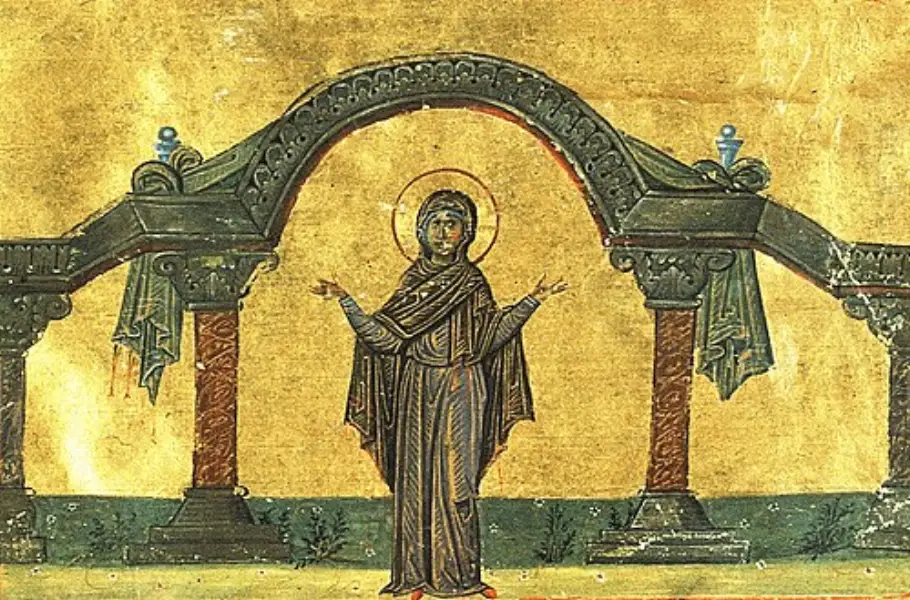
Almost everything known of Domnina's origins comes from the Religious History of Theodoret, bishop of Cyrrhus, who recorded the lives of the ascetics of northern Syria in her own century. According to his testimony, she was born to a rich Syrian family, and her upbringing placed her among the Christian gentry of the region around Cyrrhus, a city lying at some distance from Antioch. She is remembered in the Greek tradition as Domnina the Younger, a title that distinguishes her from other holy women of the same name, and her name is preserved in the Byzantine Synaxarium. The miniature of her that survives in the Menologion of Basil II shows that her cult had reached Constantinople by around the year 1000, where she was honored among the saints of the Eastern Church. Beyond these outlines the sources are silent about her childhood and family. What Theodoret chose to record was not the circumstances of her birth but the startling form her Christian commitment took once she reached young womanhood, a commitment that shaped every remaining year of her life. That a bishop of the surrounding country took the trouble to chronicle her is itself evidence of the esteem in which her way of life was held by those who knew it.
§ Life
The Hut in Her Mother's Garden
While still a young woman, Domnina sought the guidance of Saint Maron, the hermit whose mountain disciples gave the earliest shape to Syrian monasticism, and she became his spiritual daughter. Rather than withdraw into the desert, she chose an enclosure close to home: in the garden belonging to her mother's house at Cyrrhus she raised a small hut covered with straw, and there she settled permanently. Her asceticism was rigorous. Lentils soaked in water were, so far as the sources record, her only food. Each morning and each evening she left her hut to attend the church services, and on these walks she kept her face covered with a veil so that no one would set eyes on the features she had consecrated to God. Her example attracted other women rather than repelling them. In time two hundred and fifty female followers had gathered around her, forming a community that supported itself by handwork and by the carding of wool. Theodoret presents her, in this respect, as a founder in her own right: an unmarried woman who created, in her mother's garden, the center of one of the largest companies of holy women in the Syrian countryside.
§ Life
Tears as Her Native Language
The strain of such a life marked Domnina's body. The sources describe her as having become extremely thin over the years of her enclosure, a living witness to the fasting that sustained her. Yet bodily wasting was not, in Theodoret's eyes, the heart of her story. In his Religious History he writes that her prayer carried her to a state of religious ecstasy of such height that every attempt at speech dissolved in tears, a condition he ascribed to the inspiration of the love of God. Tears, in his account, had become her native language. She died at Cyrrhus between the years 450 and 460, having spent her entire adult life within sight of her mother's door. Her death was not recorded as a martyrdom; she is honored rather as a virgin ascetic, one of the quiet heroes of the generation after the great persecutions. The Eastern churches keep her memory on the first of March, and the Catholic Church venerates her on the same day, a rare point of complete agreement between the two calendars. In this she stands beside the other disciples of Maron, whose histories Theodoret gathered so that the memory of the Syrian ascetics would not fade from the church.
§ Life
The Record
- Canonization
- Pre-congregation saint, venerated since antiquity in the Catholic and Eastern Orthodox Churches
Prayer
Bibliography
Show 3 sources
- Borrelli, Antonio. "Santa Domnina." Santi e beati, February 6, 2003.
- Janos, Fr. S. "The Nun Domnina of Syria." Holy Trinity Orthodox, 1996-2001.
- "Virginmartyr Domnina of Syria." Orthodox Church in America.
Profile text adapted from the Wikipedia article, licensed CC BY-SA 4.0.
Pray with this saint every day
Save St. Domnina of Syria to your favorites, read the full profile, and get feast-day reminders in the Saints app.
Get the Saints AppFree on the App Store for iPhone and iPad