
died c. 304·Feast October 9
St. Domninus of Fidenza
Imperial chamberlain turned martyr of the Stirone
Overview
Saint Domninus of Fidenza, in Italian San Donnino, is an Italian Catholic saint whose death is placed by tradition in the year 304. A native of Parma, he is remembered as chamberlain to the emperor Maximian and keeper of the royal crown, converted to Christianity from within the imperial household itself. That conversion cost him the emperor's favor. Hunted by imperial cavalry, he made his way through Piacenza with a cross lifted in his hand, until his pursuers seized him and struck off his head on the bank of the Stirone, just beyond Fidenza — a town long known as Borgo San Donnino, the borough of Saint Domninus. The legend adds that he took up his severed head and set it down on the site where the cathedral of San Donnino now stands. His relics rest enshrined in that cathedral, and the rebuilt twelfth-century basilica carries a frieze of five scenes from his life, attributed to the school of Benedetto Antelami. The Hieronymian Martyrology commemorates him, though later medieval martyrologies pass over him in silence. From the earliest times he has been invoked against rabies, and his cult remains popular across northern Italy.
The Complete Life
Keeper of the Crown
The Domninus of the legend is a young man of Parma, a native of that Emilian city, who rose high in the imperial service. He is described as chamberlain to the emperor Maximian and keeper of the royal crown, a position of trust at the very center of power. There, in the emperor's own household, he encountered the Christian faith and accepted it — a conversion all the more dangerous because it was made under his master's eyes. Once known, his baptism changed him from a servant of the court into its suspect, and the emperor's wrath fell upon him. Everything else in his story follows from that reversal: the chamberlain who had guarded the crown now carried the cross, and the palace that had been his home became the power that hunted him. Historians of the cult note that the earliest witness to the saint, the Hieronymian Martyrology, records only his name and feast without any of these details; the legend of the chamberlain is the work of later devotion, seeking to explain why a martyr should be honored at Fidenza with such antiquity and warmth.
§ Veneration
Flight Along the Aemilian Way
Pursued by imperial troops, Domninus fled westward, and the legend preserves a striking image of his flight: he rode through Piacenza holding a cross aloft, a public confession of the faith for which he was being hunted. He did not escape. His pursuers caught him and beheaded him on the bank of the Stirone, outside the town that would take its very name from him — Borgo San Donnino, today Fidenza — or, in another version of the tradition, beside the Via Aemilia itself. To the execution the legend adds the mark of the cephalophore: the legend says he lifted his own severed head from the ground and bore it to the spot destined for the cathedral of San Donnino, designating by his own hand the site of his tomb. Whatever one makes of the miracle, the tradition encodes a memory of where the body lay. The cathedral of Fidenza is dedicated to the martyr, and the town's ancient name — the borough of Saint Domninus — testifies that his blood, in the minds of the people, founded their city's Christian identity.
§ Veneration
Patron of Fidenza, Refuge Against Rabies
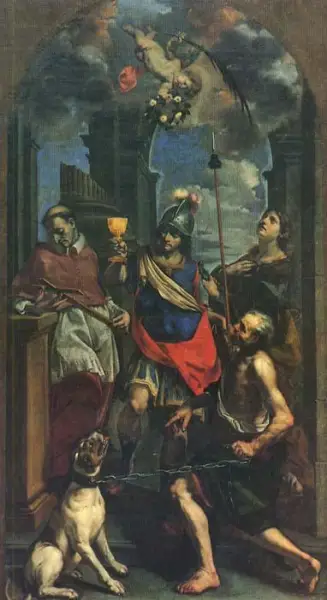
The veneration of Domninus is among the more substantial of northern Italy. The Hieronymian Martyrology, the oldest document to mention him, keeps his feast on October 9, though he is absent from the martyrologies of Bede, Ado, and Notker and from the Parvum Romanum. His relics enshrined in Fidenza Cathedral lend some plausibility to the tradition that he died in this region. The ancient basilica, rebuilt in the twelfth century, carries a sculpted frieze in five panels that tell the story of the saint, work ascribed to the workshop of Benedetto Antelami. Artists dress him in military attire and place the palm of martyrdom in his hand, and his attributes include a dog and a cup. His cult spread through the Po valley: churches dedicated to San Donnino stand at Modena, Bologna, Montecchio, Piacenza, and Pisa. From the earliest period he has been invoked against rabies; his Passio tells that water and wine, once blessed with invocation of his name, cured rabies in all who drank — a reputation that bound the martyr to the daily anxieties of the countryside he had died beside.
§ Veneration
The Record
- Patron of
- Fidenza·against rabies
- Symbols
- dog·cup·palm of martyrdom·depicted as a soldier
- Canonization
- Pre-congregation martyr, commemorated in the Hieronymian Martyrology and venerated by the Catholic Church
Prayer
Bibliography
Show 3 sources
- "Saints of October 9: Donnino (Domninus)" (archived at the Wayback Machine).
- "San Donnino's stories."
- "San Donnino di Fidenza, martire" (in Italian).
Profile text adapted from the Wikipedia article, licensed CC BY-SA 4.0.
Pray with this saint every day
Save St. Domninus of Fidenza to your favorites, read the full profile, and get feast-day reminders in the Saints app.
Get the Saints AppFree on the App Store for iPhone and iPad