
died c. 362·Feast August 7
St. Donatus of Arezzo
Bishop and Martyr of Arezzo
Overview
Donatus of Arezzo is honored as an early bishop of the Tuscan city and, in later tradition, as its martyr. The earliest account of his life, a Passio composed by Severinus, a bishop of Arezzo, is of questionable historicity and calls Donatus a martyr, while the ancient sources know him instead as a bishop who confessed the faith without shedding blood. Tradition has him a native of Nicomedia who came to Rome as a child, was orphaned in a persecution, and was raised and educated by the priest Pymenius; his schoolmate was the boy who would become the emperor Julian the Apostate. When Julian's reign brought renewed pressure on the Church, Donatus withdrew to Arezzo, where he preached alongside the monk Hilarinus, worked wonders, was ordained by Bishop Satyrus, and succeeded him through appointment by Pope Julius I. The legend recounts his restoration of a shattered glass chalice at the giving of Communion, a sign that converted seventy-nine pagans. Arrested by the prefect Quadratian, he was beheaded on August 7, 362, in the reign of Julian. His relics rest in Arezzo and, since 1125, partly in the church of Santa Maria e San Donato on Murano.
The Complete Life
A Child of Nicomedia in Rome
Severinus' account opens far from Tuscany, in the Bithynian city of Nicomedia, where Donatus was born. As a child he came to Rome with his family, and there disaster overtook them: during a persecution the boy was orphaned, left alone in a city where his faith was a dangerous inheritance. The bishop of Arezzo took charge of him and gave him the name by which he has been known ever since — Donatus, the Latin word for 'given', a gift entrusted to the Church. Under the bishop's care Donatus received a Christian education from a priest named Pymenius, and among his fellow students was a boy named Julian, who shared his lessons and his religious formation. The two children could not have imagined more different endings. Julian would climb as far as the subdiaconate before abandoning his faith; Donatus would serve as a lector, reading the Scriptures to the assembly. Centuries later Saint Peter Damian, meditating on the pair, contrasted the two sprigs that grew together in the field of the Lord, one tree grown for Paradise, the other fuel for hell's unending fire. The childhood friendship became, in Christian memory, a parable of free will and grace.
§ Legend
Persecution Under Julian
Donatus came of age just as the Church entered one of its strangest crises. On February 4, 362, his former schoolmate, now the emperor Julian, promulgated an edict guaranteeing freedom of religion. It proclaimed all religions equal before the law and declared that the empire must return to its original religious eclecticism, imposing none of them on its provinces. Christian chroniclers read the measure as it was meant: a device to restore paganism at Christianity's expense under the banner of tolerance. Catholic tradition maintains that Julian targeted Christians one by one as well, and that in these troubles Donatus lost both his parents and his old master Pymenius. Stripped of family and master, Donatus fled to Arezzo. There he joined a monk named Hilarinus, and together the two preached the Christian faith in the city and its countryside, joining their words with penances and works of wonder. The career that followed was built in that school of loss: a man with no home left in the East made a new one in an Etruscan hilltown, and the lector trained in Rome became one of the pillars of the Tuscan church.
§ Legend
Wonder-Worker and Bishop
The legend preserves a crowded catalogue of Donatus' works in Arezzo. By Severinus' account a woman called Euphrosina was raised from the dead at his word; he killed the dragon that had poisoned the town's well; the eyes of a blind woman called Syriana were opened at his prayer; and Asterius, son of Arezzo's Roman prefect, was freed from the demon that possessed him. The same tradition records his steady advance through the Church's orders: Satyrus, bishop of Arezzo, ordained him first deacon and then priest, and Donatus continued to preach in the city and the surrounding region. When Satyrus died, Pope Julius I appointed Donatus bishop in his place. A man named Anthimus served him as deacon. Whatever weight one gives the miracle stories — and the dragon entered art as surely as the chalice did, appearing on reliquaries and in Ribera's painting of the miracle — the outline is clear: a preacher of energy and holiness who led the church of Arezzo through the last years of Julian's reign, remembered equally for healing the sick, freeing the possessed, and ordering the life of his flock.
§ Legend
The Shattered Chalice
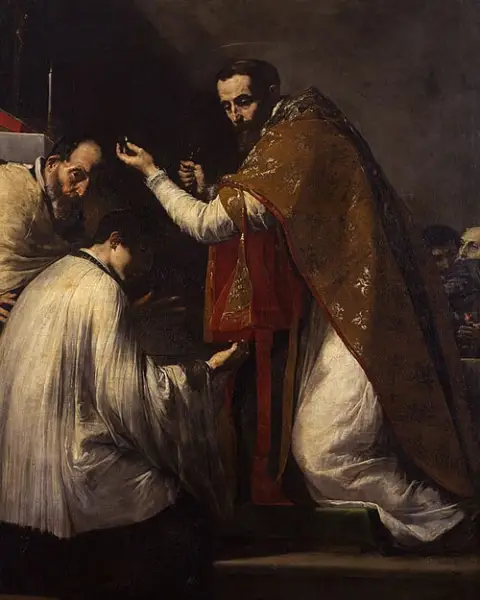
The most famous story of Donatus belongs to his last year. At Mass, while Communion was being given from a glass chalice, pagans forced their way into the church and broke the vessel to pieces. Donatus gathered the fragments, prayed intently, and joined the pieces back together; a piece was missing from the bottom of the cup, yet nothing spilled from it. Astounded by the sign, seventy-nine pagans asked for baptism and converted to Christianity. A similar legend is told of Saint Nonnosus, though there the broken object is a glass lamp. The triumph was brief. A month after the episode the prefect of Arezzo, Quadratian, arrested both Hilarinus and Donatus. Hilarinus died for the faith on July 16, 362; Donatus followed on August 7 of that year, beheaded at Arezzo under Julian the Apostate. Ancient sources call him a bishop and confessor of the faith rather than a martyr, but the tradition that grew from Severinus' Passio honored him as one who died for the faith, and the Church has kept August 7 as his day. His deacon Anthimus was of his household in the city during those months, the one companion the old narrative names for his episcopal years.
§ Legend
Dragon, Relics, and Festivals
Donatus' memory settled deep into Tuscany and beyond. In 1125 some of his relics — together with the bones of the dragon he was said to have slain — were carried across the lagoon to Murano, to the island church of Santa Maria e San Donato, one of Venice's great monuments. A large silver reliquary bust of the saint, made in the thirteenth century, is now preserved in the National Museum at Naples. Pietro Lorenzetti placed him at the far left of the Tarlati polyptych painted in 1320 for Santa Maria della Pieve in Arezzo, and Jusepe de Ribera's canvas of his miracle carried his story into the seventeenth century. His patronage spread across half of Italy: he is invoked for Arezzo, for epileptics, and for bakers, and honored in towns from Guardiagrele — where he shares with Saint Emidius an annual festival from August 6 to 8, his effigy paraded through streets where roast porchetta is the traditional dish — to Pinerolo, Fossacesia, and San Donato Milanese. Few saints of the early Tuscan church left so wide a trail of place-names and feast days.
§ Veneration
Timeline
- 362
After the miracle of the shattered chalice, the prefect Quadratian arrested Donatus and the monk Hilarinus
§ Legend
- 4 Feb 362
Julian promulgated his edict guaranteeing freedom of religion, opening the persecution in which Donatus' parents and his teacher Pymenius died.
§ Legend
- 16 Jul 362
Hilarinus, the monk who had preached with him at Arezzo, was martyred.
§ Legend
- 7 Aug 362
Beheaded at Arezzo, martyred under Julian the Apostate, according to tradition.
§ Introduction
- 1125
Relics of Donatus, together with the alleged dragon he slew, were brought to the church of Santa Maria e San Donato on Murano
§ Veneration
In Their Own Words
In the field of the Lord two sprigs, Donatus and Julian, grow together, but one will become a cedar of Paradise, the other coal for the eternal flames of Hell.
The Record
- Patron of
- Arezzo·epileptics·bakers
- Symbols
- episcopal dress·Communion chalice·sword·fighting a dragon
- Canonization
- Pre-congregation; venerated from antiquity as bishop and martyr
Prayer
Bibliography
Show 2 sources
- Borrelli, Antonio (March 21, 2002). "San Donato di Arezzo". Santie Beati. Retrieved August 21, 2008.
- Butler, Alban; Farmer, David Hugh; Burns, Paul. Butler's Lives of the Saints (Liturgical Press, 1995), p. 10.
Profile text adapted from the Wikipedia article, licensed CC BY-SA 4.0.
Pray with this saint every day
Save St. Donatus of Arezzo to your favorites, read the full profile, and get feast-day reminders in the Saints app.
Get the Saints AppFree on the App Store for iPhone and iPad