
died 387·Feast April 30
St. Donatus of Euroea
Bishop of Euroea, Wonder-Worker of Epirus
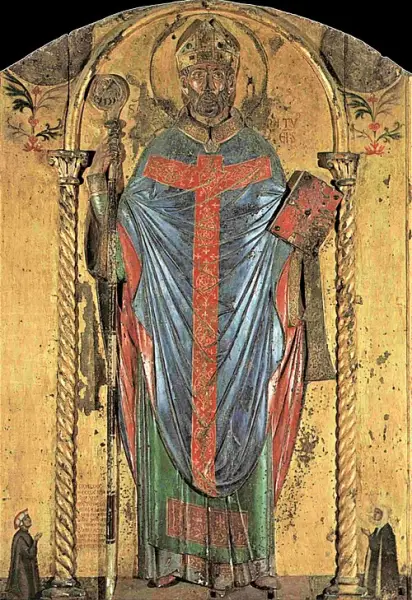
Overview
Saint Donatus of Euroea was a Greek bishop of the fourth century, revered by Eastern Orthodox and Roman Catholics alike, especially in Albania and Greece. He was born at Euroea in Epirus Vetus, today's northwestern Greece, and his life fell within the reign of Theodosius I. The fifth-century historian Sozomen records him as Bishop of Euroea, a see generally identified with Glyki in Epirus. Tradition remembers him as a wonder-worker: he is said to have fought and defeated a dragon, purified well waters, saved the emperor's daughter, and raised the dead. He died in 387. In 602 his remains were transferred to Kassiopi on Corfu to protect them from barbarian invasion, a translation that raised a dispute over jurisdiction and custody of the relics, resolved by Pope Gregory I. His cult was widespread in the Middle Ages. In 1125 or 1126 Venetians under Doge Domenico Michele plundered the relics from Cephalonia. Epirote troops had already carried his veneration to southern Italy, where Umbriatico Cathedral in Calabria is dedicated to him.
The Complete Life
A Bishop in Theodosius' Empire
Donatus was born in Euroea, a city of Epirus Vetus in what is now northwestern Greece, and his life fell within the reign of Theodosius I, the emperor who established Nicene Christianity as the religion of the Roman state. The fifth-century historian Sozomen, writing within living memory of the events, records him as Bishop of Euroea; the see is generally identified with Glyki in Epirus, in modern Greece. He is remembered as a Greek saint, honored by Albanians as Shën Dhonati and by Greeks as their own, and his cult came to belong to both the Eastern Orthodox and the Roman Catholic Church. The age into which he was ordained was one of enormous consequence for the Balkan churches: Theodosius' reign settled the doctrinal struggles of the fourth century and confronted the empire's Greek provinces with the upheavals that would soon remake them. Of Donatus' ordination, his pastoral work, and the daily shape of his episcopate the sources are largely silent; what they preserve instead is the figure the faithful remembered — a bishop whose prayers carried unusual power over the ills of body and place alike.
§ Introduction
Wonder-Worker of Epirus
Tradition assigns Donatus a gallery of miracles that made his name across Epirus and beyond. He is said to have fought a dragon and defeated it — the same combat that attaches to other bishops of the early church — and to have purified well waters that had been made deadly, an act that bound him to the springs and wells of his rugged home country. The accounts credit him with saving the emperor's daughter and with reviving the dead, the supreme sign of sanctity in the hagiographic convention of the age. Whatever form these deeds took in the earliest telling, their pattern is consistent: a bishop who protected his people from the powers that poisoned, drowned, and devoured. The cult that grew from such stories was not confined to one rite. Orthodox and Catholics alike kept his memory, and in the Middle Ages it spread widely through Epirus, the Ionian islands, and southern Italy. His feast is kept on April 30. The churches and chapels that descend from the medieval veneration of the wonder-working bishop of Euroea still bear his name across the Greek and Albanian borderlands.
§ Introduction
Relics Between Corfu, Venice, and Calabria
Donatus died in 387, but his body's history was only beginning. In 602, with barbarian invasions threatening the mainland, his remains were transferred to Kassiopi in Corfu; the shrine there became the major center of his cult. The translation opened a quarrel over which church should govern the holy remains, a dispute Pope Gregory I settled — an early instance of the papacy arbitrating the claims of Greek churches. The cult flourished throughout the Middle Ages. Its afterlife was turbulent: in 1125 or 1126 the Venetians under Doge Domenico Michele plundered the relics of Saint Donatus from the city of Cephalonia, adding them to the treasury of Greek relics — among them Saint Sabas and Saint Nicholas of Myra — with which Venetian churches dedicated to Greek saints were enriched. Epirote soldiers had already carried his veneration westward across the Adriatic: after the conquest of Nikephoros Phokas the Elder in the ninth century brought Epirote troops into Calabria, they planted the cults of the saints they knew at home, and Umbriatico Cathedral in southern Italy still stands dedicated to him. Donatus thus belongs at once to Greece, Albania, Corfu, Venice, and Calabria.
§ Introduction
Timeline
- 387
Died, having served as Bishop of Euroea under the emperor Theodosius I
§ Introduction
- 602
Remains were moved to Kassiopi on Corfu to shield them from barbarian invasion, prompting a custody dispute settled by Pope Gregory I
§ Introduction
- 1125
Venetians under Doge Domenico Michele plundered his relics from the city of Cephalonia, in 1125 or 1126
§ Introduction
The Record
- Canonization
- Pre-congregation
Prayer
Bibliography
Show 5 sources
- Elsie, Robert (2000). "The Christian Saints of Albania". Balkanistica 13. American Association for South Slavic Studies: 36.
- Speake, Graham (2021). Encyclopedia of Greece and the Hellenic Tradition. Routledge. p. 1697. ISBN 978-1-135-94206-9.
- "St Donatus the Bishop of Euroea in Epirus", Orthodox Church in America, Lives of the Saints.
- "St. Donatus of Evorea", Catholic Online.
- Pasali, Afroditi, Great Panagia Church in Paramythia, Thesprotia, p. 192.
Profile text adapted from the Wikipedia article, licensed CC BY-SA 4.0.
Pray with this saint every day
Save St. Donatus of Euroea to your favorites, read the full profile, and get feast-day reminders in the Saints app.
Get the Saints AppFree on the App Store for iPhone and iPad