
died 876·Feast October 22
St. Donatus of Fiesole
Irish Bishop, Poet, and Teacher of Tuscany
Overview
Donatus of Fiesole was an Irish teacher, poet, and bishop who became one of the best documented of the Irish peregrini. Born in Ireland to noble parents near the end of the eighth century, probably a native of the region around Lough Derg, he was likely educated at the monastic school of Inishcaltra, now Holy Island, and became first a priest and then a bishop, winning distinction as a professor. About 816 he travelled to Rome with his friend Andrew Scotus; the two eventually reached Tuscany and stopped at the hospice of the monastery at Fiesole, meaning only to rest. In 829, amid popular acclaim that took the spontaneously ringing bells of the cathedral as a sign, Donatus was elected bishop of Fiesole. For forty-seven years he served as bishop, teacher, and public administrator: he founded a school in Florence under Lothair's patronage, led troops against the Saracens in 840, attended the coronations of Louis II in 844 and 850, secured restitution of the church's property in 866, and promoted the cult of Brigid of Kildare, composing a metrical Life of the saint. He died in 876 and was buried in the cathedral, where his self-composed epitaph survives.
The Complete Life
An Irish Scholar of Lough Derg
Donatus was born in Ireland to noble parents toward the end of the eighth century. The tenth- or eleventh-century Vita sancti Donati episcopi preserves little biographical detail, but enough evidence survives to make him one of the Irish peregrini we know best — those wandering scholars and churchmen who carried Irish learning to the continent. There is reason to believe he was educated at the monastic school of Inishcaltra, a small island in Lough Derg near the Galway shore, better known today as Holy Island; he was, in all likelihood, a man of that region. There his mind received its demanding formation in Scripture, Latin, and verse that the Irish schools of the period supplied, and in time he became a priest and then a bishop. Contemporaries regarded him as greatly distinguished as a professor. When he left Ireland he carried with him the two loves that mark his whole later life: the learning of the Irish monastic schools, which he would exercise as a teacher of grammar and metrical composition in Italy, and a tender, regretful attachment to his native island, which he would set down in Latin verse.
§ Biography
Pilgrim to the Tombs of the Apostles
About 816, as an account in a Vitae Patrum collection of great age records — its eleventh-century copy is kept in Florence's Laurentian Library — Donatus set out for Rome with his friend Andrew Scotus — 'the Scot', another Irishman whose name would be entwined with his for the rest of their lives. They visited the tombs of the Apostles, remained in the city a considerable time, and then resumed their journey toward Tuscany until they reached Fiesole, the ancient hilltown above the Arno. There they put up at the monastery's hospice, meaning to stay no more than a week or two. They never left. In 829 the see of Fiesole fell vacant in grim circumstances: its previous bishop, by the traditional account, had been drowned by the feudal lords, and the faithful were at prayer, asking God for a shepherd. As Donatus walked into the cathedral of Saint Romulus, the bells were said to begin ringing of themselves and the candles to light; the people took this for a sign that their prayers had been heard — though it has also been suggested that no local man wanted the dangerous office. Raised by popular acclaim, Donatus became bishop.
§ Bishop of Fiesole
Bishop, Teacher, and Diplomat
Donatus governed Fiesole for forty-seven years as bishop, teacher, and public administrator. He made Andrew his archdeacon and encouraged him to restore the church of San Martino di Mensola and found a monastery there. In Florence he established a school under the patronage of the emperor Lothair, teaching grammar and metrical composition for many years in the tradition of the Irish professors. His career also touched the military and political affairs of the Italian kingdom: in 840 he marched at the head of a troop against Saracen raiders, and in 844 he stood in Rome for the coronation of Louis II as King of Italy and again in 850 for the coronation as emperor. He sat with king and pope to judge a quarrel between the sees of Arezzo and Siena, and on November 18, 861, he took part in Pope Nicholas I's Roman synod. A man of his island's church to the end, he gave the Church of St. Brigid at Piacenza — an important stop on the Via Francigena — to Columbanus' abbey at Bobbio in 850, on condition that the monks maintain a hospice for Irish pilgrims there.
§ Bishop of Fiesole
Brigid and the Love of Ireland
Two devotions define Donatus' inner life: Brigid of Kildare and Ireland itself. He did much to promote Brigid's cult and composed a metrical Life of Saint Brigid, interspersed with short lyrical poems; Colgan printed it in 1647 under Coelan's name — an eighth-century Irish monk — and credited Donatus with nothing but the foreword, which recalls earlier Lives by Ultan and Aileran. Like Columkille, he cherished a tender, regretful love for the country of his birth, and like him he wrote a short Latin poem in its praise, singing his homeland's beauty and fruitfulness, the riches of its ground, the bravery and godliness of its people. The Vita adds a legend of his deathbed: according to Donatus' own story, preserved in manuscript in the Laurentian Library in Florence, Saint Brigid flew to his side to give him spiritual strength and comfort, and, before she laid a hand on him, hung her cloak out to dry upon a beam of sunlight. Andrew has a story of his own kind: his sister Bridget, it was said, reached him from Ireland by miracle not long before he died.
§ Works
Redress, Restitution, and a Self-Written Epitaph
Long years of imperial interference had stripped the Fiesole church of lands and rights, and Norman raids had cost it its charters. Donatus petitioned Emperor Louis for restoration and won it in 866; at Placentia, Charles the Bald later confirmed what Louis had given, adding a penalty of thirty pounds of gold for any violation of what was granted. These recoveries closed a long defense of his see's temporal rights. Donatus died in 876, after forty-seven years of service, and was buried in the cathedral. The epitaph he dictated himself may still be seen there: It recalls, in his own words, the Ireland of his birth, the years spent serving Italy's rulers Lothair and Louis, his governance of the Fiesole church, and his labors as an instructor in grammar and verse. Few churchmen of the ninth century left so deliberate an account of their own lives in stone. The self-composed epitaph, the preserved poems, and the manuscript tradition of his Brigid make him, for all the gaps in his biography, one of the most vividly recoverable Irish voices of the Carolingian world.
§ Bishop of Fiesole
San Donato Across Tuscany
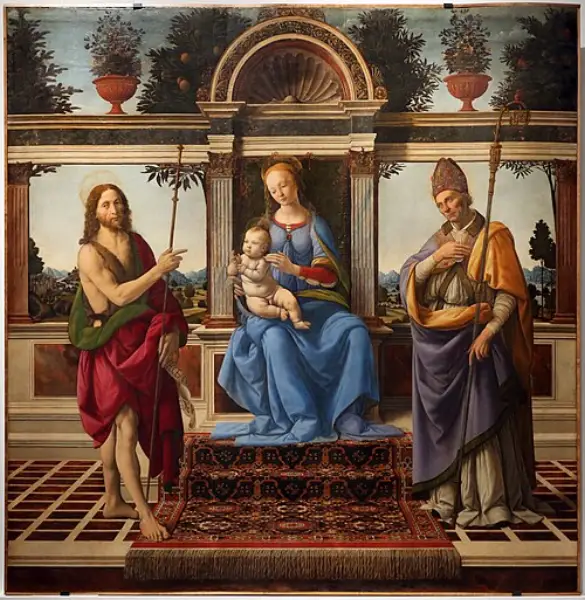
The feast of Donatus falls on October 22. All through Tuscany, places and churches that carry the name San Donato show how far his repute reached; his body rests in an altar of his own within Fiesole's cathedral of San Romolo, the Duomo. Renaissance art took up his figure: Andrea del Verrocchio set him beside John the Baptist in the Madonna with Saints painted for Pistoia Cathedral in 1475–83, showing the Irish bishop in the garb of his office, an Irish wolfhound at his feet, or pointing out a church to his deacon Andrew the Scot. His historical afterlife has been equally rich: students of the Hiberno-Latin tradition rank him among the Irish authors working on the continent in his age, and reference works from the Dictionary of National Biography to the Dictionary of Irish Biography have retold his career. For Irish readers he stands as the exemplar of the peregrinus who never stopped being Irish — a bishop on the Arno who wrote verses in praise of the milk and honey and bearded corn of the island he had left, and who asked that Brigid herself come to him at the end.
§ Veneration
Timeline
- 816
Set out on pilgrimage to the tombs of the Apostles in Rome with his friend Andrew Scotus
§ Biography
- 829
Elected bishop of Fiesole after the people took the cathedral's spontaneously ringing bells and lit candles for a sign
§ Bishop of Fiesole
- 840
Marched with a troop of soldiers against Saracen raiders
§ Bishop of Fiesole
- 844
Present in Rome when Louis II was crowned King of Italy
§ Bishop of Fiesole
- 850
Attended Louis II's coronation as emperor and gave the Church of St. Brigid at Piacenza to Bobbio for an Irish hospice
§ Bishop of Fiesole
- 18 Nov 861
Attended the Roman synod of Pope Nicholas I
§ Bishop of Fiesole
- 866
Obtained from Emperor Louis restitution of the property and prerogatives the church of Fiesole had lost
§ Bishop of Fiesole
- 876
Died after forty-seven years of service and was buried in the cathedral with the epitaph he had dictated himself
§ Biography
In Their Own Words
Far westward lies an isle of ancient fame, By nature bless'd; and Scotia is her name, Enroll'd in books: exhaustless is her store, Of veiny silver, and of golden ore.
The Record
- Major works
- Metrical Life of St. Brigid·Latin poem in praise of Ireland·School of grammar and metrical composition in Florence
- Symbols
- bishop's garb·Irish Wolfhound at his feet·pointing out a church to his deacon Andrew the Scot
- Canonization
- Pre-congregation
Prayer
Bibliography
Show 11 sources
- Breen, Aidan. "Donatus", Dictionary of Irish Biography, 2009.
- Joyce, P.W., "St. Donatus, Bishop of Fiesole", The Wonders of Ireland, 1911.
- Turner, William. "Donatus of Fiesole." The Catholic Encyclopedia, Vol. 5. New York: Robert Appleton Company, 1909.
- Olden, Thomas (1885–1900). "Donatus". Dictionary of National Biography. London: Smith, Elder & Co.
- Staley, Tony (18 October 2012). "A chance election as bishop". The Compass — Catholic Diocese of Green Bay, Wisconsin.
- J. D. Mansi (ed.), Sacrorum Conciliorum nova et amplissima collectio, editio novissima, Tomus XV (Venice: A. Zatta 1770), p. 604.
- Benigni, Umberto. "Fiesole." The Catholic Encyclopedia, Vol. 6. New York: Robert Appleton Company, 1909.
- Grattan-Flood, William. "St. Brigid of Ireland." The Catholic Encyclopedia, Vol. 2. New York: Robert Appleton Company, 1907.
- Degl'Innocenti, Antonella. "Donato di Fiesole, santo." Dizionario Biografico degli Italiani, Volume 41 (1992).
- Bossue, Benjamin, "De S. Donato episc. et confes., Fesulis in Tuscia", Acta Sanctorum Octobris, Tomus Nonus. Bruxelles: Alphonsus Greuse 1858, pp. 648-662.
- Lanigan, John (1822). An Ecclesiastical History of Ireland. Vol. III. Dublin: Graisberry. pp. 280-285.
Profile text adapted from the Wikipedia article, licensed CC BY-SA 4.0.
Pray with this saint every day
Save St. Donatus of Fiesole to your favorites, read the full profile, and get feast-day reminders in the Saints app.
Get the Saints AppFree on the App Store for iPhone and iPad